Introduction
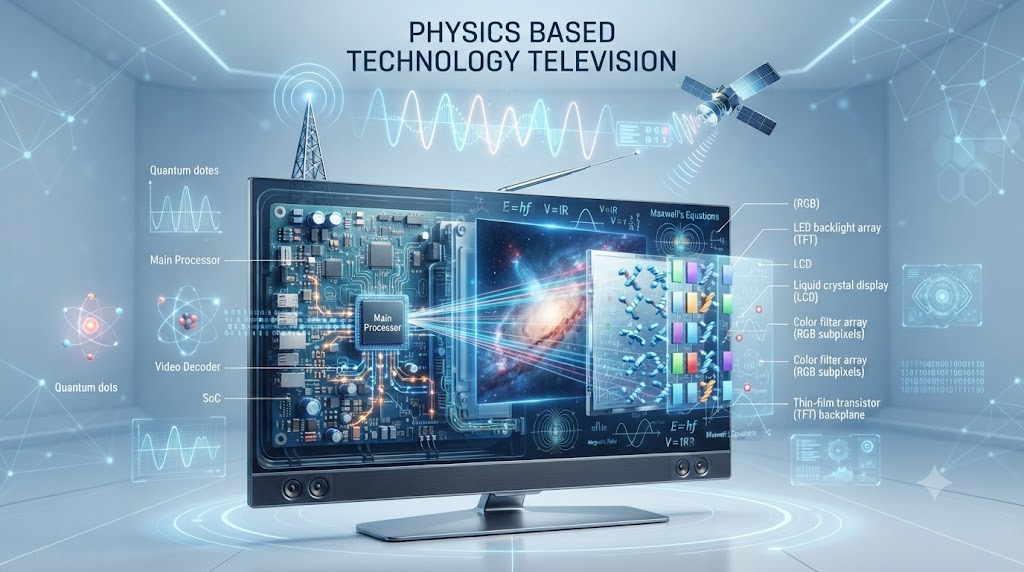
Physics Based Technology Television is a great example of how physics principles are used in modern electronic devices. From electromagnetic waves and signal transmission to LED, LCD, and OLED display technology, televisions work by combining different areas of physics, electronics, and computer science.
Have you ever wondered how a television converts invisible signals into colorful moving images and realistic sound? Every TV we use today depends on scientific concepts like electromagnetism, optics, semiconductor physics, and digital electronics.
Have you ever wondered how a television transforms invisible signals into colorful moving images and realistic sound? Whether you’re watching live sports, movies, documentaries, or educational videos, every television relies on fascinating principles of physics.
From electromagnetic waves traveling through space to millions of tiny pixels producing light, television technology is one of the best examples of physics in everyday life.
In this article, you’ll learn the physics behind television, how different TV technologies work, and why modern televisions deliver stunning picture quality.
If you’re interested in how physics powers modern technology, you may also enjoy learning about the physics behind mobile phones, laptops, microprocessors, generators, refrigerators, and solar panels. and Artificial Intelligence. Together, these articles explain how physics, electronics, and intelligent computing power the technologies we use every day.
What Is Television?
A television is an electronic device that receives video and audio signals, processes them, and converts them into moving images and sound.
Modern televisions include:
- LED TVs
- LCD TVs
- OLED TVs
- QLED TVs
- Smart TVs
Although their display technologies differ, all televisions operate using the same fundamental laws of physics.
Physics Based Technology: The Science Behind Television
Television combines multiple branches of physics:
- Electromagnetism
- Optics
- Electricity
- Semiconductor Physics
- Wave Physics
- Quantum Physics (OLED & Quantum Dot Displays)
These scientific principles work together to create the realistic images we see on the screen.
Physics Based Technology Television: How It Works
Let’s explore the process step by step.
Step 1: Receiving Electromagnetic Signals
Television broadcasts travel through the air as electromagnetic waves.
These waves are transmitted by broadcasting towers or communication satellites and are received by your TV antenna or cable connection.
Physics Principle:
- Electromagnetic Waves
- Radio Frequency Transmission
- Maxwell’s Equations
Without electromagnetic waves, television broadcasting would not exist.
Step 2: Signal Processing
Once the signal reaches the television, electronic circuits decode the information.
The TV separates:
- Video
- Audio
- Digital Data
A powerful processor converts compressed digital information into images and sound.
Physics Used:
- Semiconductor Physics
- Integrated Circuits
- Digital Electronics
Step 3: Image Generation
Modern televisions contain millions of tiny pixels.
Each pixel is made of three colors:
- Red
- Green
- Blue
By changing the brightness of these colors, televisions create millions of different colors.
Physics Concepts:
- Light Emission
- Color Mixing
- Optics
Step 4: Backlighting (LED TVs)
In LED televisions, LEDs produce white light behind the LCD panel.
Liquid crystals control how much light passes through each pixel.
Physics Behind It:
- Polarization
- Refraction
- Liquid Crystal Physics
This process creates clear and colorful images.
Step 5: OLED Technology
OLED televisions work differently.
Each pixel generates its own light without needing a backlight.
Advantages:
- Perfect Black Levels
- Better Contrast
- Faster Response Time
- Energy Efficient
Physics Used:
- Organic Semiconductor Physics
- Electroluminescence
Step 6: Producing Sound
Televisions use speakers that convert electrical signals into sound waves.
Inside the speaker:
- Electric current flows through a coil.
- Magnetic fields are generated.
- The coil moves.
- The speaker cone vibrates.
- Air vibrations create sound.
Physics Principles:
- Electromagnetism
- Sound Waves
- Vibrations
Types of Television Technology
Let’s explore the different types of television technologies and how physics contributes to their operation. Modern displays show how Physics-Based Technology Television combines electronics, optics, and semiconductor science to create high-quality images with improved brightness, contrast, and efficiency.
CRT Television
Older televisions used a cathode ray tube.
An electron gun fired electrons toward a phosphor-coated screen.
Physics Used:
- Electron Beam
- Vacuum Physics
- Magnetic Deflection
Although revolutionary, CRT TVs were bulky and consumed more electricity.
LCD Television
LCD TVs use liquid crystals that control light passing through the display.
Advantages:
- Thin Design
- Low Power Consumption
- Bright Display
Physics:
- Polarized Light
- Liquid Crystal Alignment
LED Television
LED televisions are an improved version of LCD TVs.
Instead of fluorescent lamps, they use Light Emitting Diodes (LEDs) for backlighting.
Benefits:
- Higher Brightness
- Better Contrast
- Lower Energy Usage
OLED Television
OLED displays produce light directly from organic compounds.
Advantages:
- Infinite Contrast
- Deep Blacks
- Flexible Displays
- Excellent Viewing Angles
Physics:
- Organic Electronics
- Quantum Energy Levels
QLED Television
QLED TVs use Quantum Dot technology.
Quantum dots emit highly pure colors when illuminated.
Physics Used:
- Quantum Mechanics
- Nanotechnology
- Photoluminescence
The Role of Electromagnetic Waves in Television
Television broadcasting depends entirely on electromagnetic waves.
These waves carry:
- Images
- Audio
- Digital Information
Signals travel at the speed of light, allowing people worldwide to watch live events almost instantly.
Why Television Displays Millions of Colors
Every pixel combines three primary colors:
- Red
- Green
- Blue
By adjusting the intensity of each color, televisions create over one billion color combinations.
Physics:
- RGB Color Theory
- Human Vision
- Light Mixing
Energy Efficiency in Modern TVs
Modern televisions consume far less electricity than older CRT models.
Reasons include:
- Efficient LEDs
- OLED self-lighting pixels
- Better power management
- Advanced semiconductor technology
This reduces electricity costs and environmental impact.
Smart Television Technology
Smart TVs integrate internet connectivity with traditional television technology.
Features include:
- Streaming Services
- Voice Assistants
- Wi-Fi
- Bluetooth
- Screen Mirroring
- Artificial Intelligence
Physics still governs:
- Wireless Communication
- Radio Waves
- Electronics
- Signal Processing
Real-Life Applications of Television Physics
Television technology is used in many fields beyond home entertainment:
- Education
- Medical Imaging Displays
- Sports Broadcasting
- Security Monitoring
- Business Presentations
- Scientific Research
- Gaming
- Virtual Classrooms
Advantages of Modern Television Technology
- Ultra HD Resolution
- Energy Efficient
- High Contrast
- Realistic Colors
- Smart Connectivity
- Faster Refresh Rates
- Better Audio Quality
Future of Television Technology
The future of television is rapidly evolving with advances in physics and engineering. The future of television is rapidly evolving with advances in physics and engineering. The future of Physics-Based Technology Television will include advanced displays, artificial intelligence integration, and more energy-efficient technologies.
Emerging innovations include:
- MicroLED Displays
- Transparent Screens
- Rollable TVs
- Holographic Displays
- 8K Resolution
- AI Image Processing
- Quantum Dot Improvements
Scientists continue applying advanced physics to create brighter, thinner, and more immersive displays.
Frequently Asked Questions (FAQs)
What is the physics behind television?
Television works using electromagnetism, optics, electricity, semiconductor physics, and light. These principles enable TVs to receive signals, process information, and display images and sound.
How does a television receive signals?
A television receives electromagnetic waves through antennas, cable connections, or satellite systems. These signals are decoded into audio and video.
Why are OLED TVs better?
OLED televisions produce light from each individual pixel, resulting in perfect black levels, superior contrast, faster response times, and lower power consumption.
What physics concepts are used in LED televisions?
LED televisions rely on electricity, light emission, liquid crystal polarization, optics, semiconductor physics, and electromagnetic principles.
How do speakers in televisions work?
Television speakers use electromagnetism. Electric current passing through a coil creates magnetic forces that move the speaker cone, producing sound waves.
Final Thoughts
Television is one of the most remarkable examples of Physics Based Technology. From electromagnetic waves carrying information across vast distances to advanced display technologies like LED, OLED, and QLED producing vivid images, every aspect of a television is rooted in the principles of physics.
As technology advances, future televisions will become even smarter, more energy-efficient, and more immersive. Understanding the physics behind television not only helps us appreciate modern entertainment systems but also demonstrates how scientific discoveries shape our everyday lives.Understanding Physics Based Technology Television helps us see how scientific discoveries transform everyday entertainment systems.