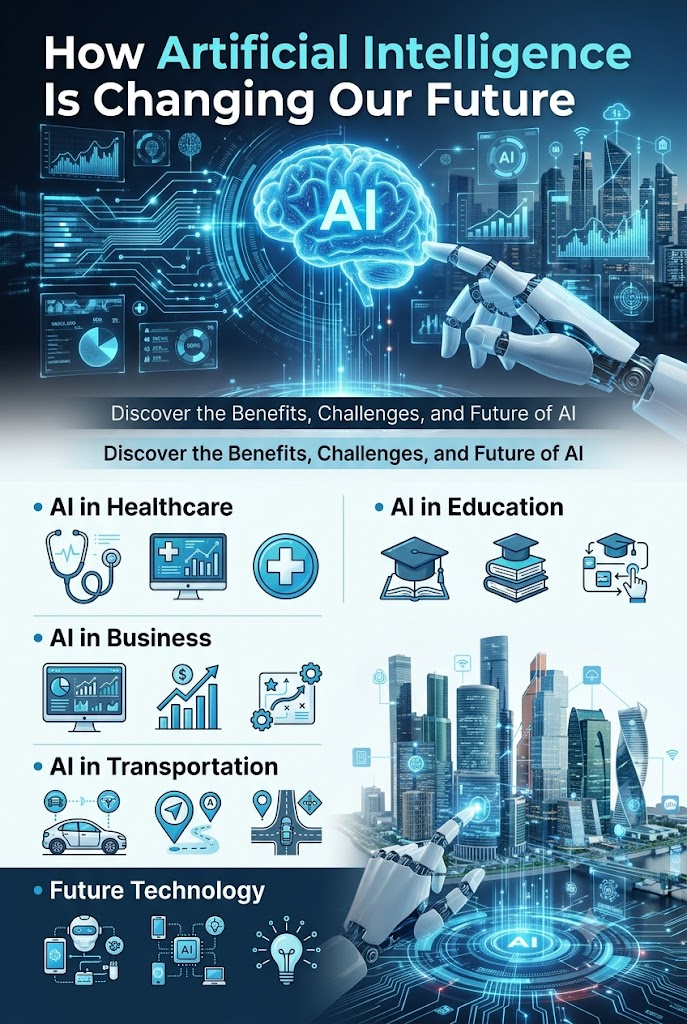
Introduction
Artificial Intelligence (AI) is one of the most revolutionary technologies of the 21st century. It is transforming the way people live, work, learn, and communicate. From voice assistants and recommendation systems to self-driving cars and advanced medical tools, AI has become an essential part of modern life. As technology continues to evolve, Artificial Intelligence is expected to play an even greater role in shaping our future.
What Is Artificial Intelligence?
Artificial Intelligence refers to the ability of machines and computer systems to perform tasks that normally require human intelligence. These tasks include learning, problem-solving, decision-making, speech recognition, and language understanding.
AI systems use large amounts of data and advanced algorithms to identify patterns, make predictions, and improve their performance over time. This ability to learn from experience makes AI different from traditional computer programs.
AI in Everyday Life
Many people use Artificial Intelligence every day without realizing it. AI powers several common technologies and services, including:
- Voice assistants like Siri and Google Assistant
- Online shopping recommendations
- Navigation and map applications
- Social media feeds
- Email spam filters
- Smart home devices
These technologies make daily tasks faster, easier, and more convenient.
Artificial Intelligence in Healthcare
Healthcare is one of the sectors benefiting the most from AI technology. AI-powered systems can analyze medical data, detect diseases, and assist doctors in making accurate diagnoses.
Some important applications of AI in healthcare include:
Early Disease Detection
AI can identify signs of diseases such as cancer, diabetes, and heart conditions at early stages, improving treatment outcomes.
Medical Research
Researchers use AI to analyze large datasets and discover new medicines more quickly than traditional methods.
Virtual Health Assistants
AI-powered chatbots and virtual assistants can provide basic medical information and help patients manage their health.
As AI technology advances, healthcare services are becoming more efficient and accessible.
AI in Education
Artificial Intelligence is transforming education by creating personalized learning experiences. Modern educational platforms use AI to understand students’ strengths and weaknesses.
Benefits of AI in education include:
- Personalized study plans
- Instant feedback on assignments
- Automated grading systems
- Interactive learning tools
- Language learning assistance
These innovations help students learn more effectively and improve educational outcomes.
AI in Transportation
Transportation is undergoing significant changes due to Artificial Intelligence. Self-driving vehicles and smart traffic management systems are becoming increasingly common.
AI can help:
- Reduce traffic congestion
- Improve road safety
- Optimize delivery routes
- Lower transportation costs
- Increase fuel efficiency
Although fully autonomous vehicles are still developing, AI is already making transportation smarter and safer.
Artificial Intelligence in Business
Businesses around the world are using AI to improve productivity and customer satisfaction. AI helps companies automate repetitive tasks, analyze customer behavior, and make better decisions.
Common business applications include:
- Customer service chatbots
- Market analysis
- Fraud detection
- Inventory management
- Sales forecasting
These tools allow businesses to operate more efficiently while reducing costs.
The Impact of AI on Jobs
One of the most discussed topics about Artificial Intelligence is its impact on employment. Some jobs that involve repetitive tasks may become automated in the future.
However, AI is also creating new career opportunities in fields such as:
- Machine Learning
- Data Science
- Robotics Engineering
- Cybersecurity
- AI Development
Workers who develop digital and technical skills will be better prepared for the changing job market.
Challenges and Concerns
Despite its many benefits, Artificial Intelligence also presents several challenges.
Privacy Issues
AI systems often require large amounts of data, raising concerns about personal privacy and data security.
Bias and Fairness
If AI systems are trained on biased data, they may produce unfair or inaccurate results.
Job Displacement
Automation may reduce demand for certain jobs, requiring workers to learn new skills.
Ethical Questions
As AI becomes more powerful, society must address important ethical questions regarding responsibility, transparency, and decision-making.
Proper regulations and responsible development will be essential to ensure AI benefits everyone.
The Future of Artificial Intelligence
The future of AI is incredibly promising. Experts believe AI will continue to transform industries, improve healthcare, enhance education, and solve complex global challenges.
Future developments may include:
- More advanced personal assistants
- Improved medical diagnosis systems
- Smarter cities
- Enhanced scientific research
- Better environmental monitoring
- Advanced robotics
As technology continues to evolve, AI will likely become even more integrated into everyday life.
Final Thoughts
Artificial Intelligence is changing the world at an unprecedented pace. Its influence can already be seen in healthcare, education, transportation, business, and many other industries. While challenges such as privacy and job displacement must be addressed, the potential benefits of AI are enormous. By developing and using AI responsibly, humanity can create a future that is more efficient, innovative, and connected than ever before.