Introduction
How Does a Refrigerator Work? A refrigerator is one of the most important household appliances used every day around the world. It keeps food fresh, prevents bacterial growth, and helps preserve food for longer periods.
Many people use refrigerators daily, but few understand the physics and technology behind their operation. This article explains the refrigeration cycle, heat transfer process, and the science that makes modern refrigerators possible.
A refrigerator is one of the most important household appliances used every day around the world. It keeps food fresh, prevents bacterial growth, and helps preserve perishable items for longer periods. While most people use refrigerators daily, few understand the fascinating physics and technology that make them work.
The refrigerator is an excellent example of how scientific principles and engineering combine to solve real-life problems. Instead of creating cold air, a refrigerator removes heat from its interior and releases that heat into the surrounding environment.
What Is the Main Purpose of a Refrigerator?
The primary purpose of a refrigerator is to maintain a low temperature that slows down the growth of microorganisms and reduces food spoilage. By keeping food at temperatures between 1°C and 5°C, refrigerators significantly extend the shelf life of many products.
Modern refrigeration technology has transformed food storage, transportation, healthcare, and industrial processes worldwide.
The Physics Behind a Refrigerator
The physics behind refrigerator operation is based on the principles of thermodynamics and heat transfer. According to the Second Law of Thermodynamics, heat naturally flows from a warmer area to a cooler area.
However, a refrigerator does the opposite. It moves heat from a cold space (inside the refrigerator) to a warmer space (the surrounding room) by using electrical energy and a refrigeration cycle.
This process is possible because of a special fluid called a refrigerant that continuously circulates through the system.
Key Components of a Refrigerator
Several important components work together to create the cooling effect.
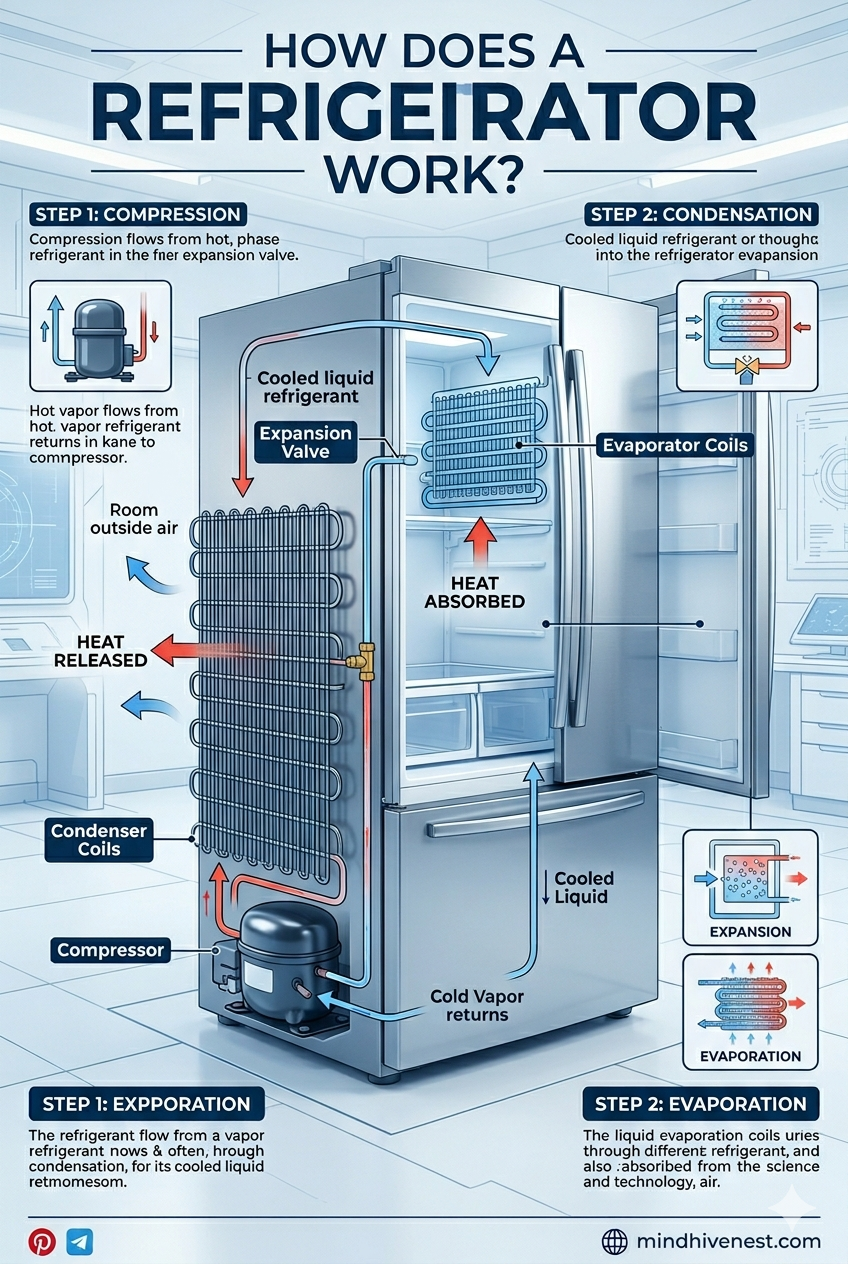
Compressor
The compressor is often called the heart of the refrigerator. It compresses the refrigerant gas, increasing its pressure and temperature.
Condenser Coils
The hot, high-pressure refrigerant travels through condenser coils located at the back or bottom of the refrigerator. These coils release heat into the surrounding air.
Expansion Valve
The expansion valve reduces the pressure of the liquid refrigerant. As the pressure drops, the refrigerant becomes extremely cold.
Evaporator Coils
The cold refrigerant passes through the evaporator coils inside the refrigerator. Here it absorbs heat from the food and air inside the refrigerator, producing the cooling effect.
How Does a Refrigerator Work: Step-by-Step Process
The refrigerator working principle is based on a continuous cycle consisting of four main stages.Many students often ask, “How Does a Refrigerator Work?” The answer lies in thermodynamics, heat transfer, and the refrigeration cycle.
1. Compression
The compressor compresses low-pressure refrigerant gas into a high-pressure, high-temperature gas.
2. Condensation
The hot refrigerant moves through the condenser coils and releases heat into the surrounding environment. During this stage, the refrigerant changes from a gas to a liquid.
3. Expansion
The liquid refrigerant passes through the expansion valve where its pressure drops rapidly. This causes the refrigerant temperature to decrease significantly.
4. Evaporation
The cold refrigerant enters the evaporator coils and absorbs heat from inside the refrigerator. As it absorbs heat, it evaporates into a gas and returns to the compressor.
The cycle then repeats continuously.
Thermodynamics in Refrigerator Technology
A refrigerator demonstrates the practical application of thermodynamics. The appliance functions as a heat pump that transfers thermal energy from one place to another.
The refrigerant undergoes repeated phase changes between liquid and gas states. During evaporation, it absorbs heat, and during condensation, it releases heat.
This efficient heat transfer process allows refrigerators to maintain stable cooling temperatures.
Modern Refrigerator Technology
To understand how does a refrigerator work, it is important to learn about the compressor, condenser, expansion valve, and evaporator.
Modern refrigerators are far more advanced than earlier models. Many now include:
- Inverter compressors
- Smart temperature control systems
- Energy-efficient cooling technology
- Frost-free systems
- AI-based monitoring features
- Eco-friendly refrigerants
These innovations improve energy efficiency, reduce electricity consumption, and increase appliance lifespan.
Benefits of Refrigeration Technology
Refrigeration technology offers numerous advantages:
- Preserves food freshness
- Reduces food waste
- Prevents bacterial growth
- Supports healthcare and medicine storage
- Improves global food transportation
- Enhances energy efficiency in modern homes
Final Thoughts
The refrigerator is a remarkable example of applied physics and engineering. Using thermodynamics, heat transfer, and advanced refrigeration technology, it continuously removes heat from its interior and keeps food fresh. Understanding how a refrigerator works not only reveals the science behind everyday life but also highlights the importance of technological innovation in modern society. In conclusion, how does a refrigerator work is a fascinating example of applied physics and modern technology