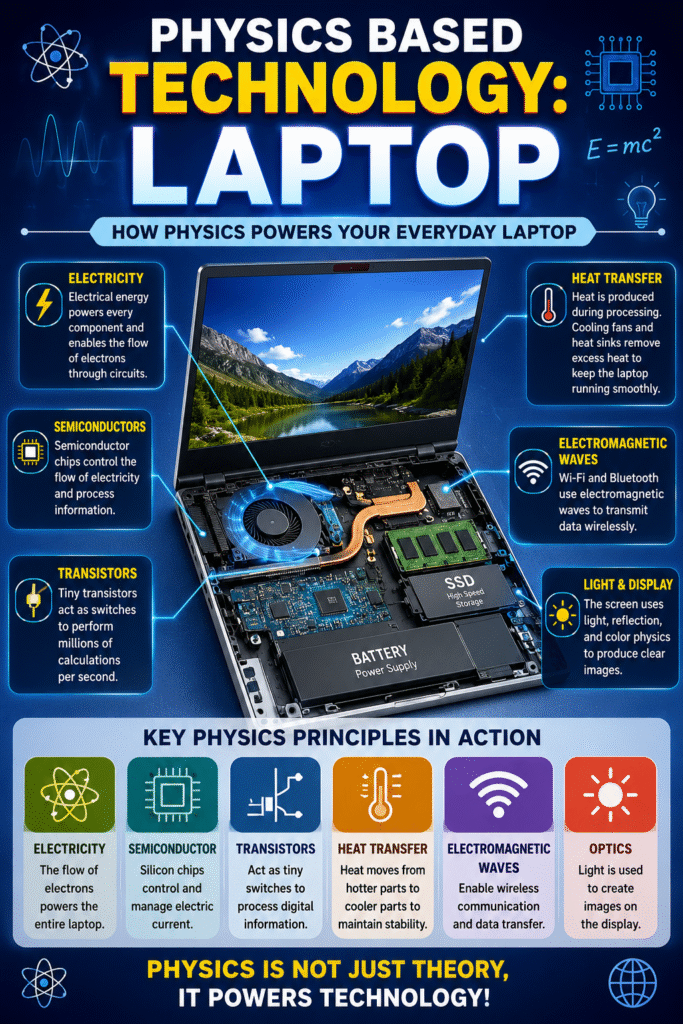
Have you ever wondered how a laptop performs millions of calculations every second? Physics Based Technology: Laptop explains how the laws of physics make modern laptops fast, efficient, and reliable. Every time you open a program, browse the internet, or watch a video, different physics principles work together behind the scenes.
A laptop is much more than a portable computer. It is a combination of electronic circuits, semiconductor technology, electricity, heat transfer, and electromagnetic principles. Understanding these basic concepts helps us appreciate the amazing technology we use every day.
Physics-Based Technology: Laptop – How Does It Work?
A laptop receives electrical energy from its battery or charger. This electricity travels through tiny electronic circuits on the motherboard.
Inside the laptop, billions of microscopic transistors switch electrical signals on and off. These switches process information using binary numbers (0 and 1). The processor then performs calculations and sends results to the display, storage, memory, and other hardware components.
Without physics, none of these processes would be possible.
The Physics Behind Laptop Technology
Electricity and Electric Current
Electric current is the movement of electrons through conductive materials.
A laptop depends on controlled electrical current to power every component, including the CPU, RAM, keyboard, display, speakers, and storage devices.
Stable voltage ensures that every part operates safely and efficiently.
Semiconductor Physics
Semiconductors are materials that conduct electricity only under specific conditions.
Silicon is the most common semiconductor used in laptop processors and memory chips. Engineers carefully control silicon to create electronic devices capable of processing billions of instructions every second.
Semiconductor physics is the foundation of modern laptop technology.
Transistors
A modern laptop processor contains billions of tiny transistors.
Each transistor works like a microscopic electronic switch. By turning on and off extremely quickly, transistors process digital information and execute software instructions.
The smaller the transistors become, the faster and more energy-efficient laptops become.
Heat Transfer
As the processor works, it generates heat.
Physics explains that heat naturally flows from hotter objects to cooler surroundings. Laptops use heat sinks, cooling fans, and thermal paste to remove excess heat from the CPU and GPU.
Efficient cooling improves performance and increases the lifespan of laptop components.
Electromagnetic Waves
Wireless communication inside laptops depends on electromagnetic waves.
Wi-Fi and Bluetooth transmit data through radio waves, allowing laptops to connect to the internet and other devices without cables.
This is another important application of physics in everyday technology.
Main Components That Use Physics
CPU (Central Processing Unit)
The CPU performs calculations using billions of semiconductor transistors.
RAM (Random Access Memory)
RAM temporarily stores information while programs are running, allowing quick access to data.
SSD Storage
Solid State Drives use semiconductor memory instead of spinning disks, making laptops faster and more reliable.
Display
Laptop screens use light produced by LCD or LED technology. Physics explains how light passes through different layers to create colorful images.
Battery
Laptop batteries convert chemical energy into electrical energy using electrochemical reactions.
Advantages of Physics Based Technology in Laptops
- High-speed computing
- Portable design
- Energy-efficient operation
- Reliable wireless communication
- Fast data storage
- Better cooling systems
- Improved battery performance
These advantages are possible because engineers apply physics principles during laptop design and manufacturing.
Real-Life Applications
Physics-based laptop technology is used in almost every industry.
Students use laptops for online learning.
Businesses rely on laptops for office work.
Engineers create designs using specialized software.
Doctors analyze medical records.
Scientists perform research and simulations.
Programmers develop software and artificial intelligence systems.
Future of Laptop Technology
The future of Physics Based Technology: Laptop is exciting.
Researchers are developing smaller semiconductor chips, faster processors, better batteries, advanced cooling systems, flexible displays, and even quantum computing technologies.
Future laptops will become faster, lighter, more energy-efficient, and more powerful than today’s devices.
Final Thoughts
Physics Based Technology: Laptop shows how the principles of physics power one of the most important devices in our daily lives. From electricity and semiconductors to transistors, heat transfer, and electromagnetic waves, every laptop component relies on the laws of physics to function efficiently.
If you want to build a stronger understanding of physics in modern technology, don’t stop here. You can also explore our related guides on Physics-Based Technology: Microprocessor, Physics-Based Technology: Generator, Physics-Based Technology: Solar Panel, and Physics-Based Technology: Refrigerator. These articles explain how different technologies use the same fundamental principles of physics in unique ways.
Together, these guides provide a complete beginner-friendly journey into the fascinating world of Physics Based Technology. Be sure to read them all to deepen your knowledge and discover how physics shapes the technology we use every day.
👉 Continue exploring our Physics-Based Technology series and share this article with anyone interested in science, engineering, and modern technology. Enjoyed learning about Physics-Based Technology: Laptop? Explore our other physics-based technology articles to discover how CPUs, semiconductors, transistors, and generators power the modern world. Share this article with friends who love science and technology.