Introduction
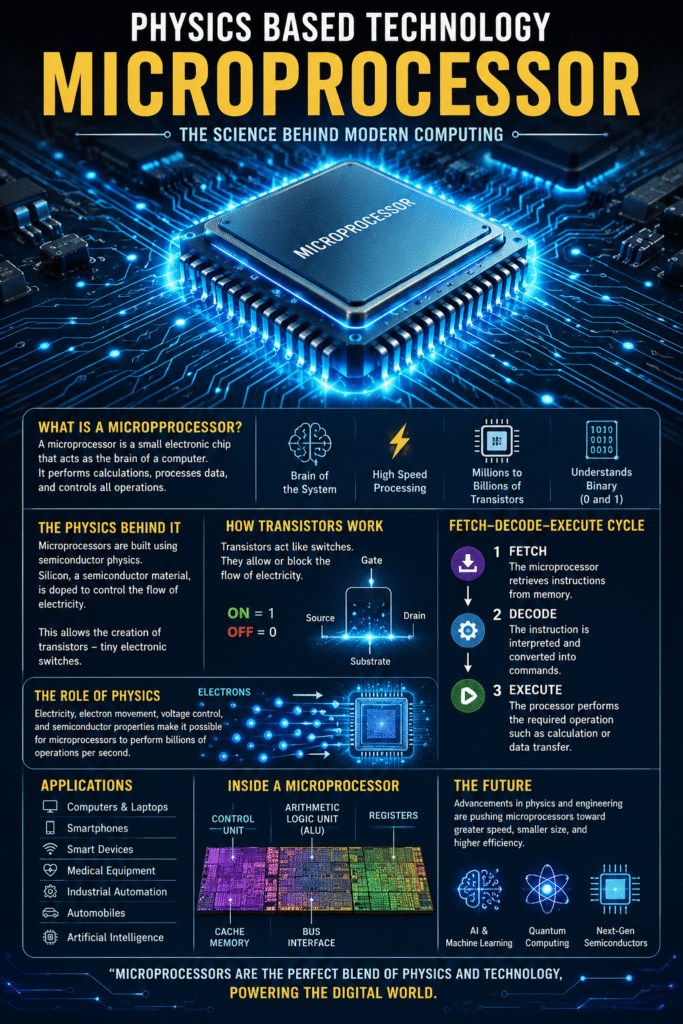
Physics Based Technology Microprocessor explains how modern computing systems work using semiconductor physics, electrical signals, and transistor-based processing. Microprocessors are one of the most important inventions in modern technology. They are often called the “brain” of computers, smartphones, and many electronic devices. Without microprocessors, modern digital technology would not exist.
Microprocessors are one of the most important inventions in modern technology. They are often called the “brain” of computers, smartphones, and many electronic devices. Without microprocessors, modern digital technology would not exist. From performing calculations to controlling complex systems, microprocessors play a vital role in our daily lives.
The working principle of a microprocessor is deeply connected to physics, especially semiconductor physics and electrical engineering. Understanding how a microprocessor works helps us appreciate the science behind modern computers and smart devices.
What is a Microprocessor?
A microprocessor is a small electronic chip that performs calculations, processes data, and executes instructions. It acts as the Central Processing Unit (CPU) of a computer system.
Millions or even billions of tiny electronic components called transistors are packed inside a single microprocessor. These transistors work together to perform logical operations and calculations at extremely high speeds.
Today, microprocessors are used in computers, smartphones, smart TVs, cars, medical equipment, and industrial machines.
The Physics Behind Microprocessors
The operation of a microprocessor is based on the principles of semiconductor physics.
Semiconductors are materials that have electrical conductivity between conductors and insulators. Silicon is the most commonly used semiconductor material because it is abundant, stable, and efficient.
Engineers modify silicon through a process called doping. This process changes the electrical properties of silicon, allowing it to control the flow of electricity.
By controlling electric current, semiconductors can create switches known as transistors, which are the building blocks of microprocessors.
How Transistors Work
A transistor acts like an electronic switch. It can either allow electricity to pass or block it.
In digital electronics, these two states represent binary numbers:
- ON = 1
- OFF = 0
Since computers understand only binary language, billions of transistors rapidly switch between ON and OFF states to process information.
Modern microprocessors contain billions of transistors working together every second to perform tasks such as calculations, data processing, and decision-making.
Microprocessor Working Process
The working process of a microprocessor follows a cycle called the Fetch-Decode-Execute Cycle.
1. Fetch
The microprocessor retrieves instructions from memory.
2. Decode
The instruction is interpreted and converted into commands the processor can understand.
3. Execute
The processor performs the required operation, such as addition, comparison, or data transfer.
This cycle repeats billions of times every second, allowing computers to operate efficiently and perform complex tasks instantly.
Role of Electricity and Physics
Electricity is the driving force behind microprocessor operations.
Tiny electrical signals travel through microscopic circuits inside the processor. These signals are controlled by semiconductor materials and transistor networks.
Physics principles such as electron movement, electrical conductivity, voltage control, and electromagnetic behavior make it possible for microprocessors to process data accurately and efficiently.
Without these physical principles, modern computing technology would be impossible.
Applications of Microprocessors
Microprocessors are found in countless devices around us.
Some common applications include:
- Personal computers
- Smartphones
- Tablets
- Smartwatches
- Gaming consoles
- Medical devices
- Industrial automation systems
- Modern vehicles
- Artificial intelligence systems
As technology advances, microprocessors continue to become faster, smaller, and more energy-efficient.
Future of Microprocessor Technology
Scientists and engineers are constantly developing advanced microprocessors with higher performance and lower power consumption.
Emerging technologies such as Artificial Intelligence (AI), Quantum Computing, and Internet of Things (IoT) are driving the demand for more powerful processors.
Future microprocessors may use new materials and innovative architectures that push the limits of modern physics and computing technology.
Final Thoughts
Microprocessors are the foundation of modern digital technology. Their operation relies on the principles of semiconductor physics, electrical conductivity, and transistor switching. By processing billions of instructions every second, microprocessors power the devices we use every day.
Understanding the physics behind microprocessors not only reveals how computers work but also highlights the remarkable connection between science and technology. As technology continues to evolve, microprocessors will remain at the heart of innovation and digital progress.
Understanding How Refrigerators Work Using Physics not only helps us learn scientific principles but also shows how physics contributes to technologies we use every day.