Introduction
Mobile phones have revolutionized the way people communicate, work, learn, and entertain themselves. From making voice calls to accessing the internet, taking high-quality photos, and using artificial intelligence, smartphones have become an essential part of everyday life. However, behind every smartphone is a combination of remarkable scientific principles. The concept of Physics Based Technology Mobile Phone explains how the laws of physics make modern mobile communication possible. Electromagnetic waves carry signals through the air, semiconductors process billions of calculations, lithium-ion batteries store electrical energy, and touchscreens detect human touch using electrical properties. Understanding these principles helps us appreciate the science that powers one of the world’s most important technologies.
What Is a Mobile Phone?
A mobile phone is a portable electronic device that enables wireless communication. Unlike traditional telephones that require physical cables, mobile phones communicate through radio waves and nearby cellular towers. Modern smartphones combine several devices into one, including a camera, GPS navigator, computer, music player, and communication system.
Inside every smartphone are advanced components such as a processor (CPU), memory chips, antennas, sensors, cameras, speakers, microphones, and a rechargeable battery. All these components work together using the principles of physics and electronic engineering.
The Physics Behind Mobile Phones
Physics is the foundation of every smartphone. Several branches of physics work together to make mobile technology possible.
1. Electromagnetic Waves
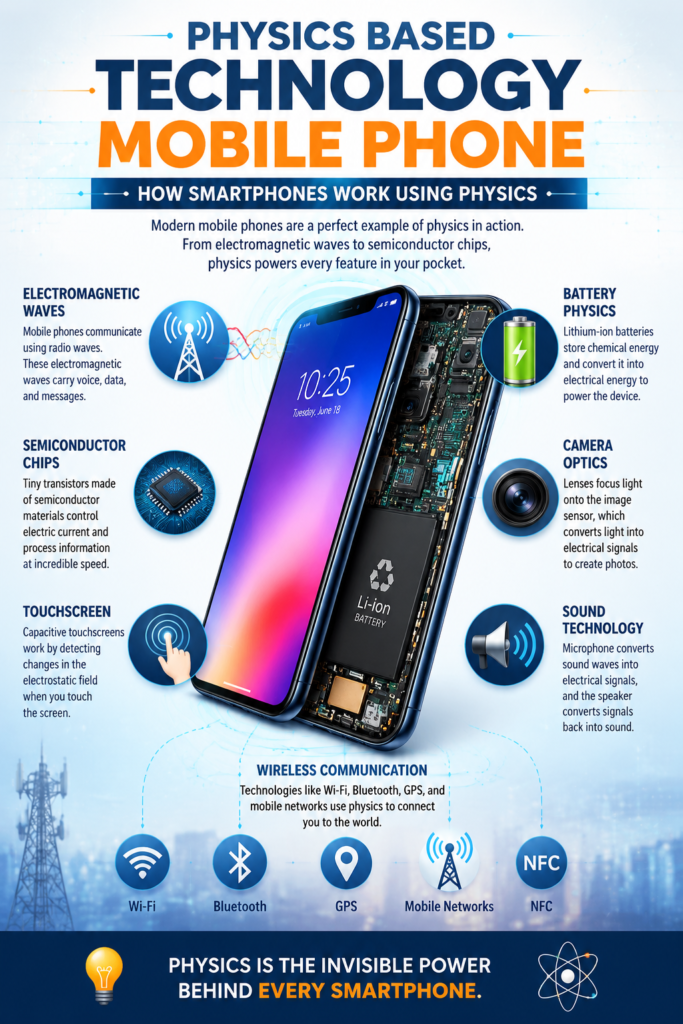
The most important principle behind mobile communication is the use of electromagnetic waves. When a user makes a call or sends a message, the phone converts digital information into radio-frequency electromagnetic waves. These waves travel through the air to the nearest cellular tower, which forwards the information through the communication network until it reaches the recipient.
Different mobile generations such as 3G, 4G, and 5G use different frequency ranges to improve speed, coverage, and data capacity.
2. Semiconductor Physics
The processor inside a smartphone is made from semiconductor materials, primarily silicon. Semiconductors control the movement of electric current through billions of tiny transistors packed onto a microchip.
Every time you open an app, play a game, or browse the internet, these transistors perform billions of calculations every second. This incredible processing power is possible because of semiconductor physics and modern chip manufacturing.
3. Electricity and Battery Technology
A smartphone operates using electrical energy stored inside a rechargeable lithium-ion battery. Chemical reactions inside the battery produce electrical energy that powers every component of the device.
Power management systems distribute electricity efficiently to the processor, display, camera, speakers, and wireless communication modules while preventing overheating and energy waste.
4. Capacitive Touchscreen
Modern smartphones use capacitive touchscreens. The screen contains a transparent conductive layer that creates a weak electric field. When a finger touches the display, it changes the local electric field. The phone instantly detects this change and identifies the exact touch location, allowing users to interact smoothly with the device.
Important Components and Their Physics
Processor (CPU)
The processor acts as the brain of the smartphone. It performs calculations, controls applications, and manages system resources. It works by processing electrical signals through billions of microscopic transistors.
Camera
A smartphone camera uses lenses to focus incoming light onto an image sensor. The sensor converts light into electrical signals, which are processed into digital photographs using advanced image-processing algorithms. This process depends on the physics of optics and light.
Microphone and Speaker
The microphone converts sound waves into electrical signals, while the speaker performs the opposite process by converting electrical signals back into sound waves. These components operate using the principles of acoustics and electromagnetism.
Sensors
Modern smartphones include several sensors such as:
- Accelerometer
- Gyroscope
- Proximity Sensor
- Ambient Light Sensor
- Magnetometer
- Fingerprint Sensor
These sensors measure motion, orientation, light intensity, magnetic fields, and touch to provide a smarter user experience.
Wireless Technologies
Modern smartphones support several wireless communication technologies.
Wi-Fi allows devices to connect to the internet through wireless routers using radio waves.
Bluetooth enables short-range communication between nearby electronic devices.
GPS uses signals from multiple satellites to determine a user’s precise location through mathematical calculations based on signal travel time.
NFC (Near Field Communication) allows contactless payments and quick data transfer over very short distances.
Advantages of Mobile Phone Technology
Mobile phones have transformed modern society in many ways.
- Instant global communication
- Fast internet access
- Online education and e-learning
- Digital banking and mobile payments
- GPS navigation
- Remote work and business communication
- Emergency communication
- Entertainment through music, movies, and games
- Access to artificial intelligence applications
- Smart home device control
These benefits have made smartphones one of the most influential technologies of the 21st century.
Challenges
Despite their advantages, mobile phones also present several challenges.
- Battery life limitations
- Electronic waste (E-waste)
- Privacy and cybersecurity risks
- Device overheating during heavy use
- Signal interference in crowded areas
- Environmental impact of manufacturing electronic components
Scientists and engineers continue to develop better batteries, energy-efficient processors, recyclable materials, and faster wireless communication technologies to address these issues.
Future of Mobile Phone Technology
The future of smartphone technology is closely connected with advances in physics and engineering. Researchers are developing flexible displays, solid-state batteries, satellite communication, quantum computing applications, holographic displays, AI-powered processors, and even 6G wireless networks. These innovations aim to provide faster communication, greater energy efficiency, improved security, and enhanced user experiences.
Related Articles
If you enjoyed learning about the physics behind mobile phones, you may also like these articles:
- Physics Based Technology: Solar Panel – Learn how sunlight is converted into electricity using the photovoltaic effect.
- Physics Based Technology: Generator – Discover how electromagnetic induction generates electrical power.
- Physics Based Technology: Refrigerator – Understand the thermodynamics and heat transfer principles behind refrigeration.
- Physics Based Technology: Microprocessor – Explore how billions of transistors process information inside modern electronic devices.
Final Thoughts
The Physics Based Technology Mobile Phone demonstrates how scientific principles have transformed human communication. Electromagnetic waves enable wireless connections, semiconductor physics powers powerful processors, optics improves smartphone cameras, and electrical engineering ensures efficient battery performance. Every feature of a modern smartphone depends on the laws of physics working together in perfect harmony. As research in physics and technology continues to advance, future mobile phones will become even faster, smarter, and more energy-efficient, shaping the next generation of global communication.
Frequently Asked Questions (FAQs)
1. What is the main physics principle behind mobile phones?
Electromagnetic waves are the primary physics principle used for wireless communication.
2. Why are semiconductors important in smartphones?
Semiconductors control electrical current and enable processors to perform billions of calculations every second.
3. How does a smartphone touchscreen work?
It uses capacitive sensing, where changes in the electric field caused by a finger touch are detected.
4. Which battery is commonly used in smartphones?
Most modern smartphones use rechargeable lithium-ion batteries.
5. How does GPS work in a mobile phone?
GPS receives signals from satellites and calculates the phone’s location based on the travel time of those signals.