Intorduction
Physics based technology SaaS product solutions combine the principles of physics, scientific calculations, and cloud computing to help students, teachers, engineers, researchers, and professionals solve technical problems online. Instead of installing complex software on a personal computer, users can access many physics-based tools through a web browser and perform calculations whenever an internet connection is available.
Physics plays an important role in modern technology. From electricity and mobile charging to air conditioning, mechanical systems, renewable energy, and electronics, many technologies depend on physical laws and mathematical equations. SaaS products make these calculations and scientific tools more accessible by delivering software through the internet.
A physics-based SaaS product might provide an online calculator, an interactive simulation, a scientific data-analysis tool, or a platform for modeling physical systems. These applications can help users understand scientific concepts, test mathematical models, and explore how physical systems behave.
In this guide, we will explore what physics-based SaaS products are, how they work, the physics principles behind them, their benefits, their limitations, and their applications in education, engineering, and modern technology.
What Is a Physics-Based Technology SaaS Product?
A physics based technology SaaS product is an online software application that uses physics equations, scientific models, mathematical calculations, or simulations to help users solve problems and understand physical systems.
SaaS stands for Software as a Service. In this delivery model, software is hosted and maintained by a provider and made available to users over a network, commonly through a web browser.
For example, a student might use an online physics calculator to calculate force, velocity, acceleration, energy, or power. An engineering student might use a browser-based simulation to study motion or electrical circuits.
A more advanced application could help professionals analyze thermal systems, mechanical motion, fluid behavior, or energy consumption.
The main idea is to make useful software available online without requiring every user to manage the complete software installation and computing infrastructure.
How Does Physics Based Technology SaaS Product Work?
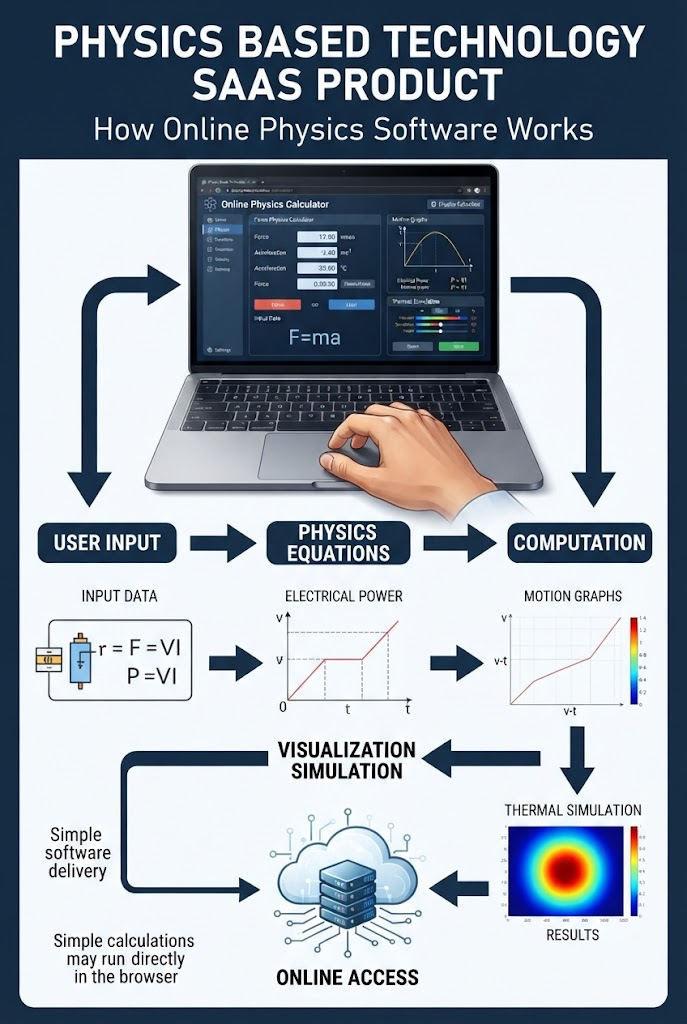
A physics-based SaaS product generally combines a user interface, calculation logic, data processing, and online infrastructure.
The process usually follows several steps.
1. User Input
The user enters information into the software.
For example, a physics calculator may request mass and acceleration to calculate force. A thermal calculation tool may ask for temperature, material properties, or energy values.
The application should validate the inputs and explain which units are required.
2. Scientific Calculation
The software applies the appropriate mathematical formula or scientific model.
For example, Newton’s second law states:
F = ma
Where:
- F = force measured in newtons
- m = mass measured in kilograms
- a = acceleration measured in metres per second squared
If a user enters a mass of 5 kg and an acceleration of 2 m/s², the calculated force is 10 N.
This is a simple example of physics-based software transforming user input into a useful scientific result.
3. Processing and Results
Depending on the application, calculations may take place in the user’s browser or on a remote server.
Simple calculators can often perform calculations directly in the browser. More demanding simulations may require server-side processing or specialized computing resources.
The software then displays the result, which may include numbers, graphs, diagrams, or a detailed explanation.
4. Cloud Infrastructure
Many SaaS applications use cloud infrastructure to host their software and store relevant data.
The infrastructure may include servers, databases, storage systems, networking components, and monitoring services.
These resources allow users to access the application without having to manage the underlying server hardware themselves.
For background on this delivery model, see
The Physics Principles Behind Scientific SaaS Products
A physics-based software product can use one or more branches of physics, depending on its purpose.
Mechanics
Mechanics deals with motion, forces, momentum, and energy.
A mechanics calculator may use equations such as:
F = ma
v = u + at
KE = ½mv²
These formulas can help users calculate force, final velocity, and kinetic energy under suitable assumptions.
A more advanced mechanics application might simulate the motion of an object over time.
Electricity and Magnetism
Electrical and magnetic principles are essential in electronics, power systems, motors, generators, and communication technologies.
For example, Ohm’s law is:
V = IR
Where voltage equals current multiplied by resistance.
An online electrical calculator can use this relationship to calculate an unknown quantity when the other two are known.
More advanced tools can model circuits containing resistors, capacitors, inductors, and other components.
Thermodynamics and Heat Transfer
Thermodynamics explains energy, temperature, and heat transfer.
A physics-based application might help users estimate heat transfer, calculate thermal energy, or understand the performance of cooling systems.
For example, the equation:
Q = mcΔT
can be used to calculate the heat required to change the temperature of a material when its mass, specific heat capacity, and temperature change are known.
Such calculations are useful in education and preliminary engineering analysis.
Optics and Waves
Optics studies light and its behavior, while wave physics covers phenomena such as sound, oscillations, and electromagnetic waves.
Online scientific tools can help users calculate wavelength, frequency, wave speed, and basic optical relationships.
Interactive graphs can make these abstract concepts easier to understand.
Common Types of Physics Based SaaS Products
Physics-based SaaS products can serve different purposes.
1. Online Physics Calculators
Online physics calculators allow users to enter values and calculate scientific quantities.
Examples include force calculators, velocity calculators, acceleration calculators, energy calculators, and power calculators.
These tools are particularly useful for students who need quick calculations while studying physics.
2. Physics Simulation Software
Physics simulation applications use mathematical models to represent physical systems.
Depending on the software, users may simulate projectile motion, oscillations, collisions, electric circuits, or other phenomena.
Simulations can help users explore how changing one variable affects the outcome.
However, the accuracy of a simulation depends on the mathematical model, assumptions, input data, and numerical methods used.
3. Engineering Calculation Platforms
Engineering-oriented software can support calculations involving mechanical components, thermal systems, electrical circuits, and material properties.
These tools can help with preliminary analysis, education, and design exploration.
For safety-critical engineering decisions, results should be checked against appropriate standards, validated methods, and professional judgment.
4. Scientific Data Analysis Tools
Some applications process experimental measurements and display the results using graphs, tables, statistical summaries, or fitted mathematical models.
Students and researchers can use these tools to identify trends and compare observations with theoretical predictions.
5. Educational Physics Platforms
Educational platforms may combine calculators, interactive diagrams, practice questions, formula references, and simulations.
These features can make it easier for students to connect equations with real-world physical behavior.
How Cloud Computing Supports Physics Software
Cloud computing can make scientific software easier to access and maintain.
Instead of requiring each user to install and update a complete application, a SaaS provider can maintain a central application and deliver updates online.
When the system is designed appropriately, cloud infrastructure can also support increasing numbers of users.
For example, an educational physics calculator might experience higher traffic during examination periods. A scalable hosting setup can help the application handle changing demand.
Cloud infrastructure can also support shared projects, online data storage, account management, and collaboration features.
However, not every physics application requires a cloud server. A simple calculator may work entirely in the browser, while a computationally intensive simulation may need more powerful processing resources.
The correct architecture depends on the complexity of the calculations, privacy requirements, cost, and expected usage.
Benefits of Physics Based Technology SaaS Product
Easy Accessibility
Users can access many web-based physics applications from different devices without installing traditional desktop software.
This can be useful for students who study at home, in classrooms, or in university laboratories.
Lower Initial Setup Requirements
A browser-based tool may eliminate the need to purchase and configure specialized hardware or install a large software package.
Some products offer free access, while others require a subscription or usage-based payment.
Actual costs depend on the provider and the features available.
Convenient Software Updates
A SaaS provider can update the application centrally.
Users can then access new features and corrections without manually installing every update, although some products may still require local components.
Educational Support
Interactive calculations and visualizations can help students connect mathematical equations with physical concepts.
For example, changing mass and acceleration in a force calculator can demonstrate how Newton’s second law works.
Collaboration
Some cloud applications allow users to save projects, share results, or collaborate with other users.
These features may be useful for group assignments, teaching, and research projects.
Flexible Computing Resources
Applications that use cloud infrastructure can sometimes increase or decrease computing resources according to demand.
This is particularly useful when a simulation requires more processing power than a user’s device can provide.
Limitations and Challenges
Despite their benefits, physics-based SaaS applications also have limitations.
Internet Dependence
An online application may become unavailable when the user loses internet access or when the service experiences an outage.
Some tools address this issue by supporting offline features, but not all do.
Data Privacy
Users may enter experimental measurements, research information, or project files into an online service.
Before uploading sensitive data, they should review the provider’s privacy policy, storage practices, access controls, and security measures.
Calculation Accuracy
Software does not automatically guarantee a correct scientific result.
Incorrect formulas, unit conversions, numerical approximations, or user inputs can produce misleading answers.
Reliable tools should explain their assumptions, support appropriate units, and be tested against known results.
Subscription Costs
Some advanced SaaS products require monthly or annual payments.
Users should compare the available features, usage limits, and total cost before choosing a service.
Model Limitations
A simulation is a mathematical representation of reality, not reality itself.
For example, a basic motion simulation may ignore air resistance. Its results may therefore differ from the motion of an actual object.
Users should understand the assumptions behind a model before applying its results to real situations.
Physics Based SaaS Products in Education
Education is one of the most useful areas for physics-based online software.
Students often need to understand both the mathematical and conceptual parts of physics.
An online tool can help them calculate answers, visualize relationships, and test how changing a variable affects a result.
For example, a student studying electrical power can use:
P = VI
If voltage is 12 V and current is 2 A, electrical power is:
P = 12 × 2 = 24 W
A suitable calculator can perform the calculation immediately. A well-designed educational tool can also explain the units and meaning of the result.
Students should still learn the underlying equations and assumptions rather than relying only on automated answers.
Real-World Applications of Physics-Based Software
Physics-based software can support learning and analysis in several areas.
Electrical engineering: Calculating voltage, current, resistance, and power.
Mechanical engineering: Studying forces, velocity, acceleration, and energy.
Thermal engineering: Estimating heat transfer and examining cooling-system performance.
Renewable energy: Modeling energy production and evaluating system parameters.
Scientific education: Exploring wave motion, optics, mechanics, and electricity.
Research and development: Processing experimental data and comparing measurements with theoretical models.
These examples show how scientific equations and computational methods can be transformed into accessible digital tools.
How to Choose a Physics Based SaaS Product
Before selecting a physics-based SaaS application, consider the following factors.
First, check whether the application supports the calculations or simulations you actually need.
Second, review the scientific formulas, units, and assumptions used by the software.
Third, look for clear explanations, documentation, and examples that help you verify the results.
Fourth, examine the pricing structure and determine whether a free plan is sufficient.
Fifth, review privacy and data security policies before uploading important files.
Finally, test the application with a known example to see whether its results are reasonable.
For students, an easy-to-use interface and clear explanations may be more valuable than advanced features that are difficult to understand.
The Future of Physics Based Technology SaaS Product
The future of physics-based SaaS products may involve more interactive simulations, browser-based scientific visualization, artificial intelligence-assisted analysis, and integrations with experimental equipment.
AI features could help users understand equations, explain graphs, or identify potential mistakes in calculations. However, AI-generated scientific results still need verification.
Improved browser technologies and cloud computing may also make more advanced tools accessible to users with ordinary devices.
Another important direction is the integration of calculators, data analysis, and simulations into a single educational platform.
For example, a student might enter experimental measurements, calculate physical quantities, plot a graph, and compare the results with a theoretical model in one application.
The success of these tools will depend on scientific reliability, usability, data protection, and transparent explanations of their limitations.
Frequently Asked Questions
What is a physics based technology SaaS product?
It is an online software application that uses physics equations, scientific calculations, modeling, or simulations to help users solve problems through a web-based service.
What does SaaS stand for?
SaaS stands for Software as a Service. It is a software delivery model in which applications are provided over a network, commonly through a web browser.
Can students use physics-based SaaS products?
Yes. Students can use online physics calculators, interactive simulations, and scientific tools to practice calculations and understand physical concepts.
Are physics-based SaaS products always cloud-dependent?
No. The term SaaS usually describes software delivered as a service, but individual calculations may run in a browser or on remote servers. Some tools also provide offline functionality.
Are online physics calculators accurate?
They can be accurate when the formulas, units, input values, and implementation are correct. Users should verify important results and understand the assumptions behind each calculation.
What is the difference between physics calculator software and physics simulation software?
A physics calculator usually evaluates a formula using supplied values. Physics simulation software models how a system may behave, often across multiple time steps or under changing conditions.
How can physics-based software help engineers?
It can support calculations, modeling, visualization, and preliminary analysis. Important engineering decisions still require appropriate validation and professional review.
Final Thoughts
A physics based technology SaaS product combines scientific principles, mathematical models, and online software delivery to make physics calculations and simulations more accessible.
These applications can help students understand scientific equations, support engineers with preliminary calculations, and allow users to explore physical systems through interactive tools.
Cloud computing can make software easier to access, maintain, and scale, while calculators and simulations can turn complex equations into understandable results.
However, scientific accuracy, clear assumptions, correct units, privacy, and appropriate validation remain essential.
As web technologies and scientific computing continue to develop, physics-based SaaS products may become increasingly useful for education, engineering, research, and everyday scientific problem-solving.