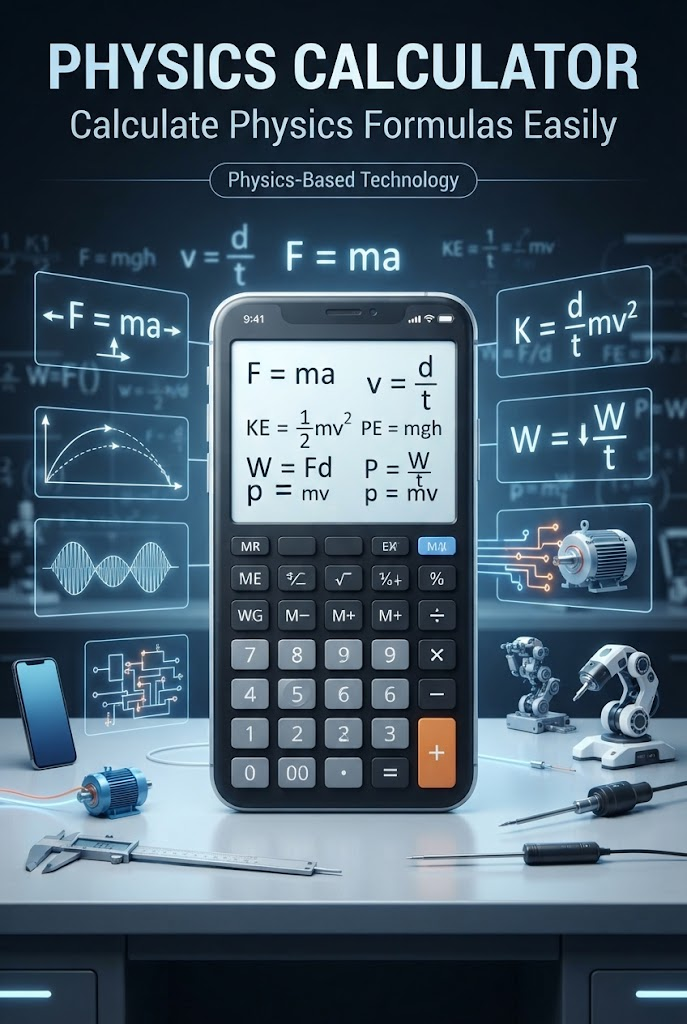
Physics is one of the most important branches of science for understanding how the world around us works. From the movement of a car to the operation of a smartphone, vacuum cleaner, electric motor, and Wi-Fi router, physics plays an important role in modern technology.
However, solving physics equations manually can sometimes be confusing, especially when a problem contains multiple variables, units, and mathematical operations. This is where a physics calculator online can be useful.
A physics calculator helps students, teachers, science enthusiasts, and technology learners calculate common physics quantities such as force, velocity, acceleration, energy, work, power, momentum, pressure, and density.
In this guide, we will explore what a physics calculator is, how it works, which physics formulas can be calculated, and how physics calculations are connected to modern physics-based technology.
What Is a Physics Calculator?
A physics calculator is a digital tool designed to solve mathematical calculations based on common physics formulas.
Instead of calculating every equation manually, users can enter known values and use the appropriate physics formula to find an unknown quantity.
For example, Newton’s Second Law gives us:
F = ma
Where:
- F = Force
- m = Mass
- a = Acceleration
If an object has a mass of 10 kg and an acceleration of 5 m/s², the force is:
F = 10 × 5 = 50 N
A physics calculator can perform this calculation quickly while reducing basic arithmetic mistakes.
Why Use a Physics Calculator Online?
Students often have to solve many physics problems while studying mechanics, energy, electricity, waves, and other topics. An online calculator can make the calculation process faster and easier.
Some useful benefits include:
- Faster physics calculations
- Easy formula-based problem solving
- Helpful for homework and revision
- Useful for checking manual calculations
- Supports understanding of physics equations
- Saves time during practice
- Can help beginners understand relationships between variables
However, a calculator should not replace understanding the physics formula. It is better to understand the equation first and then use the calculator to check or simplify the numerical calculation.
Common Physics Formulas You Can Calculate
A useful physics formula calculator can cover many basic equations. Some of the most common ones are explained below.
1. Force Calculator
Force describes an interaction that can change the motion of an object.
Newton’s Second Law is:
F = ma
For example, if:
- Mass = 20 kg
- Acceleration = 3 m/s²
Then:
F = 20 × 3 = 60 N
The resulting force is 60 newtons.
Force calculations are important in engineering and technology because machines, vehicles, robots, and mechanical systems all involve forces.
2. Velocity Calculator
Velocity describes how quickly an object’s position changes in a particular direction.
A simple velocity equation is:
v = d/t
Where:
- v = velocity
- d = distance
- t = time
For example, if an object travels 100 meters in 20 seconds:
v = 100/20 = 5 m/s
So, its average velocity is 5 m/s when the direction is appropriately defined.
Velocity calculations are widely used in transportation technology, robotics, sports science, and engineering.
3. Acceleration Calculator
Acceleration describes how quickly velocity changes.
The basic formula is:
a = Δv/t
Suppose the velocity of an object changes from 10 m/s to 30 m/s in 5 seconds.
The change in velocity is:
Δv = 30 – 10 = 20 m/s
Therefore:
a = 20/5 = 4 m/s²
Acceleration is an important concept in vehicle technology, elevators, robotics, and many mechanical systems.
4. Kinetic Energy Calculator
Kinetic energy is the energy an object has because of its motion.
The formula is:
KE = ½mv²
Where:
- KE = kinetic energy
- m = mass
- v = velocity
For example, a 2 kg object moving at 5 m/s has:
KE = ½ × 2 × 5²
KE = 25 J
This concept is important when studying vehicles, machines, collisions, projectiles, and mechanical systems.
5. Potential Energy Calculator
Gravitational potential energy depends on mass, gravitational acceleration, and height.
The basic equation is:
PE = mgh
Where:
- PE = potential energy
- m = mass
- g = gravitational acceleration
- h = height
For example, if a 5 kg object is lifted 2 meters above the ground and we use approximately 9.81 m/s² for gravitational acceleration:
PE = 5 × 9.81 × 2
PE = 98.1 J
Potential energy is useful for understanding elevators, hydroelectric systems, falling objects, and mechanical energy storage.
Work and Power Calculations
Work Calculator
In a simple case where force and displacement are in the same direction:
W = Fd
Where:
- W = work
- F = force
- d = displacement
If a force of 50 N moves an object 4 meters:
W = 50 × 4 = 200 J
The work done is 200 joules.
Power Calculator
Power describes the rate at which work is done or energy is transferred.
The basic formula is:
P = W/t
For example, if 1,000 J of work is completed in 10 seconds:
P = 1,000/10 = 100 W
Power is especially important in technology because motors, appliances, engines, and electrical systems are often described by their power ratings.
Momentum Calculator
Momentum is related to the mass and velocity of an object.
The formula is:
p = mv
Where:
- p = momentum
- m = mass
- v = velocity
If a 4 kg object moves at 6 m/s:
p = 4 × 6 = 24 kg·m/s
Momentum is important when studying collisions, vehicles, sports, rockets, and mechanical systems.
Pressure Calculator
Pressure describes how force is distributed over an area.
The basic formula is:
P = F/A
Where:
- P = pressure
- F = force
- A = area
For example, if a force of 200 N acts over an area of 4 m²:
P = 200/4 = 50 Pa
Pressure is used in many technologies, including hydraulic machines, tires, pumps, vacuum systems, and fluid-based equipment.
Density Calculator
Density describes how much mass exists in a given volume.
The formula is:
ρ = m/V
Where:
- ρ = density
- m = mass
- V = volume
For example, if an object has a mass of 500 kg and a volume of 0.25 m³:
ρ = 500/0.25 = 2,000 kg/m³
Density is important in material science, fluid mechanics, engineering, and product design.
How Physics Calculators Connect With Physics-Based Technology
A physics calculator is not just a mathematical tool. It can also help us understand how physics operates inside modern technology.
Almost every modern machine depends on one or more physical principles.
For example, a vacuum cleaner uses pressure differences, airflow, electric motors, and fluid dynamics. You can learn more about this in our guide to Physics-Based Technology: Vacuum Cleaner.
A car uses force, acceleration, friction, momentum, energy, pressure, and aerodynamics. These concepts help engineers design safer and more efficient vehicles.
Similarly, a Wi-Fi router uses electromagnetic waves, frequency, signal propagation, and electrical energy to transmit information wirelessly.
A smartphone also depends on several areas of physics, including electricity, electromagnetic waves, semiconductor technology, sound, light, and energy conversion.
This connection between scientific principles and practical machines is what makes physics-based technology such an interesting field of study.
Physics Calculator for Students
A physics calculator can be especially useful for students.
When studying physics, students often need to work with formulas containing several variables. Instead of spending most of the time performing arithmetic, they can use a calculator to verify their numerical result.
For example, when studying mechanics, students may need to calculate:
- Force
- Velocity
- Acceleration
- Momentum
- Kinetic energy
- Potential energy
- Work
- Power
- Pressure
- Density
The best approach is to first identify the correct formula, write down the known values, check the units, solve for the unknown variable, and then use a calculator to verify the numerical result.
Why Units Matter in Physics Calculations
One of the most common mistakes in physics is using incorrect or inconsistent units.
For example:
- Distance is commonly measured in meters (m)
- Time is measured in seconds (s)
- Mass is measured in kilograms (kg)
- Force is measured in newtons (N)
- Energy is measured in joules (J)
- Power is measured in watts (W)
- Pressure is measured in pascals (Pa)
- Velocity is commonly measured in meters per second (m/s)
Before using a physics formula calculator, always check whether the input values are using compatible units.
A calculator can produce a mathematically correct result from incorrect inputs, so understanding units remains essential.
Example: Using a Physics Formula Calculator
Imagine a student wants to calculate the kinetic energy of a moving object.
The student knows:
- Mass = 10 kg
- Velocity = 4 m/s
The formula is:
KE = ½mv²
Substituting the values:
KE = ½ × 10 × 4²
KE = 5 × 16
KE = 80 J
Therefore, the kinetic energy is 80 joules.
A digital physics calculator can perform the numerical calculation quickly, but understanding why the formula is used is still important.
Physics Calculator and Modern Technology
Physics calculations are used far beyond classroom problems.
Engineers use physics principles when designing:
- Electric vehicles
- Smartphones
- Computers
- Solar panels
- Robots
- Aircraft
- Satellites
- Electric motors
- Refrigerators
- Vacuum cleaners
- Communication systems
For example, engineers can use calculations involving energy and power to estimate how an electrical device performs.
Similarly, force and acceleration calculations can help engineers understand how mechanical components behave.
This shows why learning physics is valuable for understanding modern technology.
How to Get Better Results From a Physics Calculator
To use any online physics calculator effectively, follow these steps:
- Identify what you need to calculate.
- Find the correct physics formula.
- Write down the known values.
- Check the units.
- Rearrange the formula if necessary.
- Enter the values carefully.
- Check the result and its unit.
- Compare the result with your manual calculation.
If the answer looks unrealistic, check the formula, units, and input values again.
Advantages and Limitations of Physics Calculators
Advantages
A physics calculator can:
- Save calculation time
- Reduce basic arithmetic mistakes
- Help students check answers
- Make formula practice easier
- Support self-learning
- Help visualize relationships between variables
Limitations
A calculator cannot automatically replace conceptual understanding.
It may not tell you whether you selected the correct physical model, whether your measurements are accurate, or whether the assumptions of a formula apply to a real-world situation.
Real engineering systems can also involve friction, air resistance, heat loss, material limitations, measurement uncertainty, and other factors that simple classroom formulas may not include.
Therefore, use a calculator as a learning and verification tool rather than treating every numerical result as a complete description of a real system.
Frequently Asked Questions About Physics Calculator
What is a physics calculator?
A physics calculator is an online or digital tool that uses mathematical physics formulas to calculate quantities such as force, velocity, acceleration, energy, work, power, momentum, pressure, and density.
Is a physics calculator useful for students?
Yes. Students can use a physics calculator to check calculations, practice formulas, and save time during physics problem solving.
What formulas can a physics calculator solve?
Depending on the tool, common formulas include force, velocity, acceleration, kinetic energy, potential energy, momentum, work, power, pressure, density, and other physics equations.
Can I use a physics calculator for physics homework?
Yes. It can be useful for checking numerical calculations. However, students should understand the formula and show the appropriate steps when submitting homework or examination answers.
Why are units important in a physics calculator?
Physics equations depend on consistent units. Entering incompatible units can produce an incorrect or misleading result even if the arithmetic itself is correct.
What is the difference between a physics calculator and a normal calculator?
A normal calculator mainly performs mathematical operations. A physics calculator can be designed around specific physics formulas, variables, units, and scientific relationships.
Final Thoughts
A physics calculator online can make physics calculations faster, easier, and more convenient. From force and velocity to kinetic energy, momentum, pressure, work, and power, these calculations help students understand the mathematical side of physics.
More importantly, physics calculations help explain the technology around us. Cars, smartphones, vacuum cleaners, Wi-Fi routers, electric motors, and countless other devices depend on physical principles.
By combining physics knowledge with simple digital calculation tools, students can better understand how scientific equations become real-world technology.
Physics is not only about solving equations. It is about understanding how the world works—and how those principles are transformed into the technologies we use every day.