Introduction
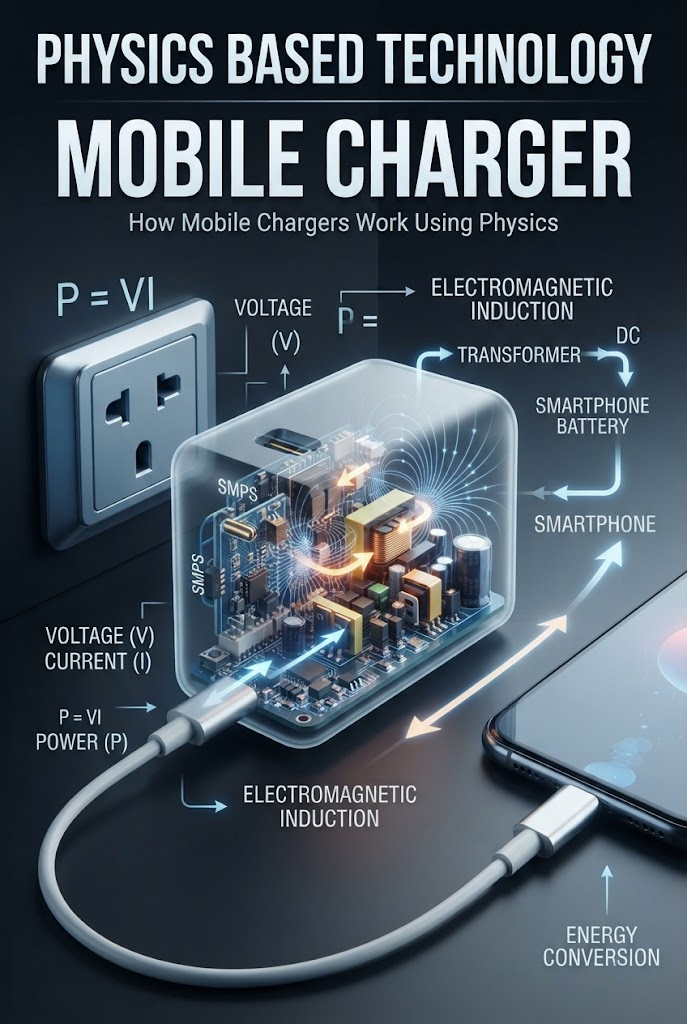
Physics based technology mobile charger is a practical example of how physics and electronics work together in modern technology. A mobile charger converts electrical energy from an AC power source into a controlled DC output that can safely charge a smartphone battery.We use mobile phones every day for communication, education, entertainment, online shopping, photography, and many other activities. But behind every smartphone is a simple-looking device that plays a very important role: the mobile charger.
A mobile charger may look like nothing more than a small power adapter, but inside it is a combination of electrical engineering, electronics, electromagnetism, energy conversion, and physics. The charger takes electrical energy from a power source and converts it into a form that the smartphone can safely use.
This makes a mobile charger an excellent example of Physics Based Technology.
In this article, we will explore the physics behind mobile chargers, how a mobile charger works, how AC electricity becomes DC electricity, why modern chargers use switching technology, how voltage and current are controlled, how fast charging works, and how the charging process connects physics with everyday technology.
What Is a Mobile Charger?
A mobile charger is a power supply system designed to provide suitable electrical power to a smartphone or another portable electronic device.
When you plug a charger into a wall outlet, the charger receives electrical energy from the mains supply. The internal electronic circuits then convert and regulate that energy before it reaches the phone.
Modern phone chargers commonly use Switch Mode Power Supply (SMPS) technology. This allows the charger to be much smaller and lighter than older power supplies while providing regulated electrical power efficiently.
It is also important to understand that the external charger and the phone’s internal charging system are not exactly the same thing. The adapter primarily provides controlled electrical power, while the smartphone contains its own power-management and battery-charging circuitry.
Why Is a Mobile Charger a Physics-Based Technology?
A mobile charger uses several fundamental concepts of physics and electrical engineering.
Some of the important concepts include:
- Electrical voltage
- Electric current
- Electrical power
- Resistance
- Energy conversion
- Electromagnetic induction
- Magnetic fields
- Semiconductor switching
- Heat transfer
- AC and DC electricity
- Energy efficiency
These principles work together inside a very small electronic device.
For example, electrical power can be expressed as:
P = VI
Where:
- P = power in watts
- V = voltage in volts
- I = current in amperes
This simple relationship helps us understand why a charger with a higher power rating can potentially deliver more electrical power, provided that the phone, cable, and charging protocol support it.
How Does a Mobile Charger Work?
The basic job of a wall charger is to convert electrical energy from the mains into a controlled low-voltage output suitable for the phone.
A simplified charging process can be described as:
AC input → Rectification → Filtering → High-frequency switching → Transformer/conversion → Rectification → Filtering → Regulation → Phone
Modern SMPS chargers perform this process using compact electronic components and high-frequency switching.
A typical charger first processes the incoming AC electricity, converts it to DC, switches that energy at high frequency, transfers it through a transformer or converter stage, and then produces regulated output power.
Let’s examine these stages.
1. AC Electricity Enters the Charger
The electricity supplied by a wall outlet is alternating current, commonly called AC.
The voltage continuously changes direction over time. A charger cannot simply send this mains electricity directly to a smartphone because the voltage level and waveform are not suitable for the phone’s battery and electronics.
Therefore, the first job of the charger is to process the incoming electrical energy.
Safety components and filtering circuits can also help protect the charger from electrical disturbances and reduce unwanted electromagnetic interference.
2. Rectification: Converting AC Into DC
The next important step is rectification.
A rectifier uses semiconductor diodes to convert alternating current into a one-directional electrical waveform.
A bridge rectifier is a common arrangement using multiple diodes.
The output of the rectifier is not yet perfectly smooth DC. It contains fluctuations called ripple.
This is where the next stage becomes important.
3. Filtering the Electrical Signal
After rectification, capacitors and other filtering components help smooth the electrical waveform.
A capacitor can temporarily store electrical energy and release it when needed.
This reduces fluctuations in the voltage and creates a more useful DC supply for the switching stage.
So, the simplified process becomes:
AC → Rectified DC → Filtered DC
The exact circuit design varies between charger types, but the principle of converting and conditioning electrical energy remains fundamental.
4. High-Frequency Switching and SMPS
One of the most important technologies inside a modern mobile charger is the Switch Mode Power Supply, commonly called SMPS.
Instead of continuously reducing voltage in the same way as an old-fashioned linear supply, an SMPS rapidly switches electronic components on and off.
This switching happens at a much higher frequency than the original 50 or 60 Hz mains frequency.
High-frequency operation allows transformers and magnetic components to be much smaller. This is one major reason modern chargers can be compact and lightweight.
The switching transistor or MOSFET acts like a very fast electronic switch.
By controlling the switching process, the charger can transfer energy efficiently and regulate the output.
5. The Role of the Transformer
Transformers work through electromagnetic induction.
When changing current flows through a coil, it creates a changing magnetic field. This changing magnetic field can induce a voltage in another coil.
In a modern charger, a high-frequency transformer can help transfer energy between the primary and secondary sides while providing electrical isolation.
Because the switching frequency is high, the transformer can be much smaller than the large low-frequency transformers used in older power supplies.
This is a beautiful example of physics directly influencing product design.
Higher switching frequency → smaller magnetic components → smaller charger
6. Converting the Output Back to DC
After the high-frequency transformer or conversion stage, the electrical waveform is processed again.
A rectifier converts the high-frequency output into DC, while capacitors and other components smooth the signal.
The result is a low-voltage DC supply that can be controlled and regulated for the connected device.
A simplified representation is:
High-frequency AC → Rectification → Filtering → Regulated DC
This regulated output is what the phone’s charging system receives.
7. Voltage Regulation
Voltage regulation is one of the most important parts of a mobile charger.
The output voltage needs to remain within the range required by the device and charging protocol.
Electronic feedback circuits monitor the output and help the switching controller adjust its operation.
For example, if the load changes, the control system can modify the switching behavior to maintain the desired output.
This feedback process is one reason modern chargers can provide stable power under changing conditions.
What Is the Relationship Between Voltage, Current, and Power?
To understand mobile charger technology, it is useful to understand three basic electrical quantities.
Voltage
Voltage is the electrical potential difference that drives current through a circuit.
It can be thought of as the electrical “pressure” that helps move charge.
Current
Current represents the rate at which electric charge flows.
It is measured in amperes.
Power
Electrical power represents the rate at which electrical energy is transferred.
The basic relationship is:
For example, a theoretical 5 V output supplying 2 A corresponds to:
P = 5 × 2 = 10 W
This does not mean every phone will always draw exactly 10 W. The actual charging power depends on the phone, charger, cable, temperature, battery condition, and charging protocol.
How Does Fast Charging Work?
Modern smartphones can charge much faster than older phones because charging systems have become more sophisticated.
Fast charging is not simply about forcing a huge current into a battery.
The charger and phone can work together to determine an appropriate voltage and current level.
USB Power Delivery, for example, provides a standardized way for compatible devices to negotiate power requirements. USB-IF states that USB Power Delivery can support different power levels and allows devices to request the power they require.
Depending on the implementation, a compatible charger may provide different voltage levels rather than always remaining at the basic USB voltage.
This means modern charging is better described as controlled power delivery rather than simply “more electricity.”
How Does the Phone Control Battery Charging?
The external power adapter is only one part of the charging system.
The smartphone contains battery-management and charging circuits that monitor the battery and control how energy is delivered to it.
Lithium-ion batteries commonly use a constant-current/constant-voltage (CC/CV) charging process.
During the constant-current stage, the battery receives controlled charging current. As the battery voltage reaches its target level, the system moves toward constant-voltage charging and the current gradually decreases.
This explains why a phone may charge quickly at a low battery percentage but slow down as it approaches full charge.
The charging system is continuously managing electrical energy rather than simply applying maximum power until the battery reaches 100%.
Why Does a Mobile Charger Become Warm?
You may have noticed that a phone charger becomes slightly warm during operation.
This happens because real electrical systems are not perfectly efficient.
Some energy is lost through:
- Resistance
- Semiconductor switching losses
- Transformer losses
- Diode or rectification losses
- Magnetic losses
- Other circuit losses
Some of this lost energy appears as heat.
A small amount of warmth can therefore be a normal consequence of energy conversion. However, unusual overheating, burning smells, damaged cables, sparks, or physical deformation are warning signs that should not be ignored.
Why Are Modern Chargers So Small?
Older chargers and power adapters could be relatively large and heavy.
Modern chargers are much smaller mainly because of advances in switching power electronics.
The key physics principle is that magnetic components can become smaller when they operate at much higher frequencies.
Instead of relying on a large 50/60 Hz transformer, an SMPS can first convert the electrical energy into a high-frequency switching waveform and then use a much smaller transformer or magnetic component.
This is one of the clearest examples of how physics-based technology can improve everyday products.
Mobile Charger and Electromagnetic Induction
Electromagnetic induction is another important physics principle connected to charger technology.
A transformer transfers energy between coils through a changing magnetic field.
The basic concept is described by Faraday’s law of electromagnetic induction: a changing magnetic flux can induce an electromotive force.
In a charger, this principle enables energy transfer between electrically separated sections of the power supply.
This is particularly important for safety because the low-voltage output side can be isolated from the high-voltage input side in appropriately designed isolated power supplies.
What About Wireless Mobile Charging?
Not every mobile charger uses a cable.
Wireless charging uses electromagnetic fields to transfer energy across a small air gap.
A transmitter coil produces a changing magnetic field, and a receiver coil inside the compatible smartphone responds through electromagnetic induction.
The received electrical energy is then converted and controlled so that the phone can charge its battery.
Wireless charging therefore provides another excellent example of physics-based technology in everyday life. Research into wireless charging covers electromagnetic coupling, power transfer, efficiency, and system design.
Mobile Charger as an Example of Physics-Based Technology
The mobile charger connects several areas of physics and engineering in one small device.
It involves:
- Electromagnetic induction
- Electric current
- Voltage
- Electrical power
- Energy conversion
- Semiconductor physics
- Magnetic fields
- Heat transfer
- Feedback control
- Battery charging principles
This is why a mobile charger is more than just an accessory for a smartphone.
It is a compact example of how scientific principles are transformed into practical technology.
Just like a vacuum cleaner uses pressure differences, airflow, electric motors, and mechanical motion, a mobile charger combines electricity, magnetism, switching, energy conversion, and thermal management to perform its job.
How to Choose a Suitable Mobile Charger
When selecting a charger, do not look only at the highest wattage number.
Consider:
- Your phone’s supported charging standard
- Output voltage
- Maximum current
- Total power rating
- USB connector type
- Cable capability
- Manufacturer specifications
- Safety certifications
- Compatibility with fast-charging protocols
A charger with a very high power rating does not automatically mean that every phone will charge at that maximum power.
The phone and charger must support compatible charging technology.
Safety and Mobile Chargers
A mobile charger is connected to potentially dangerous mains electricity, so its internal circuit should not be opened or modified by untrained users.
Even after unplugging, some components can retain electrical charge.
For everyday use, it is safer to use a properly manufactured charger, avoid damaged cables, keep chargers away from water, and replace equipment showing signs of damage.
This article explains the physics and technology for educational purposes; it is not a guide for constructing or repairing a mains-powered charger.
Frequently Asked Questions
What is a physics-based mobile charger?
A physics-based mobile charger is not a separate product category. The term refers to understanding mobile charger technology through physics principles such as voltage, current, electromagnetic induction, energy conversion, switching, and heat transfer.
How does a mobile charger work?
A modern mobile charger generally processes AC electrical energy, converts it into DC, uses high-frequency switching and power conversion, and produces regulated output power suitable for a connected device.
Why do mobile chargers use SMPS?
SMPS technology allows efficient power conversion and enables smaller, lighter magnetic components because the power conversion occurs at high frequency.
What is the physics behind fast charging?
Fast charging involves controlled voltage and current, power negotiation, battery-management electronics, and appropriate charging algorithms. Compatible systems can adjust power delivery according to the device’s requirements.
Why does my charger get warm?
Some electrical energy is inevitably lost during power conversion and appears as heat. Mild warmth can occur during normal operation, although excessive or unusual heating can indicate a problem.
Does a charger directly charge the phone battery?
The external power adapter supplies regulated electrical power. The smartphone’s internal charging and battery-management circuitry controls how that power is used to charge the battery.
Final Thoughts
The humble mobile charger is a fascinating example of Physics Based Technology.
Inside a small adapter, principles of electricity, magnetism, electromagnetic induction, semiconductor switching, energy conversion, feedback control, and thermal management work together.
From the initial AC electricity entering the charger to the regulated DC power reaching a smartphone, every stage has a scientific purpose.
Modern SMPS technology has made chargers smaller, lighter, and more efficient, while advanced charging protocols allow compatible phones and chargers to manage power more intelligently. USB Power Delivery is one example of how modern charging systems can negotiate different power levels.
The next time you connect your smartphone to a charger, remember that you are not simply plugging in a cable. You are using a compact piece of technology built around some of the most important principles of physics and electronics.