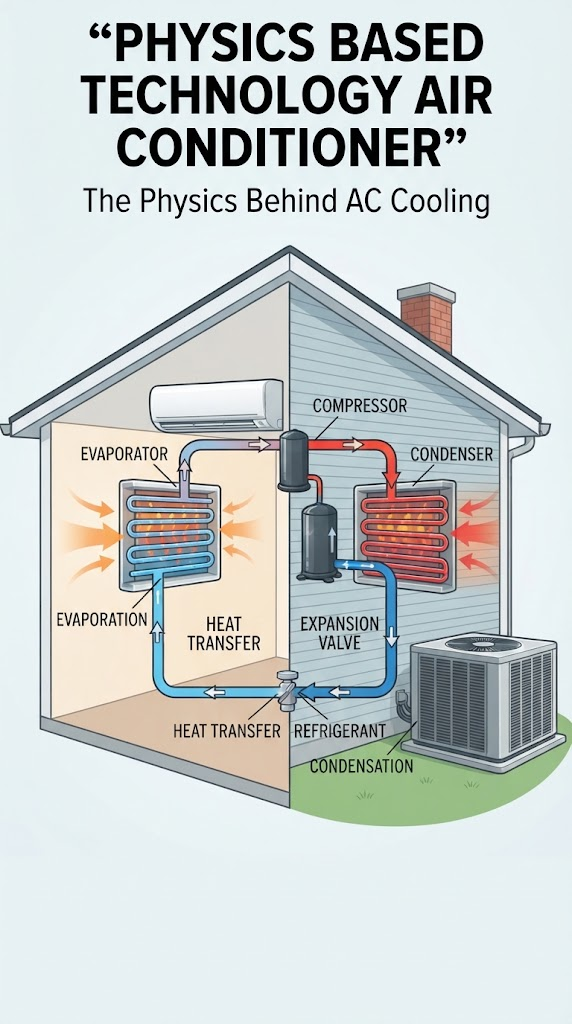
Physics based technology air conditioner systems are one of the best everyday examples of physics being used in modern technology. When we sit inside a cool room on a hot day, an air conditioner may look like a simple machine that produces cold air. In reality, an air conditioner uses several important principles of physics, including heat transfer, thermodynamics, pressure changes, evaporation, condensation, and electrical energy conversion.
An air conditioner does not simply create cold air. Instead, it removes heat from the indoor air and transfers that heat to the outside environment. This process is possible because of a refrigeration cycle that continuously moves heat from one location to another.
Understanding the physics behind air conditioner technology helps us understand why an AC can cool a room, why its outdoor unit becomes hot, why refrigerant is important, and why the compressor consumes a significant amount of electrical energy.
PHYSICS BASED TECHNOLOGY CALCULATOR
What Is a Physics Based Technology Air Conditioner?
A physics based technology air conditioner is a cooling system that uses physical laws to control the temperature of an indoor space. The main purpose of an air conditioner is to remove heat and, in many systems, reduce humidity from indoor air.
Modern air conditioners normally use a refrigeration system containing components such as a compressor, condenser, expansion device, and evaporator. These components work together in a continuous cycle.
The basic idea is simple:
Indoor Heat → Refrigerant Absorbs Heat → Compressor → Condenser → Heat Released Outside → Expansion → Evaporator → Cycle Repeats
The process depends heavily on heat transfer and the changing pressure and state of the refrigerant.
According to the U.S. Department of Energy, conventional air-conditioning systems use components such as a compressor, condenser, expansion valve, and evaporator as part of the refrigeration cycle.
How Does an Air Conditioner Work Using Physics?
The air conditioner working principle is based mainly on moving heat rather than creating cold directly.
Imagine a closed room on a hot summer day. The air inside the room contains thermal energy. To make the room cooler, the AC needs to remove this heat.
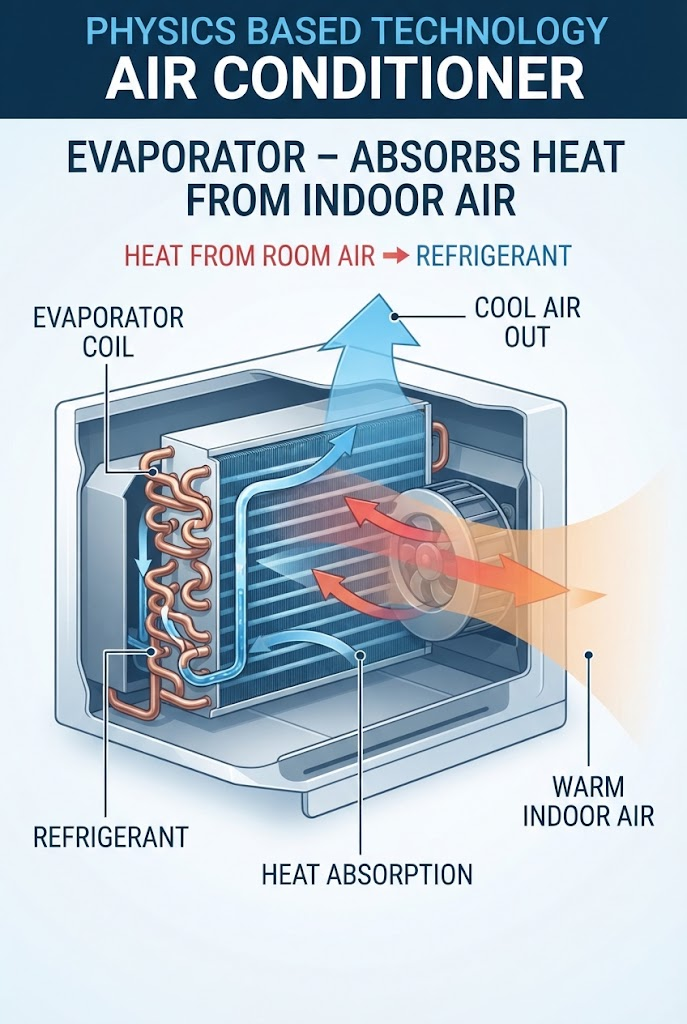
The indoor unit contains an evaporator coil. Warm indoor air passes over this relatively cold coil. The refrigerant inside the coil absorbs heat from the air.
The air therefore loses some of its thermal energy and becomes cooler. A fan then pushes this cooled air back into the room.
At the same time, the refrigerant carries the absorbed heat toward the outdoor unit.
This is the basic physics of air conditioner cooling: heat moves from the warmer indoor air to the colder refrigerant, and eventually that heat is rejected outside.
The Refrigeration Cycle in an Air Conditioner
The refrigeration cycle is the heart of modern AC cooling technology. It consists of several important stages.
1. Evaporation
The process begins at the evaporator.
The refrigerant enters the evaporator at a low pressure and low temperature. Warm indoor air flows across the evaporator coil.
Because the indoor air is warmer than the refrigerant, heat transfers from the air into the refrigerant.
The refrigerant absorbs this heat and changes from a liquid-like state into a vapor.
This process is called evaporation.
The important physics principle here is heat transfer. Heat naturally moves from a higher-temperature region toward a lower-temperature region.
As a result, the indoor air becomes cooler.
2. Compression
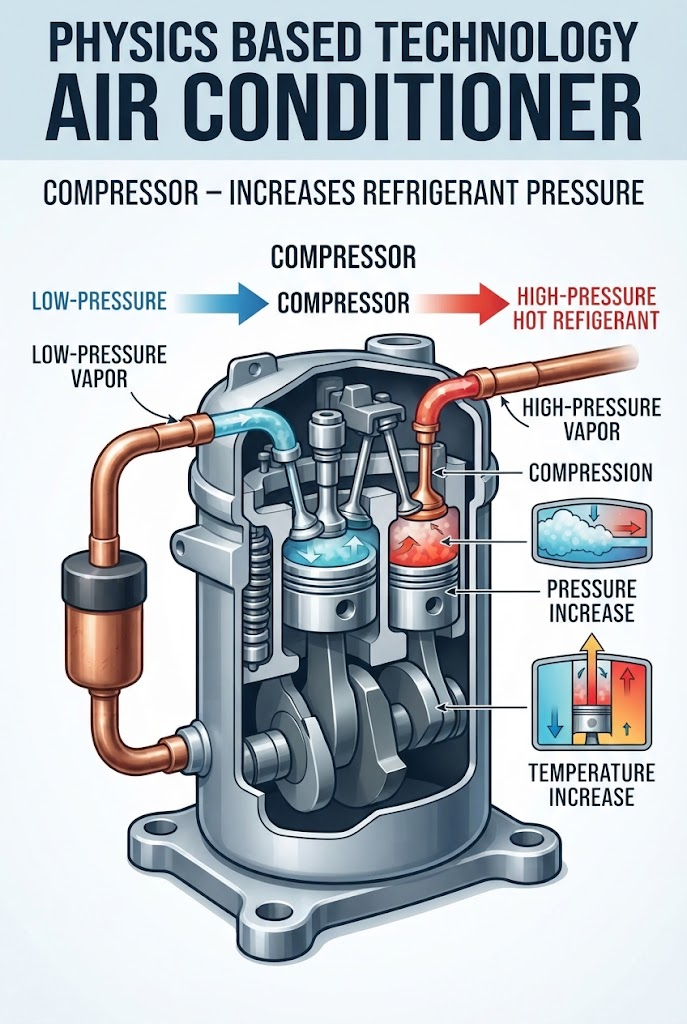
After absorbing heat, the refrigerant moves toward the compressor.
The compressor is located in the outdoor unit in a typical split air conditioner.
Its job is to compress the refrigerant vapor.
When the refrigerant is compressed, its pressure increases. Its temperature also rises significantly.
The compressor therefore plays a major role in the physics of air conditioner cooling.
It requires electrical energy to perform this work. This is one reason why an air conditioner consumes electricity.
The compressor can be considered the driving force that keeps the refrigeration cycle moving.
3. Condensation
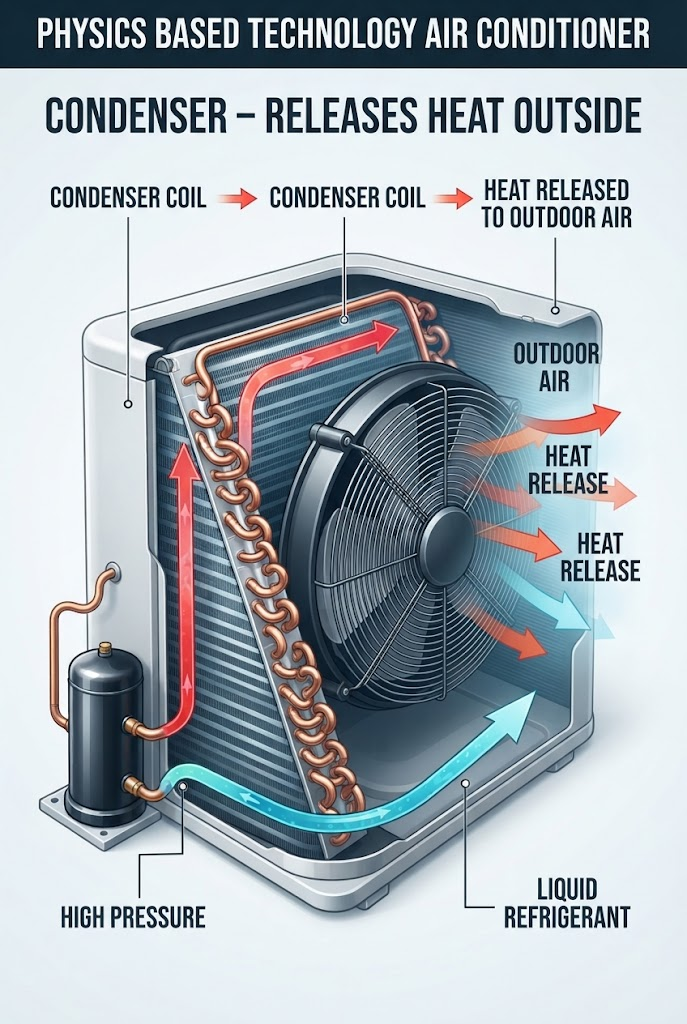
The hot, high-pressure refrigerant then travels to the condenser coil in the outdoor unit.
The outdoor fan moves surrounding air across the condenser.
Because the refrigerant is hotter than the outdoor environment, heat moves from the refrigerant to the outside air.
As the refrigerant loses heat, it changes from a vapor into a liquid.
This process is called condensation.
This explains an interesting observation: the outdoor unit of an air conditioner often blows hot air.
The AC is not producing unnecessary heat. It is releasing the heat that was removed from inside the room, along with the energy supplied to the compressor.
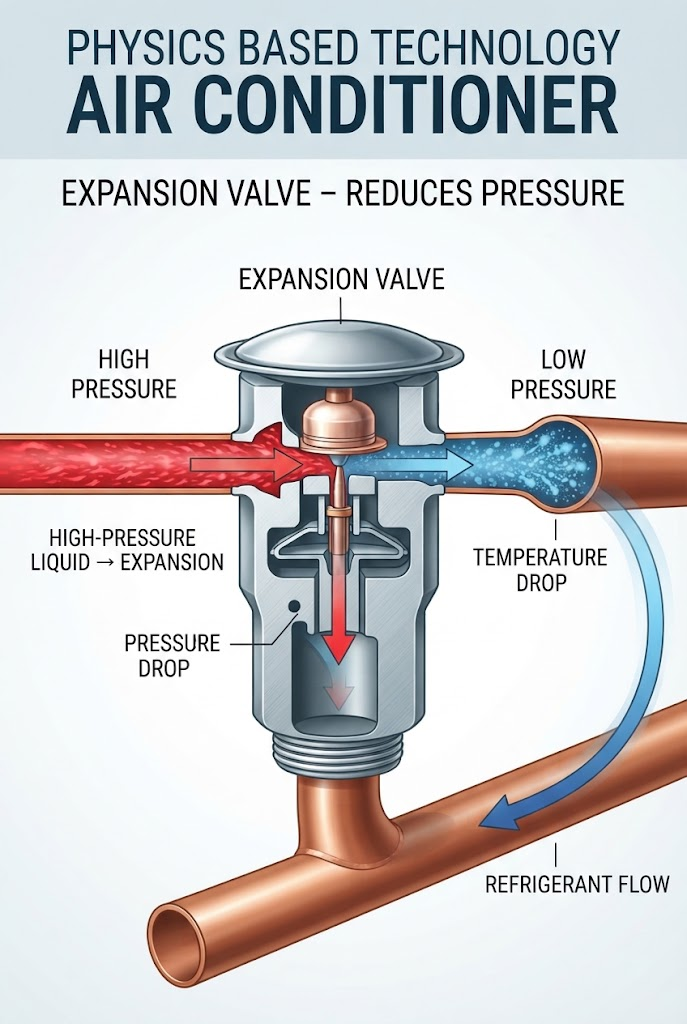
4. Expansion
After condensation, the refrigerant passes through an expansion valve or another expansion device.
The expansion device causes a large pressure drop.
As the pressure decreases, the refrigerant temperature also falls.
The refrigerant is now prepared to absorb heat again when it reaches the evaporator.
This completes the basic refrigeration cycle.
The cycle then repeats continuously while the AC is operating.
Why Does an Air Conditioner Need Refrigerant?
Refrigerant is one of the most important parts of modern air conditioner technology.
A refrigerant is specially selected because it can absorb and release heat efficiently while changing between liquid and vapor states under suitable operating conditions.
The refrigerant travels through the closed system.
It absorbs heat at the indoor evaporator and releases heat at the outdoor condenser.
Therefore, the refrigerant acts as the medium that transports thermal energy from inside the building to the outside environment.
This is why an AC does not need to bring cold air from outside. Instead, it continuously transfers heat using the refrigerant cycle.
Physics Behind the Compressor
The compressor is an important part of the physics based technology air conditioner system.
Its main job is to increase the pressure of the refrigerant vapor.
When a gas is compressed, work is performed on the gas. This increases its energy and raises its temperature.
The compressor then sends the high-pressure, high-temperature refrigerant toward the condenser.
Without the compressor, the refrigeration cycle could not operate in the same way because there would not be enough pressure difference to drive the refrigerant through the system.
This is a practical example of how mechanical work and electrical energy can be converted into a useful cooling process.
Heat Transfer in Air Conditioner Technology
Heat transfer is one of the most important concepts in air conditioning physics.
There are three basic methods of heat transfer:
- Conduction
- Convection
- Radiation
In an air conditioner, conduction and convection are particularly important.
Heat is transferred between the indoor air and the evaporator coil. The fan then helps move air across the coil, increasing the contact between the air and the cooling surface.
Inside the refrigeration system, heat also moves through the metal tubing and coil surfaces.
The condenser performs the opposite task by transferring heat from the hot refrigerant to outdoor air.
Therefore, an AC is essentially a sophisticated heat-transfer machine.
How Does AC Remove Heat From a Room?
Many people think an air conditioner simply produces cold air. However, the more accurate explanation is that an AC removes heat from indoor air.
Suppose the temperature inside a room is high.
The indoor fan pulls warm air toward the evaporator coil. The refrigerant inside the coil absorbs heat from that air.
The cooled air is then circulated back into the room.
Meanwhile, the absorbed heat travels through the refrigerant toward the outdoor condenser.
The condenser releases the heat outside.
This process continues until the indoor temperature reaches the temperature selected on the thermostat.
This is why the statement “AC creates cold” is less accurate than saying “AC removes heat.”
The Role of the Indoor and Outdoor Units
A typical split air conditioner has two major sections: an indoor unit and an outdoor unit.
The indoor unit commonly contains the evaporator coil, blower or fan, air filter, and control components.
The outdoor unit commonly contains the compressor, condenser coil, and outdoor fan.
The two units are connected by refrigerant lines and electrical/control connections.
The indoor unit is responsible mainly for absorbing heat from the room, while the outdoor unit releases that heat into the surrounding environment.
This separation allows the AC to keep the heat-producing components outside while delivering cooled air indoors.
PHYSICS-BASED TECHNOLOGY MOBILE CHARGER
Why Does the Outdoor Unit Blow Hot Air?
This is one of the easiest ways to understand the physics behind an air conditioner.
The outdoor unit is designed to release heat.
First, the evaporator absorbs heat from the indoor air.
Then the refrigerant carries that heat to the compressor and condenser.
The compressor also adds energy to the refrigerant by doing work on it.
The condenser must therefore release both the heat collected indoors and the energy associated with the compression process.
That is why air coming from the outdoor unit can feel very hot.
The hot outdoor air is evidence that the AC is transferring thermal energy out of the building.
Air Conditioner and Thermodynamics
Thermodynamics plays a central role in physics based technology air conditioner systems.
An air conditioner uses electrical energy to move heat from a relatively cooler indoor environment to a warmer outdoor environment.
Normally, heat tends to move naturally from a warmer region to a cooler region. An AC uses external work to drive the overall refrigeration process in the required direction.
This is why an air conditioner needs electricity.
The electrical energy does not directly become “cold.” Instead, electrical energy powers the compressor, fans, controls, and other components that allow heat to be transferred.
This makes an air conditioner an excellent real-world example of thermodynamics.
Why Air Conditioners Consume Electricity
An air conditioner needs electrical energy because its components must perform work.
The compressor requires energy to compress the refrigerant.
The indoor fan requires energy to circulate air.
The outdoor fan requires energy to move air across the condenser.
Electronic controls and sensors also consume a small amount of energy.
The total electricity consumption depends on factors such as cooling capacity, outdoor temperature, indoor temperature, system efficiency, operating time, maintenance, and compressor technology.
Modern inverter air conditioners can adjust compressor speed according to cooling demand. This can help reduce unnecessary cycling and improve efficiency under suitable operating conditions.
Inverter AC and Physics
Inverter AC technology is another interesting example of physics and electronics working together.
A conventional compressor may operate mainly in an on/off pattern.
An inverter-based system can vary compressor speed over a range according to the required cooling load.
When the room needs less cooling, the compressor can operate at a lower capacity. When more cooling is required, it can increase capacity.
This variable-speed operation can provide more consistent temperature control and may reduce energy waste associated with frequent full-power starts and stops.
Modern variable-speed systems therefore combine electrical engineering, control systems, thermodynamics, and refrigeration physics.
Why an AC Also Removes Moisture
An air conditioner can also help reduce humidity.
When warm, humid indoor air passes over the cold evaporator coil, water vapor in the air can condense on the cold surface when the surface temperature is below the air’s dew point.
The resulting liquid water collects on the indoor coil or drain pan and is removed through a drainage system.
This is why an air conditioner can make a room feel less humid as well as cooler.
So the physics behind air conditioner cooling involves not only temperature reduction but also moisture condensation.
Important Components of an Air Conditioner
The major components of a typical refrigeration-based AC include:
- Compressor – compresses the refrigerant vapor and raises its pressure.
- Condenser – releases heat to the outdoor environment.
- Expansion valve – reduces refrigerant pressure.
- Evaporator – absorbs heat from indoor air.
- Indoor fan – circulates room air across the evaporator.
- Outdoor fan – moves outdoor air across the condenser.
- Refrigerant – transfers heat through the refrigeration cycle.
- Thermostat and sensors – monitor and control temperature and system operation.
- Control electronics – manage compressor, fan, and other operating functions.
Together, these components create a complete air conditioner working principle based on physics.
Energy Efficiency of Air Conditioners
Energy efficiency is an important part of modern AC technology.
A more efficient system can provide the required cooling while using less electricity for the same operating conditions.
Efficiency depends on many factors, including equipment design, compressor technology, heat exchanger performance, airflow, refrigerant charge, installation quality, insulation, and maintenance.
Dirty filters and blocked airflow can reduce performance because the system must work harder to move and condition air.
Correct sizing is also important. An improperly sized system may not operate as efficiently or control humidity as effectively as a properly designed system.
How Physics Makes Modern AC Technology Possible
The modern air conditioner combines several branches of physics and engineering.
Thermodynamics explains the movement and conversion of thermal energy.
Heat transfer explains how heat moves between indoor air, refrigerant, coils, and outdoor air.
Fluid mechanics helps engineers understand refrigerant and airflow through the system.
Electricity and magnetism are involved in motors, compressors, control circuits, and electronic components.
Materials science helps determine the properties of coils, insulation, refrigerants, and other components.
Therefore, an air conditioner is not based on a single physics principle. It is a combination of several physical principles working together.
Simple Example of AC Cooling
Imagine that your room contains a large amount of heat.
The indoor fan moves this warm air across the evaporator.
The refrigerant absorbs the heat.
The refrigerant then travels to the compressor.
The compressor increases its pressure and temperature.
The hot refrigerant enters the condenser outside.
The condenser releases the heat into the outdoor air.
The refrigerant then passes through the expansion device.
Its pressure and temperature decrease.
It returns to the evaporator and is ready to absorb more indoor heat.
This cycle repeats again and again.
That simple cycle explains how an air conditioner works using physics.
Frequently Asked Questions
Does an air conditioner create cold air?
Not exactly. An air conditioner mainly removes heat from indoor air. The cooled air is then circulated back into the room.
What is the main physics principle behind an AC?
An AC mainly uses thermodynamics, heat transfer, pressure changes, and the refrigeration cycle to move heat from indoors to outdoors.
Why does the outdoor AC unit become hot?
The outdoor unit releases heat collected from indoors. The compressor also adds energy to the refrigerant, so the condenser may release a large amount of heat.
What does the compressor do in an AC?
The compressor compresses the refrigerant vapor, increasing its pressure and temperature and helping drive the refrigeration cycle.
What does the evaporator do?
The evaporator absorbs heat from indoor air. The refrigerant inside it absorbs thermal energy and evaporates.
What does the condenser do?
The condenser releases heat from the refrigerant to the outdoor environment and changes the refrigerant from vapor toward liquid.
Why does an AC remove humidity?
When humid indoor air passes over a sufficiently cold evaporator surface, moisture can condense into liquid water and be drained away.
Why does an AC need electricity?
Electricity powers the compressor, fans, electronic controls, and other components required to operate the refrigeration cycle.
Final Thoughts
A physics based technology air conditioner is a powerful example of how fundamental physics becomes useful technology in everyday life. An AC does not simply produce cold air. Instead, it uses electricity, thermodynamics, heat transfer, pressure changes, refrigerant properties, and mechanical work to transfer heat from an indoor environment to the outside.
The refrigeration cycle is the central process. The evaporator absorbs indoor heat, the compressor raises refrigerant pressure, the condenser releases heat outdoors, and the expansion device reduces pressure before the refrigerant returns to the evaporator.
Understanding the physics behind air conditioner technology makes it easier to understand why the indoor unit becomes cold, why the outdoor unit becomes hot, why refrigerant is necessary, and why compressors consume electrical energy.
From simple room air conditioners to modern inverter and variable-speed systems, air conditioning remains an excellent example of physics based technology transforming scientific principles into practical solutions for everyday life.