
Introduction
Keeping our homes clean has become much easier thanks to vacuum cleaners. Although they seem simple, vacuum cleaners are excellent examples of Physics-Based Technology Vacuum Cleaner systems that combine electricity, air pressure, fluid dynamics, and mechanical engineering into one efficient machine.
Understanding how a vacuum cleaner works not only helps us appreciate modern technology but also demonstrates how the laws of physics solve everyday problems.
In this article, you’ll learn the complete working principle of vacuum cleaners, the physics behind suction, different types of vacuum cleaners, their components, advantages, disadvantages, and future innovations.
Physics-Based Technology: Laptop → Explore how laptops combine processors, memory, batteries, and display systems using modern physics.
What is a Vacuum Cleaner?
A vacuum cleaner is an electrical cleaning device that removes dust, dirt, and debris by creating a pressure difference between the inside of the machine and the surrounding atmosphere.
Instead of “pulling” dirt directly, the vacuum cleaner allows atmospheric air pressure to push dust particles into the machine through a powerful stream of moving air.
This is one of the best real-life examples of Physics-Based Technology Vacuum Cleaner applications.
Physics-Based Technology Vacuum Cleaner Working Principle
The operation of a vacuum cleaner depends on several important laws of physics.
These include:
- Air Pressure Difference
- Fluid Dynamics
- Electric Motor Rotation
- Centrifugal Force
- Conservation of Energy
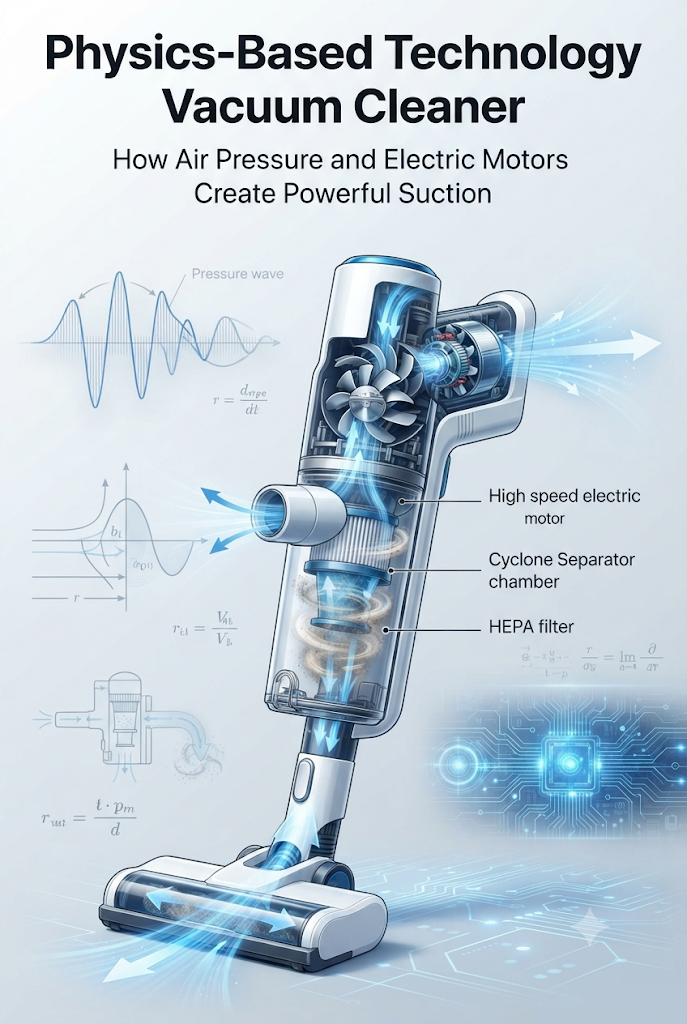
When the vacuum cleaner is turned on, an electric motor rapidly spins a fan.
The spinning fan pushes air out of the vacuum cleaner, reducing the air pressure inside the machine.
Because the pressure inside becomes lower than the outside atmospheric pressure, outside air rushes into the vacuum cleaner through the nozzle.
This fast-moving air carries dust and debris into a dust container or bag while clean air passes through filters before being released.
How Physics-Based Technology Vacuum Cleaner Creates Suction
Many people believe vacuum cleaners “suck” dirt.
Actually, physics explains that atmospheric pressure pushes air toward the region of lower pressure created inside the vacuum cleaner.
This pressure difference generates the airflow responsible for collecting dirt.
Without atmospheric pressure, vacuum cleaners would not function effectively.
Electric Motor: The Heart of the Vacuum Cleaner
The electric motor converts electrical energy into mechanical rotational energy.
It rotates the fan at extremely high speeds, often exceeding 20,000–100,000 RPM, depending on the vacuum cleaner model.
The faster the fan rotates, the greater the airflow and suction power.
Fluid Dynamics in Vacuum Cleaners
Fluid dynamics studies how gases and liquids move.
Inside a vacuum cleaner:
- Air accelerates through narrow passages.
- Faster airflow carries more dust.
- Air velocity determines cleaning efficiency.
- Pressure continuously changes throughout the airflow system.
Engineers carefully design airflow channels to maximize cleaning performance while reducing energy consumption.
Cyclonic Separation Technology
Many modern vacuum cleaners use cyclonic technology instead of disposable dust bags.
Inside the cyclone chamber:
- Air spins rapidly.
- Centrifugal force pushes heavier dust particles outward.
- Dirt falls into a collection container.
- Cleaner air continues toward the filters.
Cyclonic systems reduce clogging and maintain strong suction for longer periods.
HEPA Filtration System
Most advanced vacuum cleaners include HEPA (High-Efficiency Particulate Air) filters.
These filters capture:
- Dust
- Pollen
- Pet hair
- Mold spores
- Microscopic allergens
HEPA filters improve indoor air quality, making vacuum cleaners suitable for allergy sufferers.
Physics-Based Technology Vacuum Cleaner Components
The major components include:
- Electric Motor
- High-Speed Fan
- Air Intake Nozzle
- Dust Collection Bin or Bag
- Cyclone Chamber
- HEPA Filter
- Exhaust Vent
- Power Supply
- Hose and Cleaning Attachments
Each component contributes to the efficient operation of the Physics-Based Technology Vacuum Cleaner system.
Types of Vacuum Cleaners
Different vacuum cleaners use similar physics but vary in design.
Common types include:
- Upright Vacuum Cleaner
- Canister Vacuum Cleaner
- Stick Vacuum Cleaner
- Handheld Vacuum Cleaner
- Robotic Vacuum Cleaner
- Wet and Dry Vacuum Cleaner
- Industrial Vacuum Cleaner
Each design is optimized for different cleaning environments.
Advantages of Physics-Based Technology Vacuum Cleaners
Some major advantages include:
- Fast cleaning
- Removes microscopic dust
- Improves indoor air quality
- Saves time and effort
- Suitable for carpets and hard floors
- Reduces allergy-causing particles
- Easy to operate
Limitations of Vacuum Cleaners
Despite their benefits, vacuum cleaners also have some limitations.
These include:
- Require electricity or batteries
- Produce noticeable noise
- Filters require regular cleaning
- Premium models can be expensive
- Heavy models may be difficult to carry
Future of Physics-Based Technology Vacuum Cleaner
Today’s vacuum cleaners include many advanced technologies.
These include:
- AI-powered robotic navigation
- LiDAR mapping
- Laser dust detection
- Smart home integration
- Voice control
- Automatic suction adjustment
- Self-emptying dust bins
- Battery optimization
- Energy-efficient motors
Future vacuum cleaners will become smarter, quieter, and more energy-efficient.
Physics-Based Technology: Television → Learn how television displays images and sound using electromagnetic waves and display technology.
Real-Life Applications
Vacuum cleaners are widely used in:
- Homes
- Hospitals
- Hotels
- Offices
- Schools
- Airports
- Factories
- Laboratories
- Shopping malls
Their versatility makes them essential for maintaining cleanliness in many environments.
Frequently Asked Questions (FAQs)
How does a vacuum cleaner create suction?
A vacuum cleaner creates suction by lowering the air pressure inside the machine with a high-speed electric motor and fan. Atmospheric pressure then pushes air and dust into the vacuum cleaner.
Why is air pressure important in vacuum cleaners?
Air pressure differences generate the airflow needed to transport dust and debris into the collection chamber.
What is cyclonic technology?
Cyclonic technology uses centrifugal force to separate dust from air, maintaining stronger suction and reducing filter clogging.
Why are HEPA filters used?
HEPA filters capture extremely small particles, improving indoor air quality and reducing allergens.
Are robotic vacuum cleaners based on the same physics?
Yes. Robotic vacuum cleaners use the same principles of air pressure and airflow while adding AI, sensors, and autonomous navigation.
The Physics-Based Technology Vacuum Cleaner demonstrates how simple physical principles such as air pressure, fluid dynamics, electric motors, and centrifugal force work together to create one of the most useful household appliances.
From traditional bagged models to intelligent robotic cleaners, vacuum cleaners continue to evolve through advances in engineering and physics. Understanding these scientific principles helps us appreciate how modern technology transforms everyday life into something cleaner, healthier, and more efficient.