
Introduction
A physics based technology data center is a modern facility where computer servers, networking equipment, storage systems, and cooling technologies work together to process, store, and transfer digital information. Data centers support websites, mobile applications, artificial intelligence, cloud computing, online banking, video streaming, and many other digital services.
Every time someone watches an online video, uploads a photograph, sends an email, or visits a website, computers somewhere may be processing and delivering that information. These computers are often located inside data centers.
But how can thousands of servers operate continuously without overheating? How does electricity become computing power? Why are cooling systems, airflow, and networking equipment so important?
The answers involve physics, including electricity, thermodynamics, heat transfer, electromagnetism, and fluid mechanics.
In this guide, we will explore the physics based technology data center concept, explain how servers work, examine cooling systems, and discover seven amazing facts about the science behind modern data centers.
What Is a Physics Based Technology Data Center?
A physics based technology data center combines computer engineering with physical principles to operate large numbers of computing devices efficiently.
A typical data center contains several important components:
- Servers: Computers that process requests, run applications, and manage data.
- Server racks: Structures that organize servers and support efficient installation.
- Networking equipment: Switches and routers that move data between computers and networks.
- Cooling systems: Equipment that removes heat generated by electronic components.
- Power distribution systems: Equipment that delivers electricity to servers and supporting systems.
- Storage systems: Devices that store files, databases, backups, and application data.
- Monitoring systems: Tools that track temperature, power consumption, equipment health, and performance.
These components must work together. A server may have powerful processors, but it cannot operate reliably if its power supply fails or its temperature exceeds safe operating limits.
Physics helps engineers design systems that balance computing performance, electrical efficiency, heat removal, and reliability.
How Does a Data Center Work?
A data center receives requests from users and processes them through interconnected computing systems.
For example, when someone opens a website, the process may follow these steps:
- User Request: A browser sends a request through the internet.
- Network Communication: Routers and switches direct the request toward the appropriate server.
- Data Processing: The server’s processor executes instructions and processes the request.
- Data Retrieval: Storage devices provide the necessary files or database information.
- Response Generation: The server prepares the requested information.
- Data Transmission: Networking equipment sends the response back to the user’s device.
All these steps depend on electrical signals, semiconductor devices, electromagnetic communication, and the physical transmission of data.
Large data centers can contain many interconnected servers, allowing them to handle enormous numbers of requests. Some systems distribute workloads across multiple machines to improve performance and reliability.
Internal link opportunity: Add a link here to your existing article about the Physics Based Technology SaaS Product.
The Physics Behind Computer Servers
To understand a physics based technology data center, we must examine the scientific principles that allow servers to operate.
1. Electricity and Electronic Circuits
Electricity is fundamental to server operation. Servers receive electrical power through a power supply unit, which converts incoming electricity into suitable voltage levels for internal components.
Processors, memory modules, storage controllers, and networking devices use electronic circuits to perform their functions.
Modern processors contain billions of tiny transistors. These semiconductor devices control electrical signals and help represent binary information.
At a simplified level, digital systems process information using two logical states, commonly represented as 0 and 1. Transistors switch or control signals to implement logical operations.
Electrical engineering and semiconductor physics make these operations possible.
However, electrical energy is not converted entirely into useful computing output. Some energy becomes heat because electronic components have electrical resistance and experience switching losses.
That is why power management and cooling are essential parts of data center design.
2. Thermodynamics and Heat Generation
Thermodynamics studies energy, heat, and temperature.
When servers operate, their electronic components consume electrical energy. A significant portion of this energy ultimately becomes heat that must be removed from the equipment.
If heat accumulates inside a server, its temperature may rise beyond the manufacturer’s recommended operating range.
Excessive temperatures can cause processors to reduce their operating speed, a process known as thermal throttling. Persistent overheating may also contribute to instability or equipment damage.
Data center engineers therefore monitor temperatures and design systems to maintain suitable operating conditions.
The goal is not simply to make a room cold. It is to remove heat efficiently while maintaining the required environmental conditions for reliable operation.
3. Heat Transfer in Data Centers
Heat transfer occurs through three primary mechanisms: conduction, convection, and radiation.
Conduction: Heat moves through a material because of temperature differences. For example, heat travels from a processor into its heat spreader and cooling assembly.
Convection: Heat transfers between a surface and a moving fluid, such as air or liquid. Server fans move air across hot components, carrying heat away.
Radiation: Objects emit thermal radiation. Although radiation occurs in data centers, conduction and convection are generally more important for removing heat directly from server components.
Engineers use these principles to design heat sinks, cold plates, airflow pathways, and cooling systems.
Efficient heat transfer helps prevent local hot spots and allows equipment to operate more consistently.
4. Fluid Mechanics and Airflow
Fluid mechanics explains how liquids and gases move.
In traditional air-cooled data centers, fans move air through server racks. Cool air enters equipment, passes over heat-generating components, and leaves at a higher temperature.
The airflow must be carefully managed. If hot exhaust air mixes excessively with incoming cool air, cooling efficiency may decrease.
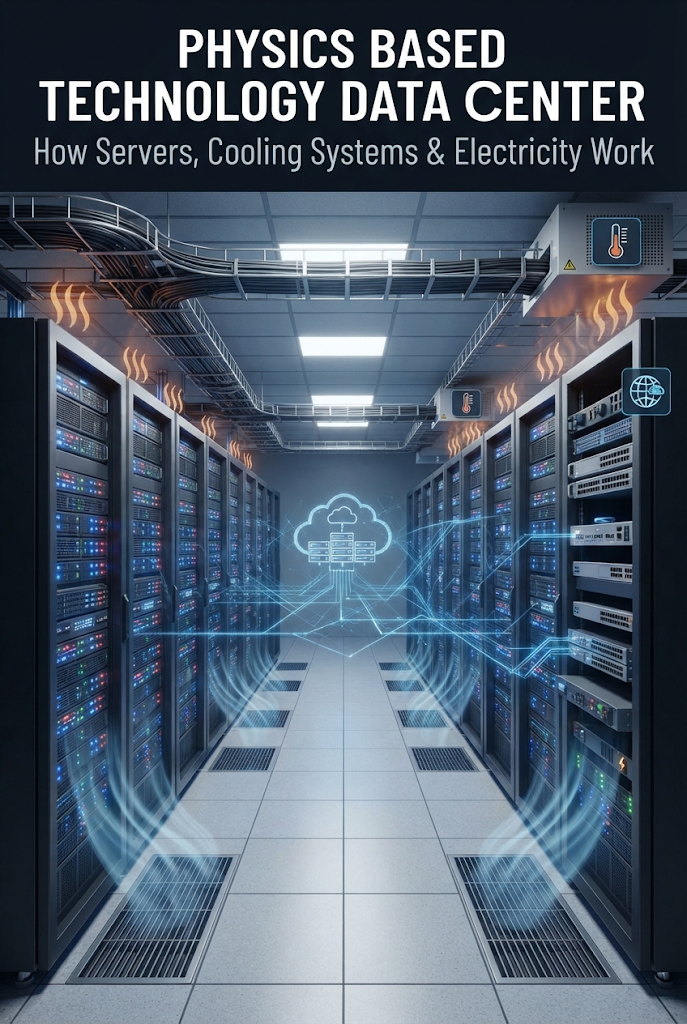
Data centers often arrange equipment into hot and cold aisles. This approach helps separate the air entering servers from the hot air leaving them.
Engineers also consider airflow resistance, fan performance, pressure differences, and air distribution when designing server rooms.
Proper airflow is important because even a powerful cooling system may perform poorly if air cannot reach the components that need cooling.
5. Electromagnetism and Data Transmission
Data centers depend on fast communication between servers, storage systems, and networking devices.
Copper cables transmit electrical signals, while optical fibers transmit information using light.
Optical communication uses principles related to electromagnetism and optics. Light travels through an optical fiber, carrying information encoded in changing optical signals.
Fiber-optic links can support high data rates over suitable distances and are widely used in modern networking infrastructure.
Inside networking devices, electronic circuits process signals and coordinate communication between connected systems.
Together, these technologies allow data centers to transfer large amounts of information between computers and users.
Seven Amazing Facts About Physics Based Technology Data Center Systems
A physics based technology data center involves much more than rows of computers. Its design depends on several interconnected scientific principles.
Fact 1: Servers Consume Electrical Power
Every active server requires electrical energy to run its processors, memory, storage, and networking components.
The total power demand depends on the number of servers, their workloads, hardware efficiency, and supporting equipment.
Data center operators monitor electrical consumption to control operating costs and maintain reliable power delivery.
Fact 2: Almost All Computing Energy Eventually Becomes Heat
A server performs useful computational work, but the electrical energy it consumes eventually becomes heat within the facility.
This makes heat removal a fundamental part of data center operation.
The amount of heat generated depends on the equipment’s power consumption and operating conditions.
Fact 3: Cooling Can Consume Significant Energy
Cooling equipment requires energy to move air or liquid and transfer heat away from servers.
The proportion of total energy used for cooling varies considerably with climate, hardware density, facility design, and cooling technology.
Engineers seek to remove heat while minimizing unnecessary fan, pump, and refrigeration energy.
Fact 4: Liquid Cooling Can Support High-Density Computing
Some processors and accelerators produce high heat loads in a relatively small space.
Liquid cooling can transfer heat from these components more effectively than air alone in certain applications because liquids can carry substantial amounts of thermal energy.
Direct-to-chip cooling uses cold plates attached to heat-generating components. Other systems use immersion cooling, in which compatible hardware is placed in a specially designed dielectric fluid.
Liquid cooling requires appropriate equipment, fluid management, leak protection, and maintenance.
Fact 5: Data Centers Need Reliable Power Systems
Unexpected power interruptions can disrupt online services and damage ongoing operations.
Data centers may use uninterruptible power supplies, backup generators, redundant electrical paths, and power monitoring systems.
These systems are designed to help maintain service continuity when part of the electrical infrastructure fails.
The exact design depends on the facility’s reliability requirements.
Fact 6: Server Racks Help Organize Equipment and Airflow
Server racks provide a structured way to install and maintain computing equipment.
Rack layout influences cable routing, service access, equipment density, and airflow.
Well-planned arrangements can simplify maintenance and help reduce hot spots caused by poor air distribution.
Fact 7: Renewable Energy Can Help Reduce Environmental Impact
Some data center operators purchase renewable electricity or develop projects that supply power from sources such as solar and wind.
However, the environmental impact of a data center depends on several factors, including its total electricity consumption, energy source, cooling efficiency, hardware lifecycle, and water use.
Improving energy efficiency and using lower-carbon electricity can help reduce emissions.
How Data Center Cooling Systems Work
Cooling is one of the most important aspects of a physics based technology data center.
The cooling system must transfer heat away from electronic components and reject that heat into the surrounding environment or another heat-removal system.
Air Cooling
Air cooling uses fans, heat sinks, air handlers, and other equipment to move heat away from servers.
A typical process works as follows:
- Cool air enters the server.
- Fans move air over heat-generating components.
- The air absorbs heat from those components.
- Heated air leaves the equipment.
- A cooling system removes heat from the return air.
Air cooling is widely used because it is familiar and can be suitable for many types of server environments.
However, high-density computing systems may require carefully engineered airflow or alternative cooling technologies.
Liquid Cooling
Liquid cooling transfers heat using a circulating liquid.
In direct-to-chip systems, a liquid passes through cold plates attached to processors or other components. The liquid absorbs heat and carries it toward a heat exchanger, where the heat is transferred to another cooling loop or heat-rejection system.
Because liquids can transfer substantial heat, liquid cooling is useful for some high-performance computing and AI workloads.
The appropriate solution depends on equipment design, heat density, maintenance needs, and overall operating costs.
Evaporative Cooling
Some facilities use evaporation to help remove heat. When a liquid evaporates, it absorbs energy from its surroundings.
This principle can reduce cooling energy under suitable environmental conditions.
However, evaporative systems can consume water, and their performance depends on humidity, temperature, water availability, and system design.
Internal link opportunity: Link the words Physics Based Technology Air Conditioner to your related article about air conditioning and heat transfer.
Why Do Data Centers Need Backup Power?
A data center must deliver electricity to its servers consistently.
Even a brief interruption may affect applications, transactions, or data processing. For this reason, facilities may use several layers of power protection.
Uninterruptible Power Supply
An uninterruptible power supply, or UPS, provides temporary power when the normal electrical supply is interrupted.
Many UPS systems use batteries or other energy-storage technologies to bridge the gap until backup power becomes available or equipment can shut down safely.
Backup Generators
Backup generators can supply electricity during extended utility outages.
They may use diesel, natural gas, or other fuels, depending on the installation.
Generators require appropriate fuel storage, testing, maintenance, and environmental controls.
Redundant Power Distribution
Some data centers provide multiple power paths so that a failure in one part of the system does not necessarily interrupt every connected server.
Redundancy improves resilience, but it adds cost and complexity. The appropriate design depends on service requirements and the consequences of downtime.
How Cloud Computing Depends on Data Centers
Cloud computing allows people and organizations to access computing resources over a network instead of operating every physical server themselves.
When a person uses an online application, the application may run on remote servers located in a data center.
Cloud providers can allocate computing resources according to workload requirements. Virtualization and container technologies help multiple applications share physical infrastructure while maintaining appropriate separation.
A cloud service may provide processing power, storage, databases, networking, or complete applications.
The physics based technology data center provides the physical foundation for these services through electrical power, semiconductor devices, cooling, and network communication.
Cloud computing does not eliminate the need for physical hardware. It changes how computing resources are managed and delivered.
Internal link opportunity: Add your article about the Physics Based Technology SaaS Product here.
The Role of Artificial Intelligence in Modern Data Centers
Artificial intelligence is increasing demand for powerful computing systems.
AI workloads often use specialized processors, including graphics processing units and other accelerators, to perform large numbers of mathematical operations.
These devices can generate substantial heat when operating at high utilization.
As a result, AI data centers may require higher electrical capacity, advanced thermal management, high-speed networking, and careful workload scheduling.
AI can also help data center operators predict equipment problems, analyze energy consumption, and adjust cooling systems according to changing conditions.
However, AI systems themselves require electricity and computing resources. Their benefits should be evaluated against the energy and infrastructure they consume.
Energy Efficiency in Data Centers
Energy efficiency helps data centers reduce operating costs and environmental impact.
Engineers can improve efficiency through several methods.
1. Efficient hardware: Newer servers may deliver more computing performance per unit of electricity for particular workloads.
2. Better airflow: Separating hot and cold air streams can reduce unwanted mixing and improve cooling performance.
3. Cooling optimization: Adjusting fans, pumps, and cooling equipment to actual demand can prevent unnecessary energy consumption.
4. Workload management: Scheduling workloads and distributing them across available servers can improve resource utilization.
5. Temperature monitoring: Sensors help operators identify hot spots and respond to changing thermal conditions.
6. Waste-heat recovery: In suitable locations, heat from computing equipment may be reused for building heating or other applications.
One commonly used metric is Power Usage Effectiveness, or PUE.
PUE is calculated as:
PUE = Total Data Center Energy ÷ IT Equipment Energy
For example, suppose a facility consumes 1,500 kWh of total energy while its IT equipment consumes 1,000 kWh during the same period.
Its PUE is:
PUE = 1,500 ÷ 1,000 = 1.5
This means the facility uses 1.5 units of total energy for every unit consumed by its IT equipment.
A lower PUE generally indicates that less additional energy is being used by facility infrastructure relative to IT equipment. However, PUE alone does not measure computing efficiency, carbon emissions, water use, or the usefulness of the work performed.
Real-World Applications of Data Center Technology
Data centers support many everyday digital services.
Websites and Online Businesses
Websites use servers to deliver pages, process forms, manage user accounts, and store information.
Businesses depend on reliable hosting to keep their services accessible.
Online Education
Learning platforms use data centers to host lessons, examinations, videos, and student records.
Students can access educational materials from different locations through internet-connected devices.
Banking and Digital Payments
Financial institutions use computing infrastructure to process transactions, manage databases, and support digital banking services.
These systems require appropriate security, availability, and data protection measures.
Video Streaming
Streaming platforms use computing and storage infrastructure to deliver video content.
Content delivery networks may cache content in different geographical locations to reduce latency and improve the viewing experience.
Artificial Intelligence
AI applications use data center infrastructure to train models, process requests, store datasets, and deliver AI-powered services.
These workloads can require specialized processors, fast networking, and advanced cooling.
Challenges Facing Modern Data Centers
Although data centers are essential to digital services, they face several challenges.
High Energy Demand
Large computing facilities can require substantial amounts of electricity. Operators must balance performance, reliability, cost, and environmental impact.
Heat Management
High-density processors generate concentrated heat loads. Poor thermal management can reduce performance and reliability.
Water Consumption
Some cooling technologies consume water directly or indirectly. Water use must be considered alongside energy efficiency and local environmental conditions.
Cybersecurity
Data centers store and process sensitive information. Security controls are needed to protect systems from unauthorized access, data theft, and disruption.
Equipment Maintenance
Servers, storage devices, power systems, and cooling equipment require monitoring and maintenance.
Infrastructure Costs
Building a data center involves expenses for land, buildings, servers, networking, electrical systems, cooling, security, and ongoing operations.
These challenges encourage continued development in efficient computing, advanced cooling, renewable electricity, and resilient infrastructure.
The Future of Physics Based Technology Data Center Systems
The future of data centers will likely involve greater computing demand, higher equipment density, and more sophisticated thermal management.
Several developments are especially important.
Advanced liquid cooling: Improved cold plates, cooling distribution systems, and heat exchangers may help support increasingly powerful processors.
Energy-aware computing: Software may schedule workloads according to energy availability, equipment temperature, and performance requirements.
Renewable electricity: Greater use of low-carbon electricity can help reduce the environmental impact of computing.
Optical networking: Improvements in optical communication may support higher bandwidth and more efficient data movement in suitable applications.
Waste-heat reuse: Some facilities may supply recovered heat to nearby buildings or industrial systems when temperature requirements and local infrastructure make it practical.
Smarter monitoring: Sensors and analytics can help operators detect abnormal temperatures, power fluctuations, and equipment failures earlier.
These developments show how physics and computing engineering work together to improve the infrastructure behind the digital world.
Frequently Asked Questions
1. What is a physics based technology data center?
A physics based technology data center is a computing facility whose servers, electrical infrastructure, networking, and cooling systems operate according to physical principles such as electricity, thermodynamics, heat transfer, and electromagnetism.
2. Why do data centers need cooling systems?
Servers convert much of the electrical energy they consume into heat. Cooling systems remove this heat to help maintain appropriate operating temperatures and reliable performance.
3. What is the difference between a server and a data center?
A server is a computer that provides computing, storage, or networking services. A data center is a facility that houses servers and the supporting infrastructure needed to operate them.
4. How does physics help improve data center efficiency?
Physics helps engineers understand electrical losses, heat transfer, airflow, liquid cooling, and communication systems. Applying these principles can improve energy efficiency and equipment reliability.
5. What is liquid cooling in a data center?
Liquid cooling uses a circulating liquid to absorb and transport heat away from computing equipment. It can be useful for high-density processors and specialized computing workloads.
6. What is PUE in a data center?
Power Usage Effectiveness is a metric that compares total facility energy consumption with the energy used by IT equipment. A lower PUE generally means lower facility overhead relative to IT energy consumption.
7. Are cloud computing and data centers the same thing?
No. A data center is a physical facility, while cloud computing is a way of delivering computing resources over a network. Cloud services often depend on data centers.
8. Do AI systems require special data centers?
Not every AI workload needs a dedicated facility, but large AI workloads may require specialized accelerators, higher power capacity, advanced cooling, and high-speed networking.
Final Thoughts
A physics based technology data center is much more than a building filled with computers. It is a complex system that combines electricity, semiconductor physics, thermodynamics, fluid mechanics, heat transfer, and networking technology.
These principles allow servers to process information, cooling systems to remove heat, power infrastructure to maintain operation, and communication networks to deliver data around the world.
As cloud computing and artificial intelligence continue to develop, efficient and reliable data centers will become increasingly important. Better cooling, energy management, and hardware design can help support this growth while addressing cost and environmental challenges.
Understanding the physics behind data centers also helps explain how websites, online education, digital banking, streaming services, and AI applications operate in everyday life.