Introduction
Have you ever wondered how a small headphone can produce clear music, powerful bass, and detailed voices directly into your ears? Modern headphones may look simple, but they combine several scientific principles, including sound waves, electromagnetism, electrical circuits, and digital signal processing.
A physics based technology headphone uses these principles to convert electrical audio signals into sound waves that our ears can detect. Modern headphones may also include wireless communication, microphones, active noise cancellation, and digital audio processing.
Headphones are used for listening to music, watching videos, attending online classes, playing games, and making phone calls. Some models are designed for professional audio production, while others focus on portability, comfort, or noise reduction.
Understanding the physics behind headphone technology helps explain why different headphones produce different sounds and how engineers improve audio quality.
In this guide, we will explore seven amazing facts about headphones, the science of sound production, headphone drivers, noise cancellation, Bluetooth technology, and the future of audio engineering.
What Is a Physics Based Technology Headphone?
A physics based technology headphone is an audio device that uses electrical, mechanical, and acoustic principles to reproduce sound from an audio source.
A typical headphone system may contain several important components:
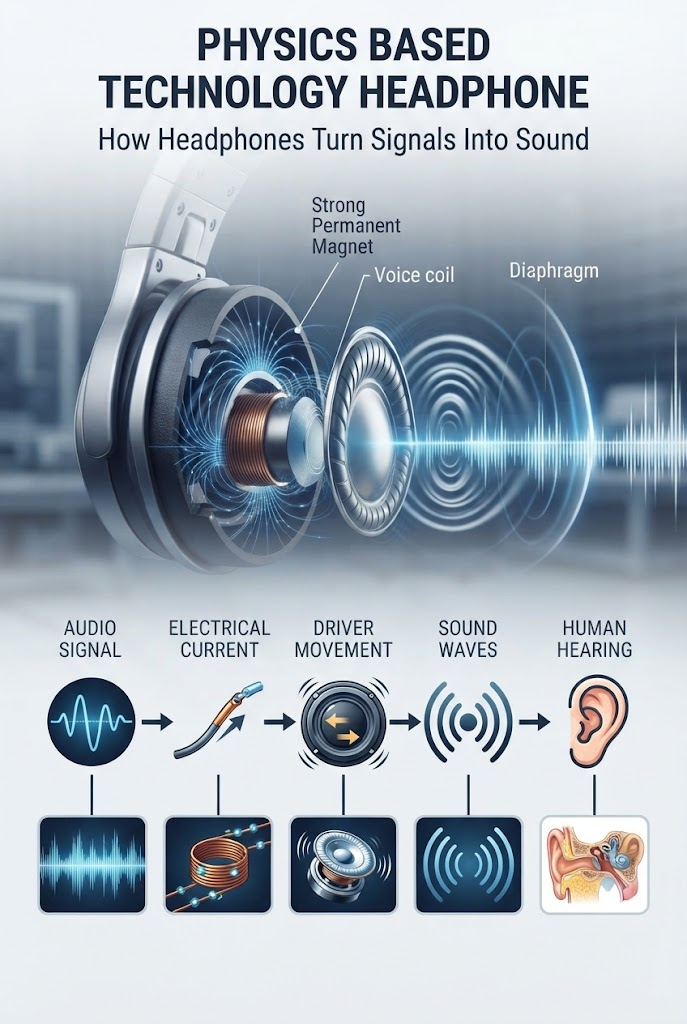
- Audio drivers: Convert electrical audio signals into mechanical vibrations.
- Diaphragm: Vibrates to produce changes in air pressure that form sound waves.
- Magnet and voice coil: In many dynamic headphones, these components generate the force needed to move the diaphragm.
- Ear cups or ear tips: Help direct sound toward the ears and provide a suitable acoustic fit.
- Audio circuitry: Processes and delivers electrical signals to the drivers.
- Microphones: Capture external sounds or the user’s voice.
- Battery and wireless electronics: Power wireless features in compatible models.
- Noise cancellation system: Uses electronic processing and sound waves to reduce certain unwanted sounds.
Not every headphone contains all these components. Wired, wireless, open-back, closed-back, and noise-cancelling models use different designs.
The fundamental goal, however, is similar: reproduce an audio signal as accurately and usefully as possible.
How Does a Physics Based Technology Headphone Work?
The working principle of a physics based technology headphone begins with an audio signal.
When a user plays a song, phone call, or video, the source device supplies an audio signal to the headphone. Depending on the design, the signal may be analog or digitally processed before reaching the driver.
The process generally follows these steps:
- Audio input: A phone, computer, music player, or other device provides the audio.
- Signal processing: Electronic circuits may adjust volume, equalization, or other audio characteristics.
- Electrical current: The driver receives an electrical signal corresponding to the sound.
- Mechanical movement: The driver converts the signal into physical vibrations.
- Sound wave production: The vibrating diaphragm creates pressure variations in the surrounding air.
- Hearing: These pressure variations reach the eardrum, allowing the listener to perceive sound.
In wireless headphones, Bluetooth or another supported wireless connection transfers audio data to the headphone. The headphone then decodes or processes the data and converts it into sound.
This combination of electronics, mechanical motion, and acoustics makes headphone technology possible.
The Physics Behind Headphone Sound Production
To understand a physics based technology headphone, we need to explore the scientific principles responsible for producing sound.
1. Sound Waves and Air Pressure
Sound is a mechanical wave that travels through a medium such as air.
When a headphone diaphragm vibrates, it creates small changes in air pressure. These changes travel toward the listener’s eardrum.
Sound waves are commonly described using frequency, amplitude, wavelength, and phase.
Frequency: Measured in hertz (Hz), frequency describes how many complete wave cycles occur each second. It is closely related to the perceived pitch of a sound.
Amplitude: Amplitude describes the size of a wave’s variation. Under suitable listening conditions, greater sound pressure generally corresponds to a louder perceived sound.
Wavelength: Wavelength is the distance between corresponding points on successive wave cycles. It depends on frequency and the speed of sound in the medium.
Phase: Phase describes a wave’s position within its cycle. Phase relationships become particularly important in active noise cancellation.
Human hearing is commonly described as spanning approximately 20 Hz to 20,000 Hz, although the actual range varies with age, hearing health, and individual differences.
Headphones are designed to reproduce sound across a range of frequencies, but their performance depends on driver design, acoustic construction, fit, and signal processing.
2. Electromagnetism in Headphone Drivers
Many headphones use dynamic drivers, which rely on electromagnetism.
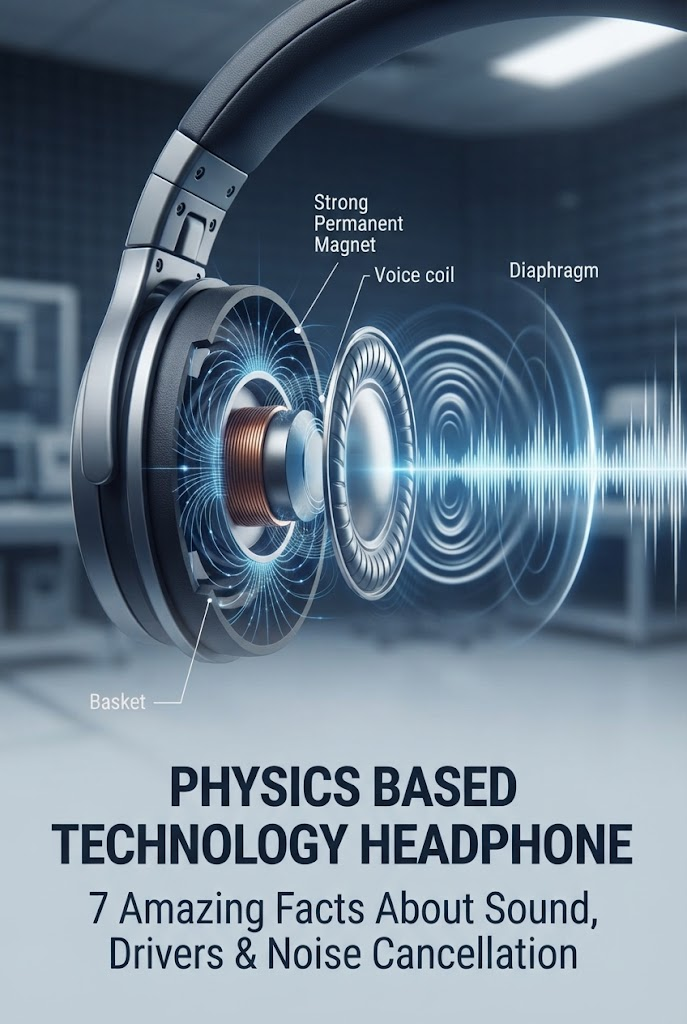
A typical dynamic driver contains a permanent magnet, a voice coil, and a diaphragm.
When an audio signal produces current in the voice coil, the interaction between the coil’s magnetic field and the permanent magnet generates a force.
As the current changes, the force changes too. This moves the diaphragm back and forth, producing sound waves.
The basic physical principle is that a current-carrying conductor in a magnetic field experiences a force. The direction and magnitude of that force depend on the magnetic field, current, and conductor arrangement.
This is one reason electromagnetism is fundamental to audio technology.
Other headphone designs use different methods. Planar magnetic headphones use a thin diaphragm with conductors arranged across its surface, while electrostatic headphones use electrostatic forces to move a specially designed diaphragm.
Each design involves different engineering trade-offs involving cost, sensitivity, distortion, size, and manufacturing complexity.
3. Frequency Response and Audio Quality
Frequency response describes how a headphone reproduces different frequencies.
A headphone with a relatively balanced frequency response aims to reproduce low, middle, and high frequencies without excessive emphasis on particular regions.
However, listener preferences vary. Some users enjoy stronger bass, while others prefer a more neutral sound for music production or critical listening.
Low-frequency sounds are often associated with bass instruments and deep musical effects. Midrange frequencies contain much of the information needed to understand voices and many musical instruments. Higher frequencies contribute to details such as cymbal sounds and certain vocal characteristics.
A headphone’s measured frequency response can help describe its sound, but it does not tell the whole story. Fit, ear shape, listening level, distortion, and individual hearing also influence the listening experience.
For this reason, audio quality cannot be determined from a single specification alone.
Seven Amazing Facts About Physics Based Technology Headphone
A modern headphone is more than a speaker placed near the ear. It is a compact system that combines physics and electronics in several interesting ways.
Fact 1: Headphones Turn Electrical Signals into Sound
Headphones do not create sound directly from digital information.
In a digital audio system, information must be converted into a suitable electrical signal and then into mechanical movement. The diaphragm’s motion creates pressure waves that the listener hears as sound.
This process connects digital electronics, electrical circuits, mechanical engineering, and acoustics.
Fact 2: Bass Depends on Low-Frequency Sound Reproduction
Bass refers to the lower-frequency portion of audio.
Producing strong, controlled bass requires a headphone design capable of reproducing low frequencies while managing diaphragm movement, acoustic leakage, and distortion.
A proper fit is particularly important for many in-ear and closed-back headphones because sound leakage can reduce perceived bass.
However, bigger drivers do not automatically guarantee better bass. Driver design, enclosure acoustics, tuning, and overall engineering also matter.
Fact 3: Noise Cancellation Uses Wave Interference
Active noise cancellation, or ANC, uses microphones and electronic processing to reduce certain external sounds.
The system measures incoming noise and generates an additional signal designed to create an opposing acoustic wave at the listener’s ear.
When the waves have suitable amplitudes and opposite phases, they can partially cancel each other through destructive interference.
ANC is particularly effective against many steady, low-frequency sounds, although performance depends on the noise, headphone fit, microphone placement, and system design.
It does not eliminate every sound, and it may be less effective against sudden or irregular noises.
Fact 4: Bluetooth Headphones Receive Audio Wirelessly
Bluetooth headphones receive audio information through a wireless radio connection.
The source device encodes audio according to a supported Bluetooth audio codec. The headphone receives the data and decodes it before producing sound.
Wireless audio performance depends on factors such as the codec, connection quality, device compatibility, signal interference, and headphone implementation.
Bluetooth headphones also require electrical power for their wireless circuitry and, in many models, digital signal processing and active noise cancellation.
Fact 5: Ear Tips and Ear Cups Affect Sound
The shape of the ear cups, ear tips, and acoustic chambers influences how sound reaches the ear.
A poor fit can allow sound to leak, particularly at low frequencies. Different ear shapes and headphone positions can also change the sound experienced by individual listeners.
This is why a headphone that sounds excellent to one person may sound different to another.
Fact 6: Wired and Wireless Headphones Use Different Signal Paths
Wired headphones receive audio through a physical electrical connection.
Wireless headphones receive data over a radio connection and generally need additional electronics to decode or process it.
However, both types ultimately need a driver or another sound-producing mechanism to create acoustic waves.
Neither connection type automatically guarantees better sound quality. The final result depends on the complete audio system, including its source, processing, driver, acoustic design, and implementation.
Fact 7: Digital Processing Can Change the Listening Experience
Modern headphones may use digital signal processing, often called DSP, to adjust sound.
DSP can support equalization, active noise cancellation, transparency modes, spatial audio effects, and other features.
For example, equalization changes the relative level of different frequency bands. Noise cancellation uses signal processing to help reduce unwanted external sound.
These features demonstrate how digital electronics and acoustic physics work together in modern audio devices.
How Active Noise Cancelling Headphones Work
Active noise cancellation is one of the most interesting developments in headphone technology.
Traditional passive isolation reduces external noise through physical barriers, such as ear cups, seals, and ear tips.
Active noise cancellation adds electronic processing to reduce certain sounds further.
Step 1: Microphones Detect External Noise
Small microphones measure sounds around the headphone or inside the ear cup, depending on the ANC design.
Step 2: Electronic Circuits Process the Signal
The headphone’s processing system analyzes the measured sound and generates an appropriate anti-noise signal.
Step 3: The Driver Produces the Anti-Noise Signal
The driver reproduces the additional signal along with the desired audio.
Step 4: Sound Waves Interact
When the original noise and the generated sound have suitable amplitude and phase relationships, they can partially cancel each other near the listener’s ear.
The process must account for timing, frequency, microphone measurements, and the acoustic characteristics of the headphone.
ANC systems therefore require careful engineering rather than simply producing an opposite sound.
Important: Noise cancellation is not the same as hearing protection. Do not assume that ANC headphones protect hearing in dangerously loud environments. Use suitable hearing protection when necessary.
Wired vs Wireless Headphones: What Does Physics Tell Us?
Both wired and wireless headphones can deliver high-quality audio, but their designs differ.
| Feature | Wired Headphones | Wireless Headphones |
|---|---|---|
| Audio connection | Physical cable | Wireless connection |
| Battery | Usually not required for basic passive models | Usually required |
| Signal processing | May be in the source device or headphone | Often includes additional processing electronics |
| Mobility | Limited by cable length | Greater freedom of movement |
| Possible interference | Less affected by wireless radio interference | Wireless connection may experience interference |
| Sound quality | Depends on the complete audio system | Depends on the complete audio system |
| Maintenance | Cable can wear or break | Battery capacity may decrease over time |
Neither type is universally superior. The best choice depends on the intended use, comfort, sound preferences, connectivity, and budget.
The Role of Materials in Headphone Technology
Materials influence the weight, durability, acoustic properties, and comfort of headphones.
Diaphragms may use polymers, metal-coated films, composite materials, or other specialized constructions.
The diaphragm must respond to electrical or mechanical forces in a controlled way while minimizing unwanted resonances and distortion.
Magnets provide the magnetic field required by many dynamic and planar magnetic designs. Their properties influence driver construction and performance.
Ear pads and ear tips use materials selected for comfort, durability, sealing, and acoustic behavior.
Engineers must balance multiple requirements. A lightweight material may improve comfort, while a different material or structure may provide better rigidity or damping.
No single material is automatically best for every headphone design.
How to Choose a Good Headphone
Understanding headphone physics can help consumers make better decisions.
1. Check Frequency Response
Frequency response can provide information about how a headphone reproduces different parts of the audible spectrum.
However, measured response should be interpreted alongside the headphone’s intended use and listening preferences.
2. Consider Comfort and Fit
Comfort is important for extended listening.
Check the headband pressure, ear-pad materials, ear-tip sizes, weight, and overall fit.
For in-ear headphones, a good seal may also improve bass reproduction and passive noise isolation.
3. Decide Whether You Need ANC
Active noise cancellation can be useful for commuting, studying, working in shared spaces, or travelling.
However, ANC performance varies by model and noise type.
4. Check Connectivity
Wired headphones may suit studio work or users who prefer a direct connection.
Wireless headphones may be more convenient for commuting, exercise, and everyday use.
Check compatibility, supported Bluetooth codecs where relevant, microphone performance, and battery life.
5. Consider Listening Safety
Listening at excessive volume can damage hearing.
Keep the volume at a comfortable level, take listening breaks, and avoid increasing the volume excessively to overcome environmental noise.
If you experience ringing in the ears or other hearing symptoms, consider seeking advice from a qualified hearing professional.
The Future of Physics Based Technology Headphone
Headphone technology continues to evolve through advances in materials, electronics, wireless communication, and acoustic engineering.
Several developments are shaping the future of audio devices.
Improved active noise cancellation: Better microphones, processing algorithms, and acoustic designs may improve the reduction of unwanted sounds in suitable environments.
Spatial audio: Digital processing can simulate the direction and placement of sounds, creating a more immersive listening experience.
Lower-power electronics: Efficient circuits can help extend battery life in wireless headphones.
Advanced materials: New diaphragm and driver materials may improve performance, durability, and weight.
Adaptive audio: Some headphones adjust sound processing according to environmental conditions, fit measurements, or user preferences.
Hearing-aware features: Future designs may offer better listening-level monitoring and features that encourage safer listening habits.
These developments show how physical science and digital technology continue to influence the way people experience sound.
Frequently Asked Questions
1. What is a physics based technology headphone?
A physics based technology headphone is an audio device that uses principles such as electromagnetism, sound-wave propagation, and electrical signal processing to convert audio signals into sound.
2. How do headphone drivers work?
Many headphone drivers use a magnetic field and a voice coil to move a diaphragm. The diaphragm’s vibrations create changes in air pressure that are heard as sound.
3. How does active noise cancellation work?
Active noise cancellation uses microphones and electronic processing to generate sound that can partially cancel unwanted external noise through destructive interference.
4. Do wireless headphones have better sound quality than wired headphones?
Not necessarily. Sound quality depends on the drivers, acoustic design, signal processing, source quality, wireless codec where applicable, and overall implementation.
5. What is headphone frequency response?
Frequency response describes how a headphone reproduces sounds across different frequencies. It helps characterize the balance between bass, midrange, and treble.
6. Why do headphones need batteries?
Wireless headphones need batteries to power their radio circuitry and usually their audio-processing electronics. Basic passive wired headphones typically do not require a battery.
7. Can noise-cancelling headphones block every sound?
No. Active noise cancellation can reduce certain sounds, especially many steady low-frequency noises, but it cannot eliminate all external sound.
8. Can loud headphone use damage hearing?
Yes. Listening to loud sound for too long can damage hearing. Keeping the volume comfortable and taking breaks can help reduce the risk.
Final Thoughts
A physics based technology headphone demonstrates how scientific principles can be applied to a small everyday device.
Electromagnetism enables many headphone drivers to move. Sound-wave physics explains how vibrations reach our ears. Signal processing supports equalization and noise cancellation, while wireless communication allows modern headphones to operate without a physical audio cable.
Understanding these principles helps explain why headphone design involves much more than choosing a speaker and placing it near the ear.
As audio technology continues to advance, improvements in materials, processing, and acoustic engineering will create new opportunities for more convenient and immersive listening experiences.