
Introduction
Have you ever wondered how a water heater transforms cold water into hot water in just a few minutes? Whether you are taking a warm shower, washing dishes, or cleaning your home, a water heater makes everyday life more comfortable.
However, the technology behind this familiar appliance involves several important scientific principles. A modern water heater uses energy conversion, heat transfer, temperature control, and thermodynamics to heat water safely and efficiently.
Understanding the physics based technology water heater system helps explain how electricity or fuel can be converted into useful thermal energy. It also helps homeowners understand energy consumption, heating performance, and the importance of proper maintenance.
What Is a Physics Based Technology Water Heater?
A water heater is an appliance designed to increase the temperature of water using an energy source such as electricity, natural gas, or heat extracted from the surrounding environment.
The physics based technology water heater concept describes how scientific principles are used to transform energy into heat and transfer that heat to water.
Different water heaters use different mechanisms.
- Electric water heaters use electrical resistance to produce heat.
- Gas water heaters burn fuel to generate heat.
- Heat pump water heaters transfer heat from the surrounding air into the water.
- Tankless water heaters heat water as it flows through the appliance instead of storing a large quantity in a tank.
- Solar water heaters use energy from sunlight to heat water, often through a solar collector.
Although their designs differ, these systems all depend on energy transfer and temperature control.
How Does a Water Heater Work?
The operating process depends on the type of water heater. In a typical electric storage water heater, the process follows several steps.
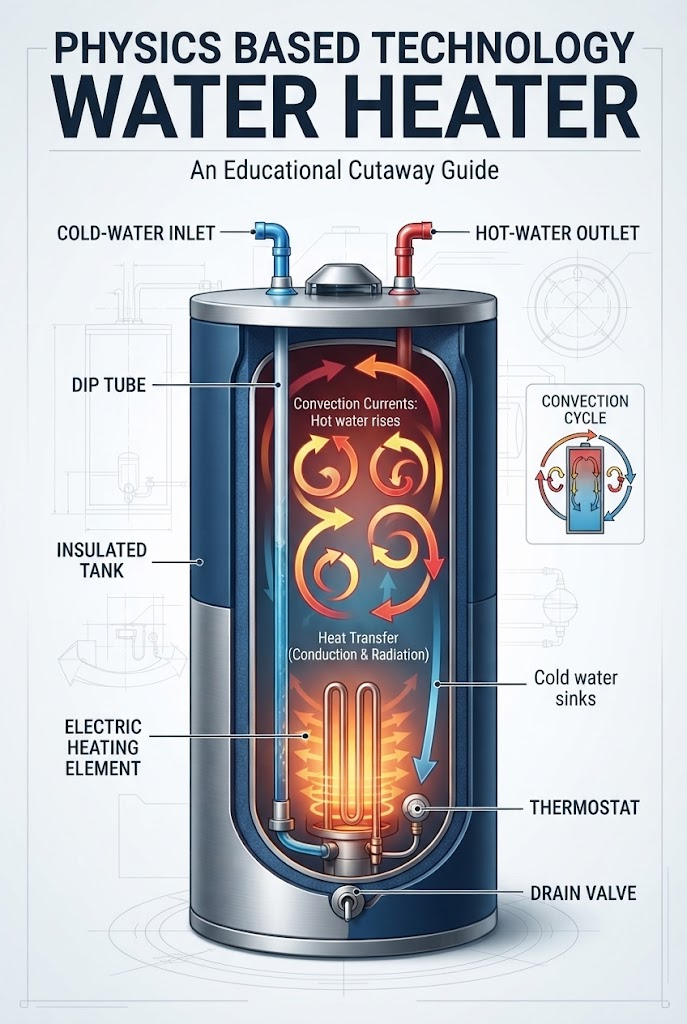
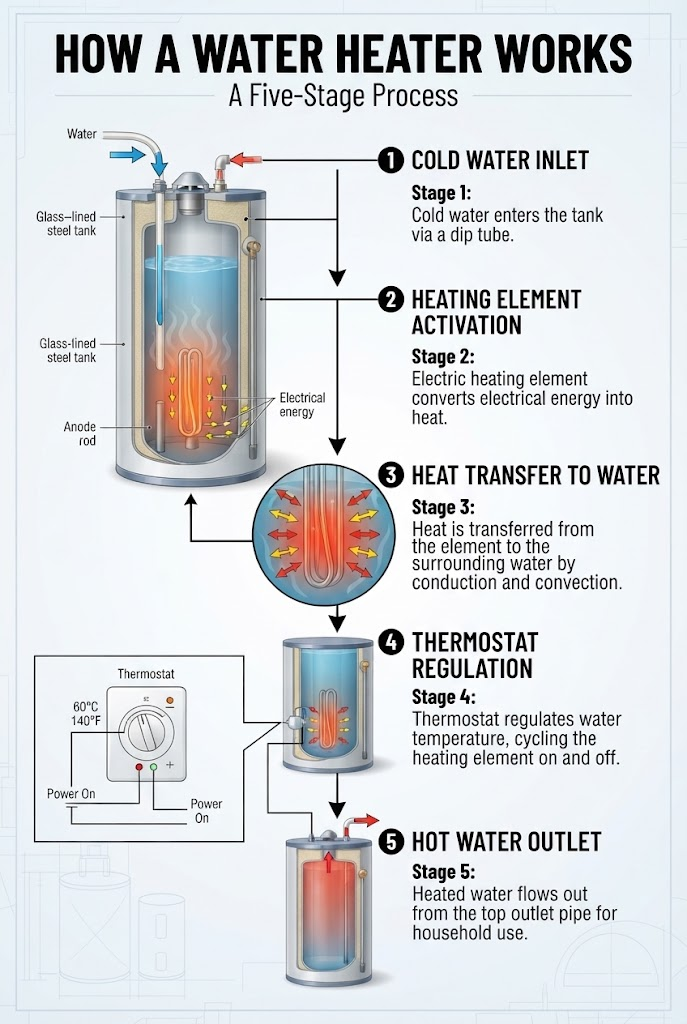
Step 1: Cold Water Enters the Tank
Cold water enters the storage tank through an inlet pipe. The tank holds the water until it is needed.
Many storage water heaters use insulation around the tank to reduce heat loss to the surrounding environment.
Step 2: The Heating Element Produces Heat
An electric water heater contains one or more heating elements. When electricity passes through an element with electrical resistance, electrical energy is converted into thermal energy.
This process is known as resistive heating or Joule heating.
The heating element transfers thermal energy to the surrounding water, increasing its temperature.
Step 3: Heat Transfers Into the Water
The water near the heating element becomes warmer. In many tank systems, this warmer water becomes less dense and rises, while cooler, denser water tends to move downward.
This movement creates natural convection, helping distribute heat throughout the tank.
The exact temperature distribution depends on the tank design, heating element placement, and water movement.
Step 4: A Thermostat Controls the Temperature
A thermostat monitors the water temperature and helps regulate the heating process.
When the water temperature falls below the control setting, the system may activate the heating element. When the desired temperature is reached, the thermostat switches the element off.
This control process helps maintain the selected temperature and prevents unnecessary heating during normal operation.
Step 5: Hot Water Flows to the Outlet
When someone opens a hot-water tap, heated water flows from the tank through the outlet pipe.
In many storage systems, incoming cold water replaces the hot water being used. The heating system then works to bring the water back toward the selected temperature.
This cycle repeats whenever hot water is consumed.
The Physics Behind Water Heater Technology
Several fundamental physics concepts explain how water heaters operate.
1. Electrical Energy and Joule Heating
Electric water heaters use electrical resistance to generate heat.
The electrical power converted into heat can be expressed as:
P = VI
Where:
- P = electrical power in watts
- V = voltage in volts
- I = electric current in amperes
For a resistive heating element, the power can also be expressed as:
Where:
- I = electric current
- R = electrical resistance
These equations show how electrical energy is converted into thermal energy inside the heating element.
2. Heat Energy and Specific Heat Capacity
The amount of energy required to raise the temperature of water can be estimated using:
Q = mcΔT
Where:
- Q = heat energy transferred, measured in joules
- m = mass of water in kilograms
- c = specific heat capacity of water
- ΔT = temperature increase in degrees Celsius or kelvin
Water has a relatively high specific heat capacity. This means a substantial amount of energy is required to raise its temperature.
For example, heating 50 liters of water from 20°C to 60°C requires approximately:
Q = 50 × 4,186 × 40
Q = 8,372,000 joules
That is approximately 8.37 megajoules, or 2.33 kilowatt-hours of thermal energy, assuming 50 liters of water has a mass of approximately 50 kilograms.
The actual electricity consumed may be higher because of heat losses and system efficiency.
3. Heat Transfer
Water heaters rely on three main heat-transfer mechanisms.
Conduction: Heat moves through solid materials, such as a metal heating element or tank wall.
Convection: Heat is transferred through the movement of fluids, such as water circulating inside a storage tank.
Radiation: Thermal energy can be transferred through electromagnetic waves. Radiation is generally less important than conduction and convection in the direct heating of water inside a typical electric storage tank, although it can contribute to heat transfer in some system components.
Understanding these mechanisms helps engineers design more effective heating systems.
4. Thermodynamics and Energy Efficiency
Thermodynamics explains how energy changes form and moves between systems.
In a water heater, the goal is to transfer energy into water while minimizing unwanted heat loss.
Some energy may escape through the tank walls, pipes, or other components. Insulation reduces heat transfer between the hot water and the cooler surroundings.
Different water-heating technologies also have different efficiency characteristics. For example, a heat pump transfers heat from the environment instead of relying entirely on electrical resistance to generate heat.
This distinction is important when comparing energy consumption and operating costs.
7 Amazing Facts About Physics Based Technology Water Heater Systems
Fact 1: Water Requires Significant Energy to Heat
Water has a high specific heat capacity, approximately 4,186 joules per kilogram per degree Celsius under ordinary conditions.
This property makes water useful for storing thermal energy, but it also means that heating a large quantity of water requires substantial energy.
For households that use hot water regularly, the amount of water heated and the temperature increase can significantly affect energy consumption.
Fact 2: Electric Heating Elements Use Electrical Resistance
An electric heating element converts electrical energy into heat through resistance.
As electric current flows through the element, electrical energy is dissipated as thermal energy. The hot element then transfers heat to the surrounding water.
This principle is also used in electric kettles, toasters, and other resistive heating appliances.
Fact 3: Hot Water Can Rise Naturally Inside a Tank
When water is heated, it generally expands and becomes less dense.
As a result, warmer water tends to rise above cooler water. This process is called natural convection.
It helps explain why temperature differences can develop between different regions of a storage tank.
Fact 4: Insulation Helps Reduce Energy Waste
A water heater may lose heat even when nobody is using hot water.
Insulation slows heat transfer between the warm tank and the cooler surrounding air.
Reducing this heat loss can decrease the amount of energy required to maintain the stored water temperature.
The effectiveness of insulation depends on its material, thickness, installation, and the overall design of the appliance.
Fact 5: Heat Pump Water Heaters Move Heat Instead of Generating It Entirely
A heat pump water heater uses a refrigeration cycle to extract heat from the surrounding air and transfer it to water.
Its main components typically include an evaporator, compressor, condenser, and expansion device.
The refrigerant absorbs heat at the evaporator, is compressed to raise its pressure and temperature, releases heat through the condenser, and then passes through an expansion device before repeating the cycle.
Because a heat pump moves heat rather than generating all of it through electrical resistance, it can deliver more thermal energy than the electrical energy it consumes under suitable operating conditions.
Its performance depends on factors such as surrounding air temperature, installation conditions, and hot-water demand.
Fact 6: Thermostats Help Control Energy Consumption
A thermostat monitors temperature and regulates when the heating system operates.
Without effective temperature control, a heating system could continue operating longer than necessary or fail to maintain the desired temperature.
Correctly configured controls help balance hot-water availability, comfort, and energy use.
However, temperature settings should also account for scalding risks and the manufacturer’s safety instructions.
Fact 7: Tankless Water Heaters Heat Water on Demand
Unlike storage systems, tankless water heaters generally heat water as it passes through the appliance.
When hot water is requested, the unit activates its heating system and transfers energy to the flowing water.
This design avoids the need to continuously maintain a large tank of hot water. However, tankless systems still consume energy while heating water, and their performance depends on the incoming water temperature, flow rate, and available heating capacity.
They are not automatically the most efficient choice for every household.
Types of Water Heaters and How They Differ
Different water heater designs use different physical mechanisms.
| Water Heater Type | Main Energy Source | Working Principle | Key Feature |
|---|---|---|---|
| Electric storage | Electricity | Electrical resistance | Stores hot water in a tank |
| Gas storage | Natural gas or other suitable fuel | Combustion transfers heat to water | Uses fuel for heating |
| Tankless | Electricity or gas | Heats water as it flows | No large storage tank |
| Heat pump | Electricity and environmental heat | Transfers heat using a refrigeration cycle | Can use less electricity than resistance heating |
| Solar water heater | Solar energy, sometimes with backup heating | Collects solar thermal energy | Uses sunlight as a heat source |
The best option depends on household size, local climate, energy prices, installation costs, available space, and hot-water requirements.
How to Improve Water Heater Energy Efficiency
Understanding the physics based technology water heater system can help you make better decisions about energy use.
Here are several practical considerations.
1. Choose an Appropriate Temperature Setting
A higher temperature setting generally requires more energy to heat water and can increase scalding risks.
Follow the manufacturer’s guidance and relevant public-health recommendations. Where appropriate, consider professional advice about balancing safe water storage with safe delivery temperatures.
2. Reduce Unnecessary Heat Loss
Insulation can help reduce heat loss from suitable storage tanks and hot-water pipes.
Before adding insulation, check the manufacturer’s instructions and applicable electrical, plumbing, and fire-safety requirements.
3. Maintain the System
Follow the manufacturer’s maintenance schedule.
Depending on the model and local water conditions, maintenance may include checking controls, inspecting connections, and having the appliance serviced by a qualified professional.
Do not open or repair electrical or gas components unless you are appropriately qualified.
4. Avoid Unnecessary Hot-Water Use
Using only the hot water you need can reduce the amount of water that must be heated.
Fixing leaking hot-water taps and selecting water-efficient fixtures may also help reduce hot-water demand.
5. Compare the Right Efficiency Measurements
Different technologies may use different efficiency ratings.
When comparing products, check the applicable energy label, estimated annual energy consumption, capacity, recovery rate, and operating conditions.
Purchase price alone does not show how much a water heater will cost to operate over its lifetime.
Common Water Heater Problems Explained by Physics
Some common problems can be understood through basic scientific principles.
Water takes too long to heat: The heating capacity may be insufficient for the amount of water being heated, or the appliance may have a technical issue.
Hot water runs out quickly: The tank may be too small for demand, the incoming water may be particularly cold, or the heating system may not be recovering quickly enough.
The tank loses heat while idle: Heat naturally transfers from a warmer object to a cooler environment. Poor insulation or other design factors can increase this loss.
Water temperature fluctuates: Changes in demand, flow rate, control behavior, or equipment condition may affect the delivered temperature.
These symptoms can have multiple causes. Gas and electrical water heaters should be inspected by qualified professionals when faults are suspected.
The Future of Water Heater Technology
Water heating technology continues to evolve as manufacturers improve energy efficiency, control systems, and integration with renewable energy.
Several developments are especially important.
Smart controls: Connected systems can monitor usage patterns and adjust operation according to user settings and available features.
Heat pump technology: Improvements in heat pumps may provide more efficient water heating across a wider range of operating conditions.
Solar thermal integration: Solar collectors can provide part of the energy needed to heat water, with another source used when solar energy is insufficient.
Thermal energy storage: Hot water itself can store thermal energy, potentially allowing systems to heat water when energy is more readily available.
Improved insulation: Better materials and tank designs can help reduce standby heat loss.
These technologies demonstrate how physics and engineering continue to improve everyday appliances.
Frequently Asked Questions
1. What is the working principle of a water heater?
A water heater transfers energy into water to increase its temperature. Depending on the model, it may use electrical resistance, fuel combustion, heat-pump technology, or solar thermal energy.
2. Which physics principle is used in an electric water heater?
An electric resistance water heater primarily uses Joule heating to convert electrical energy into thermal energy. Conduction and convection then help transfer the heat to the water.
3. How much energy does it take to heat water?
The required thermal energy depends on the mass of water, its initial temperature, and its final temperature. The formula is Q = mcΔT.
Actual energy consumption also depends on system efficiency and heat loss.
4. Why is insulation important in a water heater?
Insulation reduces heat transfer between the hot water tank and its surroundings. This helps maintain water temperature and can reduce the energy needed to replace lost heat.
5. Is a heat pump water heater different from an electric water heater?
Yes. A conventional electric resistance water heater generates heat directly using electrical resistance. A heat pump water heater uses electricity to move heat from the surrounding environment into the water.
6. What is the difference between tank and tankless water heaters?
A storage water heater keeps a quantity of hot water in a tank. A tankless system heats water as it flows through the unit, subject to its heating capacity and flow-rate limits.
7. How can I reduce water heating costs?
You can reduce hot-water demand, maintain your appliance according to its instructions, minimize unnecessary heat loss, and compare suitable energy-efficient models before purchasing a replacement.
Final Thoughts
The physics based technology water heater is an excellent example of scientific principles working together in everyday life.
Electrical resistance, heat transfer, thermodynamics, convection, and temperature control all contribute to the process of heating water. Different designs apply these principles in different ways, from simple electric storage heaters to modern heat pump systems.
By understanding how water heaters work, homeowners and students can better appreciate the science behind household appliances and make more informed decisions about energy use.
As technology advances, more efficient heating systems and smarter controls may help reduce energy consumption while maintaining convenient access to hot water.
Want to learn more about the physics behind everyday technology? Visit MindHiveNest for more educational articles about scientific concepts, electronic devices, and modern engineering.