
Introduction
Have you ever wondered how a washing machine removes dirt, stains, and odors from clothes with very little manual effort? This everyday household appliance combines physics, mechanical engineering, electricity, and fluid dynamics to make laundry faster and more convenient.
Modern washing machines do much more than spin clothes in water. They use electric motors, rotating drums, carefully controlled water flow, detergent, and programmed washing cycles to clean different types of fabric.
The physics based technology washing machine concept helps explain how these scientific principles work together. From the rotational motion of the drum to the centrifugal action used during spinning, physics plays an essential role in the washing process.
Understanding washing machine technology can also help you choose a suitable appliance, use it more efficiently, and understand why different washing programs produce different results.
In this article, we will explore how washing machines work, the physics behind their major components, seven amazing facts about washing machine technology, and practical ways to improve washing efficiency.
What Is a Physics-Based Technology Washing Machine?
A washing machine is an electrical or mechanically powered appliance designed to clean clothes by combining water, detergent, movement, and controlled washing cycles.
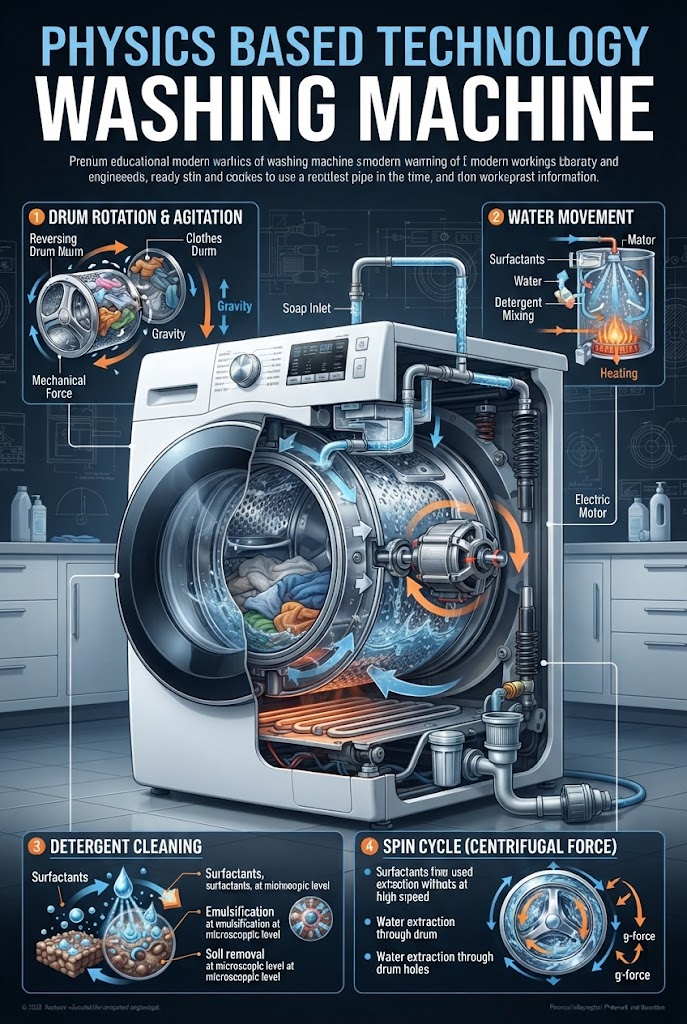
The physics based technology washing machine concept describes how scientific principles are applied to remove dirt from fabric and extract excess water after washing.
Although washing machines come in different designs, most modern models use several important components:
- Electric motor: Provides the mechanical power required to move the drum or agitator.
- Drum or washing tub: Holds the clothes and water during different stages of the cycle.
- Water inlet valve: Controls the entry of water into the machine.
- Pump: Moves water into or out of the machine, depending on the system design.
- Control system: Manages the washing program, timing, water level, and other operating functions.
- Detergent dispenser: Releases detergent into the washing process.
- Spin system: Rotates clothes to remove excess water.
The exact components depend on whether the machine is a front-loading, top-loading, or other specialized model.
How Does a Washing Machine Work?
A typical automatic washing machine follows a sequence of operations to clean clothes.
Step 1: Water Enters the Machine
When a washing program begins, the control system activates the water inlet valve.
Water flows into the washing tub until the required level is reached. Some machines use sensors to monitor water level, while others rely on different control mechanisms.
The amount of water used depends on the machine design, load size, fabric type, and selected program.
Step 2: Detergent Mixes With Water
Detergent helps remove dirt, grease, and other unwanted substances from fabric.
Its cleaning agents, known as surfactants, help water interact with oily contaminants and fabric surfaces. This allows dirt to loosen and become suspended in the wash water.
Water temperature can also affect detergent performance and the removal of certain stains.
However, using more detergent than necessary does not automatically produce cleaner clothes. Excess detergent may leave residue or require additional rinsing.
Step 3: The Drum Moves the Clothes
The motor drives the drum or another washing mechanism.
Depending on the design, the clothes may tumble, rotate, or move back and forth through the water and detergent solution.
This movement helps the wash liquid reach different parts of the fabric and assists in loosening dirt.
The process involves mechanical action, friction, fluid movement, and the interaction between water, detergent, and textile fibers.
Step 4: Dirty Water Drains Away
After the main washing stage, the machine drains the used water.
A drain pump or another drainage mechanism moves water away from the washing tub.
Depending on the selected program, the machine may then refill with clean water for one or more rinse cycles.
Rinsing helps remove remaining detergent and suspended dirt from the clothes.
Step 5: The Machine Spins the Clothes
During the spin cycle, the drum rotates rapidly.
The rotation produces an outward radial acceleration relative to the rotating drum. Water moves through the perforations in the drum and is collected outside it before being drained away.
This process reduces the amount of water remaining in the clothes.
The spin speed depends on the machine model, selected program, fabric type, and load balance.
Step 6: Sensors and Controls Manage the Cycle
Modern washing machines use electronic control systems to manage different stages of operation.
Depending on the model, sensors may monitor water level, drum movement, temperature, or load imbalance.
The control system uses this information to regulate the washing process.
These features can help improve performance, reduce unnecessary water use, and protect the appliance.
The Physics Behind Washing Machine Technology
Several important physics principles explain how washing machines operate.
1. Rotational Motion
The drum of a washing machine rotates around an axis.
Rotational motion is important during both washing and spinning. During washing, drum movement helps clothes interact with water and detergent. During spinning, rapid rotation helps separate water from fabric.
The relationship between linear speed and angular speed is:
v = rω
Where:
- v = tangential speed in meters per second
- r = distance from the axis of rotation in meters
- ω = angular speed in radians per second
This equation shows that the tangential speed of a point on the drum increases with its distance from the axis when angular speed remains constant.
2. Centripetal Acceleration During Spinning
A rotating object experiences acceleration directed toward the center of its circular path. This is called centripetal acceleration.
Its magnitude is:
a = ω²r
Where:
- a = centripetal acceleration in meters per second squared
- ω = angular speed in radians per second
- r = distance from the axis of rotation in meters
As the drum spins faster, the acceleration increases with the square of angular speed.
This helps explain why a high-speed spin cycle can remove substantial amounts of water from clothes.
Although people commonly call this effect centrifugal force, the more precise explanation depends on the reference frame being used. In the rotating frame, an apparent outward centrifugal force is used to describe the motion.
3. Electricity and Electromagnetism
The electric motor converts electrical energy into mechanical motion.
Many washing machines use electric motors that rely on electromagnetic interactions to produce rotation.
The motor drives the drum directly or through a transmission system, depending on the design.
Motor efficiency affects how much electrical energy is converted into useful mechanical output and how much is lost as heat.
Modern machines may use variable-speed motor control to adjust drum movement during different stages of the wash cycle.
4. Fluid Dynamics and Water Movement
Fluid dynamics is the study of how liquids and gases move.
Washing machines rely on water movement during filling, washing, rinsing, and draining.
Water flows through hoses and valves, interacts with the clothes, and moves through the drainage system.
The design of the drum, internal paddles, and water circulation system influences how water reaches the laundry.
Effective water movement helps distribute detergent and carry loosened dirt away from fabric.
5. Friction and Mechanical Action
During washing, clothes rub against one another and interact with the drum or agitator.
This mechanical action helps loosen dirt from textile fibers.
However, excessive friction can damage delicate fabrics, create wear, or cause pilling.
That is why washing machines offer different programs for cotton, synthetics, wool, and delicate garments.
Each program may adjust drum movement, spin speed, temperature, and cycle duration to suit the fabric and cleaning requirements.
7 Amazing Facts About Physics-Based Technology Washing Machine Systems
Fact 1: Washing Machines Use Mechanical Energy to Clean Clothes
Detergent alone does not explain how a washing machine cleans effectively.
Mechanical movement helps the detergent solution reach the fabric and assists in loosening dirt.
The motor supplies mechanical energy, which is transferred through the drum or agitator into the laundry and water.
The combination of chemical action and mechanical movement makes machine washing effective.
Fact 2: Faster Spinning Can Remove More Water
During a spin cycle, the rotating drum helps water separate from the clothes and pass through the drum’s perforations.
Increasing the spin speed generally increases the radial acceleration experienced by water moving with the rotating load.
However, a higher spin speed is not always appropriate for every fabric.
Delicate materials may require lower spin speeds to reduce the risk of damage.
Fact 3: Modern Motors Can Adjust Their Speed
Some modern washing machines use electronically controlled motors that can adjust speed and torque according to the selected program.
This allows the machine to use different movement patterns during washing, rinsing, and spinning.
Depending on the design, variable-speed control may also help improve energy efficiency and reduce mechanical stress.
Fact 4: Detergent Uses Chemistry as Well as Physics
Detergent contains substances that help water interact with oily dirt and other contaminants.
Surfactants can reduce surface tension and help loosen contaminants from fabric.
The machine’s mechanical movement then assists in separating the dirt from the clothes and dispersing it into the wash water.
This shows how chemistry and physics work together in household technology.
Fact 5: Washing Machines Depend on Water Flow
Water must enter the machine, circulate through the laundry, and drain away effectively.
Poor water flow can affect the washing process, while drainage problems may prevent the machine from completing a cycle correctly.
The inlet valves, hoses, pumps, and drum design all contribute to water management.
Fact 6: Load Balance Is Important During Spinning
Clothes can gather unevenly inside a drum.
When an uneven load rotates at high speed, it can produce vibrations and forces on the machine’s structure.
Many modern washing machines attempt to detect or correct load imbalance before continuing with a high-speed spin.
The machine may redistribute the clothes, adjust the spin speed, or stop the spin cycle if the imbalance cannot be corrected.
Fact 7: Efficient Washing Depends on More Than Electricity Use
A washing machine’s overall environmental impact depends on several factors.
These include electricity consumption, water use, detergent choice, washing temperature, cycle duration, and the lifespan of the appliance.
Cold-water washing can reduce the energy needed to heat water when it is suitable for the laundry and detergent being used.
Choosing the correct load size and washing program can also help avoid unnecessary resource consumption.
Types of Washing Machines and Their Differences
Different washing machine designs use different approaches to move clothes and water.
| Washing Machine Type | Main Mechanism | Key Feature |
|---|---|---|
| Front-loading | Horizontal-axis drum rotation | Clothes tumble as the drum rotates |
| Top-loading with agitator | Central agitator movement | Mechanical action moves clothes through water |
| Top-loading with impeller | Low-profile rotating mechanism | Uses drum or impeller movement to circulate laundry |
| High-efficiency washer | Optimized washing motion and water management | Designed to reduce resource use in suitable conditions |
| Smart washing machine | Electronic control and connected features | May support remote monitoring and customized programs |
No single design is best for every household. Capacity, installation space, water availability, energy efficiency, fabric requirements, and purchase cost all matter.
How to Improve Washing Machine Energy Efficiency
Understanding the physics based technology washing machine system can help you use your appliance more efficiently.
1. Wash Suitable Full Loads
Running a suitable full load can reduce the number of cycles needed.
However, avoid overloading the machine. An overloaded drum may prevent clothes from moving properly and can reduce washing performance.
Always follow the manufacturer’s load recommendations.
2. Choose the Appropriate Water Temperature
Heating water can account for a significant portion of the energy used in some washing cycles.
When appropriate for the fabric, detergent, and type of dirt, cold-water washing can reduce the energy required for heating.
Some items may require warmer water for hygiene or stain-removal reasons, so follow garment-care instructions.
3. Use the Correct Amount of Detergent
Excess detergent can create residue and may require additional rinsing.
Follow the detergent instructions and adjust the amount according to load size, soil level, and water conditions.
4. Use a Suitable Spin Speed
A suitable spin speed can remove more water before clothes are transferred to a dryer or hung to dry.
However, the highest available speed may not be suitable for every fabric.
Follow the care label and the washing machine’s program recommendations.
5. Maintain the Machine
Clean the detergent dispenser, filters, and other user-serviceable parts according to the manufacturer’s instructions.
Check hoses for visible damage and keep the machine level to help reduce vibration.
For electrical or mechanical faults, use a qualified technician rather than attempting unsafe repairs.
6. Compare Energy Labels
When purchasing a new washing machine, check its energy rating and estimated electricity and water consumption.
Also consider capacity, cycle options, noise, repairability, and the expected lifespan of the appliance.
A machine’s purchase price alone does not show its total lifetime cost.
Common Washing Machine Problems Explained by Physics
Some common washing machine problems can be understood through basic scientific principles.
Why Does a Washing Machine Vibrate During Spinning?
An unevenly distributed load can create an imbalance as the drum rotates.
This imbalance produces changing forces that can cause vibration. Level installation and proper load distribution can help reduce the problem.
Why Do Clothes Remain Wet After a Wash?
Clothes may remain wetter than expected if the spin cycle does not operate correctly, the load is unbalanced, or drainage is restricted.
The result also depends on the selected spin speed and the fabric’s ability to retain water.
Why Does a Washing Machine Use Different Drum Speeds?
Different washing stages require different types of movement.
Gentle movement may help protect delicate fabrics, while other programs use more vigorous motion or faster spinning.
The control system adjusts the operating pattern according to the selected program.
Why Is Water Not Draining Properly?
Drainage problems can occur because of a blocked filter, a restricted hose, or a malfunctioning pump.
Follow the manufacturer’s troubleshooting instructions. Disconnect the appliance from power before carrying out any permitted user-level maintenance, and never open electrical components unless qualified to do so.
The Future of Washing Machine Technology
Washing machines continue to evolve as manufacturers improve motor control, sensors, water management, and cleaning performance.
Smart Sensors
Some machines use sensors to estimate load size, monitor water levels, or detect imbalance.
These features can help adjust the washing cycle to the conditions inside the machine.
Artificial Intelligence and Adaptive Programs
Some newer models offer adaptive programs that use sensor information or learned usage patterns to adjust certain washing parameters.
The capabilities vary by model, and the term “AI washing machine” does not mean every appliance uses the same technology.
Improved Motor Efficiency
Advanced motor designs and electronic controls can help improve energy use, reduce noise, and support more precise drum movement.
Water-Saving Technology
Manufacturers continue to develop systems that optimize water levels, circulation, and rinsing.
Efficient water use must still be balanced with adequate cleaning and rinsing performance.
Connected Appliances
Wi-Fi-connected washing machines may allow users to monitor cycles, receive notifications, or manage certain settings through an application.
These features add convenience but are not essential to the basic washing process.
The underlying principles of mechanical motion, fluid dynamics, electromagnetism, and energy conversion will continue to shape washing machine design.
Frequently Asked Questions
1. What is the working principle of a washing machine?
A washing machine combines mechanical movement, water, detergent, and controlled washing cycles to remove dirt from clothes. During spinning, drum rotation helps remove excess water.
2. Which physics principles are used in a washing machine?
Washing machines use rotational motion, electromagnetism, fluid dynamics, friction, and energy conversion. Centripetal acceleration is particularly relevant to the physics of the spin cycle.
3. How does a washing machine remove water from clothes?
During spinning, the drum rotates rapidly. Water passes through the perforations in the drum and is collected and drained away, reducing the moisture remaining in the laundry.
4. Why does a washing machine need an electric motor?
The motor supplies the mechanical energy required to rotate the drum or operate the washing mechanism.
5. Does a higher spin speed always mean better washing?
No. Spin speed mainly affects water extraction, not every aspect of cleaning performance. The appropriate speed depends on the fabric, washing program, and machine design.
6. How can I reduce my washing machine’s energy consumption?
Use suitable load sizes, choose efficient washing programs, use cold water when appropriate, avoid unnecessary extra cycles, and maintain the machine according to the manufacturer’s instructions.
7. What is the difference between a front-loading and top-loading washing machine?
Front-loading machines generally use a horizontal-axis drum, while top-loading models may use an agitator, impeller, or another mechanism. Their water use, washing motion, capacity, and performance vary by model.
Final Thoughts
The physics based technology washing machine is an excellent example of scientific principles being used to solve an everyday problem.
Electric motors convert electrical energy into mechanical motion. Rotating drums help clothes interact with water and detergent, while centrifugal effects during spinning assist in removing excess water. Sensors and control systems coordinate the different stages of the washing cycle.
Modern washing machines also demonstrate how physics, chemistry, electronics, and engineering work together to improve convenience and efficiency.
By understanding how these appliances operate, students can connect classroom physics concepts with real-world technology, while consumers can make more informed choices about washing programs, energy use, and appliance maintenance.
Want to explore more science and technology explained in simple language? Visit MindHiveNest for more educational articles about physics, electronic devices, household appliances, and modern engineering.