Introduction
A solar eclipse is one of the most fascinating events in nature. Millions of people around the world watch solar eclipses because they are rare, beautiful, and scientifically important. But have you ever wondered how a solar eclipse actually happens?
In this article, we will explain the science behind solar eclipses in a simple and easy-to-understand way.
What Is a Solar Eclipse?
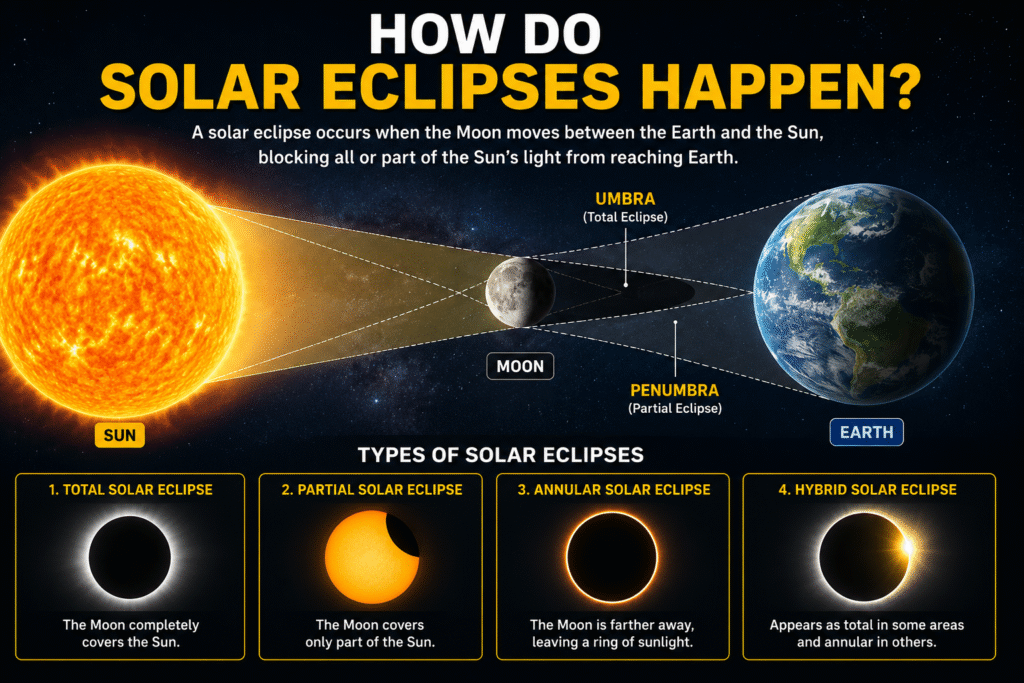
A solar eclipse occurs when the Moon moves between the Earth and the Sun, blocking all or part of the Sun’s light from reaching Earth.
Normally, sunlight reaches our planet without obstruction. However, during a solar eclipse, the Moon casts a shadow on Earth, causing the Sun to appear partially or completely covered.
Why Doesn’t a Solar Eclipse Happen Every Month?
Many people assume that a solar eclipse should occur every month because the Moon orbits Earth regularly. However, this is not the case.
The Moon’s orbit is slightly tilted compared to Earth’s orbit around the Sun. Because of this tilt, the Moon usually passes above or below the Sun from our point of view.
A solar eclipse only occurs when the Sun, Moon, and Earth align perfectly.
The Science Behind Solar Eclipses
The process is actually quite simple:
- The Sun provides light.
- The Moon moves between the Sun and Earth.
- The Moon blocks the Sun’s light.
- The Moon’s shadow falls on Earth.
People standing inside the shadow can witness a solar eclipse.
This alignment is called syzygy, a term used in astronomy when three celestial bodies line up in a straight line.
Types of Solar Eclipses
Total Solar Eclipse
A total solar eclipse occurs when the Moon completely covers the Sun.
During this event, the sky becomes dark for a few minutes, and the Sun’s outer atmosphere, known as the corona, becomes visible.
Partial Solar Eclipse
In a partial solar eclipse, only part of the Sun is covered by the Moon.
Observers see the Sun appear as if a piece has been taken out of it.
Annular Solar Eclipse
An annular eclipse occurs when the Moon is farther away from Earth and appears slightly smaller than the Sun.
As a result, a bright ring of sunlight remains visible around the Moon. This is often called the “Ring of Fire.”
Hybrid Solar Eclipse
A hybrid eclipse is a rare event that appears as a total eclipse in some locations and an annular eclipse in others.
How Long Does a Solar Eclipse Last?
A total solar eclipse usually lasts only a few minutes at a specific location.
The entire eclipse event, including the partial phases, may last several hours from beginning to end.
The exact duration depends on the positions and movements of the Earth and Moon.
Is It Safe to Look at a Solar Eclipse?
Looking directly at the Sun without proper eye protection can permanently damage your eyesight.
Experts recommend using certified solar viewing glasses or special solar filters.
Regular sunglasses are not safe for viewing a solar eclipse.
Why Are Solar Eclipses Important?
Solar eclipses help scientists study the Sun’s corona and understand solar activity.
They also provide valuable opportunities for astronomical research and public science education.
Throughout history, solar eclipses have helped scientists make important discoveries about our solar system.
Interesting Facts About Solar Eclipses
- A total solar eclipse can only be seen from a narrow path on Earth.
- The Moon is about 400 times smaller than the Sun but also about 400 times closer to Earth.
- This unique size-distance relationship makes total solar eclipses possible.
- Total solar eclipses occur somewhere on Earth approximately every 18 months.
- Ancient civilizations often viewed eclipses as mysterious or supernatural event
A solar eclipse is a remarkable astronomical event that occurs when the Moon passes between the Earth and the Sun. Although the process is based on simple alignment, the sight of the Sun being covered by the Moon remains one of nature’s most spectacular displays.
Understanding how solar eclipses happen helps us appreciate the incredible movements of celestial bodies and the beauty of our universe.