Introduction
Why is the sky blue? This is one of the most common science questions people ask. The answer lies in the way sunlight interacts with Earth’s atmosphere and how different wavelengths of light scatter through the air.
What Is Sunlight Made Of?
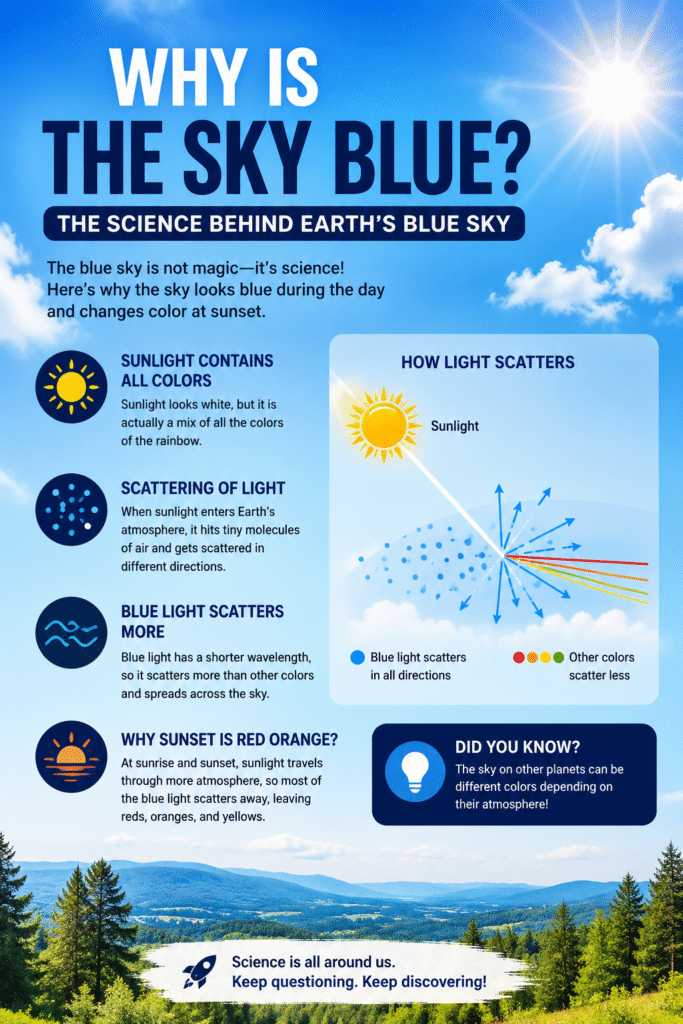
Sunlight may appear white to our eyes, but it actually contains all the colors of the rainbow. These colors include red, orange, yellow, green, blue, indigo, and violet. Each color has a different wavelength, which affects how it travels through the atmosphere.
When sunlight enters Earth’s atmosphere, it encounters gases, dust particles, and tiny molecules. These particles influence the path of light and cause a phenomenon known as scattering.
Understanding Light Scattering
Scattering occurs when light is redirected in different directions after hitting particles in the atmosphere. Different colors of light scatter by different amounts.
Blue and violet light have shorter wavelengths compared to red and yellow light. Shorter wavelengths scatter much more easily when they interact with atmospheric molecules. As a result, blue light is scattered across the sky in all directions.
Although violet light scatters even more than blue light, human eyes are more sensitive to blue, and some violet light is absorbed in the upper atmosphere. This is why the sky appears blue instead of violet.
Why Does the Sky Change Color at Sunset?
During sunrise and sunset, sunlight must travel through a greater portion of the atmosphere before reaching your eyes. Along this longer path, most of the blue light is scattered away.
The remaining light reaching the observer contains more red, orange, and yellow wavelengths. This creates the beautiful warm colors often seen during sunrise and sunset.
Does the Sky Look Blue on Other Planets?
The color of a planet’s sky depends on its atmosphere. Different gases and atmospheric conditions can create different sky colors.
For example, Mars often appears reddish because of dust particles suspended in its atmosphere. This demonstrates how atmospheric composition influences the appearance of the sky.
Final Thoughts
The sky appears blue because molecules in Earth’s atmosphere scatter blue wavelengths of sunlight more effectively than other colors. This process, known as Rayleigh scattering, spreads blue light across the sky and creates the familiar blue color we see every day. Understanding this simple phenomenon helps us appreciate the remarkable science behind our natural world.