
Introduction
Have you ever wondered how a missile can travel through the atmosphere at extremely high speeds while maintaining a controlled flight path? The answer lies in the combination of physics, aerospace engineering, propulsion, aerodynamics, and advanced electronic systems.
Physics based technology missile systems demonstrate how scientific principles can be applied to complex aerospace technology. A missile is generally a self-propelled guided vehicle designed to carry a payload along a controlled flight path. Different missile systems use different propulsion methods, flight characteristics, and guidance technologies.
The science behind missiles involves several important branches of physics, including Newton’s laws of motion, fluid dynamics, thermodynamics, electromagnetic technology, and control theory.
In this article, we will explore the basic physics behind missile technology, how propulsion and aerodynamics influence flight, and seven amazing facts about this complex aerospace technology.
What Is a Missile?
A missile is a self-propelled vehicle that uses a propulsion system to travel through the air or another environment. Guided missiles also use guidance and control systems to maintain or adjust their flight path.
Missiles are different from ordinary unguided rockets because guided systems can use electronic sensors and control technologies to influence their movement.
Missile technology combines several engineering disciplines:
- Aerospace engineering
- Physics and mechanics
- Propulsion technology
- Aerodynamics
- Electronic systems
- Guidance and control theory
- Materials science
These technologies work together to help a missile remain structurally stable and perform its intended flight function.
How Does Missile Technology Work?
Missile technology involves multiple interconnected systems. Their functions can be understood through basic aerospace engineering concepts.
1. Propulsion System
The propulsion system provides the force required for movement.
Rocket-based propulsion works according to Newton’s Third Law of Motion. It produces thrust by accelerating exhaust gases in one direction, creating an opposite reaction force.
Different aerospace vehicles use different propulsion technologies depending on their intended purpose.
2. Aerodynamic Structure
When a missile travels through the atmosphere, air interacts with its outer surface.
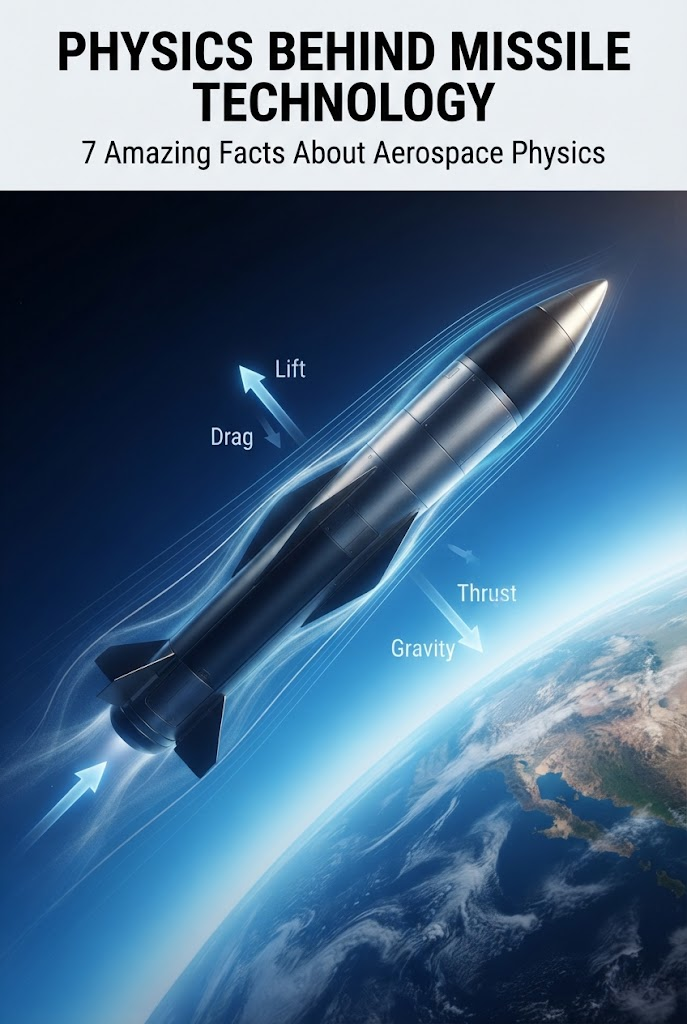
This interaction produces aerodynamic forces, including lift, drag, and changes in pressure.
The external shape and structural stability influence how an aerospace vehicle behaves during flight.
3. Guidance and Control Technology
Some missile systems use electronic guidance and control technologies.
At a general level, these systems involve sensors, onboard computing, navigation information, and control components.
Guidance concerns determining the intended flight path, while control concerns maintaining the vehicle’s orientation and responding to changes in its movement.
4. Structural System
A missile must maintain its structural integrity under demanding physical conditions.
Its structure may experience vibration, acceleration, pressure changes, and temperature variations.
Materials science helps engineers understand how materials respond to these environmental conditions.
The Physics Behind Missile Technology
Several important physical principles explain the general behaviour of missile systems.
1. Newton’s Laws of Motion
Newton’s laws are fundamental to understanding the movement of aerospace vehicles.
Newton’s First Law: An object remains at rest or continues moving uniformly unless acted upon by an external force.
Newton’s Second Law: The acceleration of an object depends on the net force acting on it and its mass.
The mathematical expression is:
F = ma
Where:
- F = Net force
- m = Mass
- a = Acceleration
Newton’s Third Law: For every action, there is an equal and opposite reaction.
This principle explains the basic physical foundation of rocket propulsion.
2. Aerodynamics
Aerodynamics is the study of how air moves around objects.
When an aerospace vehicle moves through the atmosphere, it experiences several aerodynamic forces.
The main forces include:
- Lift
- Drag
- Weight
- Thrust
These forces influence the vehicle’s motion and stability.
Aerodynamics becomes particularly important when an object travels at high speeds because air resistance, pressure changes, and heating can become significant.
3. Thermodynamics
Thermodynamics studies heat, temperature, and energy transformation.
High-speed aerospace vehicles may experience considerable aerodynamic heating because of their interaction with the surrounding air.
Engineers study thermal behaviour and material properties to understand how structures respond to high-temperature environments.
4. Electromagnetism
Modern aerospace systems use electronic equipment for communication, sensing, navigation, and information processing.
Electromagnetism is the scientific foundation of many technologies used in these systems.
Electronic sensors can collect information about the surrounding environment, while onboard computers process information to support vehicle operation.
5. Control Theory
Control theory studies how systems maintain desired behaviour through feedback and regulation.
It is used in many technologies, including aircraft autopilots, industrial robots, spacecraft, and other automated systems.
7 Amazing Facts About Physics Based Technology Missile
Fact 1: Missile Technology Uses Newton’s Third Law
One of the most important physics principles behind rocket propulsion is Newton’s Third Law.
A propulsion system accelerates exhaust gases in one direction, producing an opposite reaction force.
This scientific principle is also used in spacecraft and space launch vehicles.
Fact 2: Aerodynamics Influences High-Speed Flight
Air is not simply an empty space through which an aerospace vehicle travels.
It produces pressure forces, resistance, and heating.
Understanding aerodynamics is essential for studying the behaviour of high-speed vehicles in the atmosphere.
Fact 3: Guidance and Control Are Different Concepts
Guidance and control are closely connected, but they are not identical.
Guidance concerns the intended path of a vehicle.
Control concerns how a system maintains its orientation and responds to changes in movement.
Both concepts are important in modern aerospace engineering.
Fact 4: Advanced Materials Play an Important Role
Aerospace structures must withstand demanding environmental conditions.
Engineers study metals, alloys, ceramics, and composite materials to understand their strength, weight, thermal properties, and durability.
Material selection is an important part of aerospace engineering.
Fact 5: Electronic Sensors Support Modern Aerospace Technology
Modern aerospace systems depend on electronic sensors and information-processing technologies.
Sensors can collect information about movement, orientation, and environmental conditions.
This information can be processed by onboard electronic systems.
Fact 6: Missile Technology Has Different Flight Categories
Missiles can be classified according to their general flight characteristics.
Some follow ballistic flight paths, while others are designed for sustained atmospheric flight.
These categories demonstrate how different aerospace systems use different physical principles and engineering approaches.
Fact 7: The Physics Is Closely Related to Space Exploration
Missile and space-launch technologies share some fundamental scientific principles.
Both involve propulsion, Newton’s laws, structural engineering, thermodynamics, and flight control.
However, their missions, design requirements, safety standards, and operating environments can be very different.
Different Categories of Missile Technology
Missile systems can be classified in several ways according to their general characteristics.
| Category | General Description |
|---|---|
| Ballistic Missile | Follows a trajectory that includes a largely unpowered ballistic portion |
| Cruise Missile | Designed for sustained atmospheric flight |
| Surface-to-Air Missile | A category of missile designed for use against airborne objects |
| Air-to-Air Missile | A category designed for use between airborne platforms |
| Anti-Ship Missile | Designed for use against naval vessels |
| Anti-Tank Missile | Designed for use against armoured vehicles |
These categories describe different military applications. Their engineering characteristics and operating principles can vary considerably.
Missile Technology vs Space Rocket Technology
Missiles and space rockets share several scientific foundations, but they are designed for different purposes.
| Feature | Missile Technology | Space Rocket Technology |
|---|---|---|
| Main Purpose | Military or specialist applications | Space exploration and transportation |
| Propulsion | Depends on the missile category | Commonly rocket propulsion |
| Guidance | Varies by system | Used for navigation and mission control |
| Flight Environment | Atmospheric or ballistic flight | Atmospheric and space environments |
| Engineering | Aerospace and defence engineering | Aerospace and space engineering |
Both technologies demonstrate how physics and engineering can be combined to solve complex movement and propulsion problems.
Challenges in Modern Missile Technology
Missile technology involves demanding engineering challenges.
1. Extreme Temperature
High-speed flight can expose external structures to significant thermal conditions.
2. Structural Stress
Acceleration, vibration, and aerodynamic forces can place stress on structural materials.
3. Electronic Reliability
Electronic systems must operate under demanding environmental conditions.
4. Navigation and Stability
Maintaining stable flight requires an understanding of motion, sensing, and control theory.
5. Safety and Environmental Concerns
Missile testing, storage, transportation, and military use involve serious safety and environmental considerations.
These challenges show why aerospace engineering requires extensive scientific research, testing, and safety evaluation.
The Future of Aerospace and Missile Technology
Aerospace technology continues to develop through advances in materials science, computing, sensors, automation, and propulsion research.
Artificial intelligence, advanced simulation, improved manufacturing techniques, and more capable electronic systems are influencing the broader aerospace industry.
However, these developments also raise important questions about international security, safety, environmental effects, and responsible technological development.
Understanding the physics behind aerospace systems helps students appreciate the science involved without overlooking their wider consequences.
Frequently Asked Questions (FAQs)
1. What is physics based technology missile?
Physics based technology missile refers to the application of physical principles such as Newton’s laws, aerodynamics, propulsion, thermodynamics, and control theory in missile systems.
2. What physics principle is used in missile propulsion?
Newton’s Third Law of Motion explains the basic principle of rocket propulsion. Accelerating exhaust gases in one direction produces an opposite reaction force.
3. What is the difference between a rocket and a missile?
A rocket is a propulsion-powered vehicle or projectile. A missile is generally a self-propelled guided weapon. Some rockets are unguided, while guided missiles use additional navigation and control technologies.
4. What is missile aerodynamics?
Missile aerodynamics refers to the study of how air interacts with a missile during atmospheric flight, producing forces such as lift and drag.
5. What is the role of guidance technology?
Guidance technology helps determine and maintain an intended flight path using information from sensors, navigation systems, and onboard computing.
6. Why are advanced materials important in missile technology?
Advanced materials help aerospace structures withstand demanding conditions such as vibration, acceleration, pressure, and temperature changes.
7. Is missile technology related to space technology?
Yes. Both fields use scientific principles such as propulsion, Newton’s laws, thermodynamics, materials science, and control systems, although their purposes and requirements are different.
Conclusion
Missile technology is an example of how several branches of physics and engineering work together in a complex aerospace system.
Newton’s laws explain the foundation of propulsion, aerodynamics helps describe atmospheric flight, thermodynamics explains heat-related behaviour, and control theory provides a framework for understanding stability and automated systems.
From advanced materials to electronic sensors, missile technology demonstrates the important role of science in modern aerospace engineering.
By learning about these principles, students can better understand the relationship between physics, engineering, and real-world technology.
Explore more fascinating Science and Physics Based Technology articles on MindHiveNest to discover how science shapes the modern world.