
Introduction
Have you ever wondered how water travels from a deep underground well to the surface, or how a water pump delivers water to the upper floors of a building? The answer lies in the fascinating combination of physics, mechanical engineering, fluid dynamics, and electrical technology.
A physics based technology water pump is a machine that transfers water from one location to another by adding energy to the liquid. It uses mechanical or electrical power to create the pressure difference needed to move water through pipes, tanks, irrigation systems, and other installations.
Water pumps are essential in everyday life. They supply water to homes, support agricultural irrigation, help industries operate machinery, and play an important role in water treatment and distribution systems.
From small household pumps to large industrial pumping stations, these machines demonstrate how fundamental physics principles can solve practical problems.
In this article, we will explore how water pumps work, the physics behind water movement, centrifugal force, pressure, electric motors, and seven amazing facts about modern water pump technology.
What Is a Water Pump?
A water pump is a mechanical device designed to move water by increasing its energy. Depending on its design, it may increase water pressure, create a pressure difference, or use mechanical displacement to transfer liquid.
Most modern household water pumps use electric motors to drive an internal mechanism.
There are several types of water pumps, including:
- Centrifugal pumps
- Submersible pumps
- Jet pumps
- Diaphragm pumps
- Piston pumps
- Solar-powered water pumps
Each type works differently, but all are designed to move water from one place to another.
For example, a household centrifugal pump may draw water from a storage tank and deliver it through pipes to a building’s plumbing system.
The pump converts energy from an external source into energy that allows water to flow.
How Does a Physics Based Technology Water Pump Work?
The working process depends on the pump design. However, most water pumps follow a few basic principles.
1. The Motor Supplies Mechanical Energy
In an electric water pump, electrical energy powers an electric motor.
The motor converts electrical energy into mechanical rotational energy. This rotation drives the pump’s internal components, such as an impeller or another pumping mechanism.
The motor’s design, power rating, and operating speed influence the pump’s performance.
2. The Pump Creates a Pressure Difference
A pump moves water by adding energy to it.
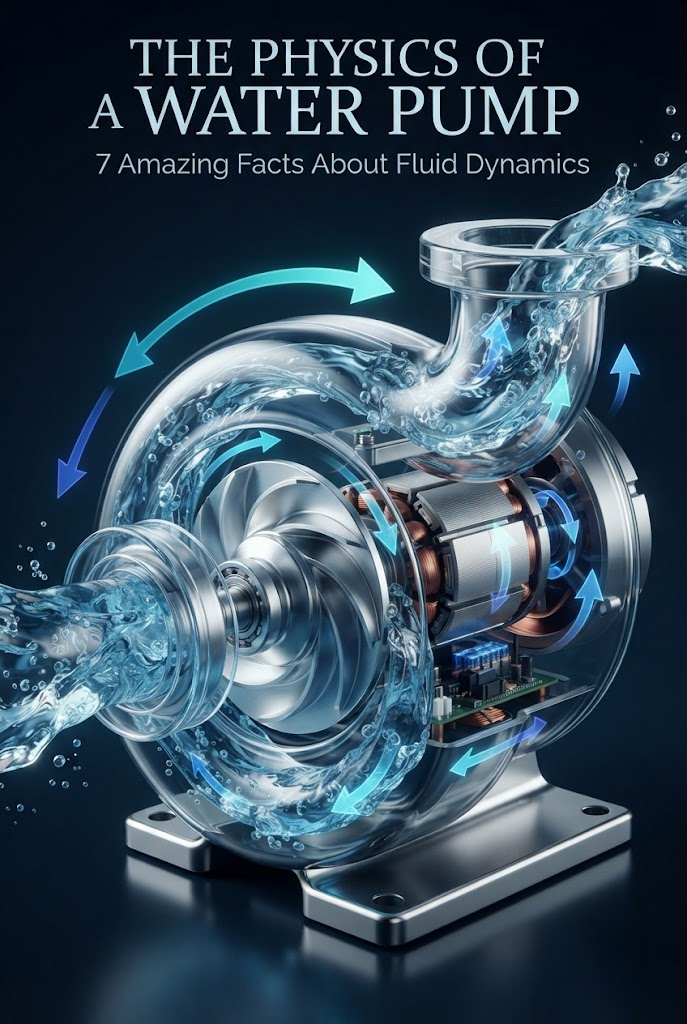
In a centrifugal pump, the rotating impeller transfers mechanical energy to the water. This increases the water’s velocity and pressure as it moves through the pump.
In other pump designs, such as positive displacement pumps, moving components repeatedly capture and displace a fixed volume of liquid.
The exact mechanism depends on the type of pump.
3. Water Enters Through the Inlet
Water enters the pump through an inlet pipe or suction opening.
In many centrifugal pump systems, the pump casing and suction line must be properly filled or primed before operation, unless the pump is specifically designed to handle air or self-prime.
The inlet arrangement helps guide water toward the pumping mechanism.
4. The Impeller Transfers Energy to Water
In a centrifugal pump, the impeller rotates at high speed.
Its curved blades transfer mechanical energy to the water and accelerate it outward from the centre of rotation.
This movement increases the water’s velocity. The pump casing and volute then help convert part of that velocity into pressure.
This is one of the most important processes in centrifugal water pump operation.
5. Water Leaves Through the Outlet
After receiving energy from the pump, water exits through the discharge opening.
The pressure difference between the pump outlet and the connected system helps drive water through pipes toward its destination.
The final flow rate and pressure depend on the pump design, pipe dimensions, water level, friction losses, and system requirements.
The Physics Behind Water Pump Technology
To understand how water pumps work, we need to explore several important scientific principles.
1. Fluid Dynamics
Fluid dynamics is the branch of physics that studies how liquids and gases move.
Water pumps rely on fluid dynamics to transfer water through pipes and pumping chambers.
When a pump operates, it changes the energy of the water and produces the conditions required for flow.
The behaviour of water depends on factors such as:
- Flow velocity
- Pressure
- Density
- Pipe diameter
- Fluid viscosity
- Friction
- Pump geometry
Understanding these factors helps engineers design efficient pumping systems.
2. Pressure and Pressure Difference
Pressure is one of the most important concepts in water pump technology.
Pressure is defined as force per unit area.
The formula is:
P = F ÷ A
Where:
- P = Pressure
- F = Force
- A = Area
A pump adds energy to water, allowing it to move through a system against pressure differences and resistance.
For example, a pump supplying water to an upper floor must provide enough energy to overcome the elevation difference and friction losses in the pipes.
This is why selecting the correct pump requires understanding the required flow rate and total system head.
3. Centrifugal Action
Centrifugal pumps use a rotating impeller to transfer energy to water.
As the impeller rotates, water moves outward from the centre due to the interaction between the rotating blades and the fluid.
The resulting increase in velocity and pressure allows the pump to deliver water through the discharge pipe.
The physics of rotational motion is therefore central to the operation of centrifugal pumps.
4. Electric Motors and Electromagnetism
Many modern water pumps use electric motors.
An electric motor operates through electromagnetic interactions. Electrical current flowing through motor windings creates magnetic fields that interact with other magnetic fields to produce torque.
This torque rotates the motor shaft, which drives the pump mechanism.
The conversion of electrical energy into mechanical energy allows electric pumps to operate continuously when supplied with appropriate power.
5. Gravity and Water Head
Gravity plays an important role in pumping systems.
The height difference between the water source and destination affects the energy required to move water.
The pressure associated with a vertical column of water can be estimated using:
P = ρgh
Where:
- P = Hydrostatic pressure
- ρ = Density of water
- g = Acceleration due to gravity
- h = Height of the water column
For water, a vertical column approximately 10.2 metres high produces about 100 kPa of hydrostatic pressure under standard conditions.
This relationship helps engineers understand how elevation affects water pressure.
7 Amazing Facts About Physics-Based Technology Water Pumps
Fact 1: Water Pumps Do Not Actually Pull Water in the Way Many People Imagine
A common misconception is that a pump simply pulls water through a pipe.
In many centrifugal pumping systems, the pump creates conditions that allow atmospheric pressure or another available pressure source to push water toward the pump inlet.
The pump then adds energy to the water and moves it through the discharge system.
This explains why suction lift and atmospheric pressure are important when designing surface-mounted pumps.
Fact 2: Centrifugal Pumps Use Rotational Motion
A centrifugal pump uses a rotating impeller to transfer energy to water.
The impeller’s motion accelerates the water outward, helping create the pressure and flow needed for pumping.
This makes rotational mechanics an essential part of modern water pump technology.
Fact 3: Submersible Pumps Operate Underwater
Unlike many surface-mounted pumps, submersible pumps are designed to operate while immersed in water.
They are commonly used in deep wells, boreholes, drainage systems, and water supply installations.
Because the pump is placed close to the water source, it does not need to lift water through a long suction pipe in the same way as a surface pump.
However, the installation must follow the manufacturer’s requirements for depth, cooling, electrical protection, and operating conditions.
Fact 4: Pump Efficiency Can Reduce Energy Consumption
A pump does not convert all its input energy into useful hydraulic energy.
Some energy is lost through friction, turbulence, leakage, mechanical losses, and motor inefficiency.
Engineers measure pump efficiency to understand how effectively input power is converted into useful water movement.
Choosing a properly sized pump and operating it near its best efficiency point can help reduce energy consumption.
Fact 5: Water Pumps Are Essential for Agriculture
Agriculture depends on reliable water supplies.
Water pumps help transfer water from rivers, canals, reservoirs, wells, and storage tanks to irrigation systems.
They can support drip irrigation, sprinkler irrigation, and other agricultural applications.
Solar-powered pumping systems are also increasingly useful in locations where grid electricity is limited.
Fact 6: Air Inside a Pump Can Cause Serious Problems
Many centrifugal pumps require proper priming before operation.
If too much air remains inside a pump or its suction line, the pump may fail to establish the necessary flow conditions.
Another serious issue is cavitation.
Cavitation occurs when local liquid pressure falls below the liquid’s vapour pressure, allowing vapour bubbles to form. These bubbles may collapse when they enter higher-pressure regions, potentially causing noise, vibration, and damage.
Proper system design helps reduce these risks.
Fact 7: Solar Energy Can Power Modern Water Pumps
Solar-powered water pumps use photovoltaic panels to convert sunlight into electrical energy.
That electricity can power a motor that drives the pump.
Solar pumping systems are useful for agriculture, livestock watering, remote communities, and locations where access to conventional electricity is difficult.
Their performance depends on sunlight availability, panel capacity, pump selection, water requirements, and system design.
Different Types of Water Pumps
Water pumps are available in several designs for different applications.
| Pump Type | Working Principle | Common Applications |
|---|---|---|
| Centrifugal Pump | Rotating impeller transfers energy to water | Homes, industries, irrigation |
| Submersible Pump | Motor and pump operate underwater | Deep wells, boreholes |
| Jet Pump | Uses a jet mechanism to help lift water | Shallow and deep well systems |
| Diaphragm Pump | Flexible diaphragm displaces liquid | Industrial and specialist applications |
| Piston Pump | Reciprocating piston moves liquid | High-pressure applications |
| Solar Water Pump | Solar electricity powers a pumping mechanism | Agriculture and remote water supply |
Each pump has different advantages and limitations. Selecting the correct type depends on the water source, required flow, pumping height, pressure, and installation conditions.
Centrifugal Pump vs Submersible Pump
Two widely used pump categories are centrifugal surface pumps and submersible pumps.
| Feature | Centrifugal Surface Pump | Submersible Pump |
|---|---|---|
| Installation | Installed outside the water source | Installed underwater |
| Water supply | Draws water through an inlet | Pumps water from its submerged position |
| Common applications | Household water supply and irrigation | Deep wells and boreholes |
| Suction requirements | Must operate within its suction limits | Avoids long surface suction lift |
| Maintenance | Often easier to access | May require removal from the water source |
| Installation needs | Requires suitable priming and suction arrangement | Requires appropriate submersion and electrical protection |
The right choice depends on the installation and the required pumping performance.
What Affects Water Pump Performance?
Several factors determine how effectively a water pump operates.
1. Pump Capacity
Pump capacity refers to the amount of water a pump can deliver over a period of time.
It is commonly measured in litres per minute or cubic metres per hour.
2. Total Head
Total head represents the energy per unit weight that the pump must provide to move water through the system.
It includes elevation differences, pressure requirements, and friction losses.
3. Motor Power
The motor must provide sufficient power to operate the pump under the required conditions.
An incorrectly selected motor may lead to poor performance or unnecessary energy consumption.
4. Pipe Diameter
Pipe diameter affects water velocity and friction losses.
An undersized pipe may increase resistance and reduce system efficiency.
5. Water Quality
Sand, mud, debris, and other particles can damage some pumps or reduce their performance.
The pump must be suitable for the quality and characteristics of the water being transferred.
Common Problems With Water Pumps
Water pumps may experience several operating problems.
Pump does not deliver water: Check the water source, priming requirements, inlet pipe, and possible blockages.
Low water pressure: Possible causes include leaks, clogged filters, incorrect pump sizing, and excessive system resistance.
Unusual noise or vibration: This may be related to cavitation, air entering the system, worn bearings, or mechanical misalignment.
Pump overheating: Poor ventilation, incorrect operation, electrical problems, or insufficient cooling may contribute to overheating.
High electricity consumption: An oversized pump, poor system design, or inefficient operation may increase energy use.
Electrical inspection and repairs should be carried out by qualified personnel, especially when working around water.
The Future of Water Pump Technology
Water pump technology continues to improve through advances in engineering, automation, and renewable energy.
Modern pumping systems may include variable-speed drives, smart sensors, automatic pressure control, and remote monitoring.
These features can help systems adjust their operation according to water demand.
Solar-powered pumping systems are also becoming increasingly important for agriculture and remote water supply.
In the future, improvements in motor efficiency, intelligent monitoring, materials, and hydraulic design may make water pumping systems more reliable and energy-efficient.
These developments demonstrate how physics and engineering continue to improve one of the most essential technologies in everyday life.
Frequently Asked Questions (FAQs)
1. What is a physics based technology water pump?
A physics based technology water pump is a machine that uses physical principles such as fluid dynamics, pressure, rotational motion, and electromagnetism to move water from one location to another.
2. How does a water pump work?
A water pump adds energy to water through a mechanical mechanism. This creates the conditions needed to move water through pipes, tanks, and other systems.
3. What is a centrifugal water pump?
A centrifugal water pump uses a rotating impeller to transfer energy to water. The impeller accelerates the water outward, while the pump casing helps convert velocity into pressure.
4. What is the difference between a centrifugal pump and a submersible pump?
A centrifugal surface pump is installed outside the water source and draws water through an inlet. A submersible pump operates underwater and delivers water from its submerged position.
5. Why does a water pump need electricity?
Many modern water pumps use electric motors to convert electrical energy into mechanical energy. However, some pumps operate using solar power, fuel engines, or manual power.
6. What is pump cavitation?
Cavitation occurs when local liquid pressure drops below the liquid’s vapour pressure, causing vapour bubbles to form. Their collapse can produce noise, vibration, and damage.
7. Can solar energy operate a water pump?
Yes. Solar panels can generate electricity that powers an electric motor connected to a water pump. These systems are commonly used in agriculture and remote locations.
Final Thoughts
A water pump is an excellent example of how physics makes modern life easier. By combining fluid dynamics, pressure, rotational motion, electromagnetism, and mechanical engineering, water pumps transfer water to homes, farms, industries, and communities.
From centrifugal impellers to underwater pumping systems, every design uses scientific principles to solve practical water supply challenges.
Understanding the physics behind water pumps helps us appreciate the engineering that makes reliable water distribution possible.
Explore more science and technology articles on MindHiveNest to discover how physics powers the machines and systems we use every day.