Introduction
A refrigerator is one of the most useful household appliances in modern life. It keeps food fresh, prevents spoilage, and helps preserve medicines. But have you ever wondered how a refrigerator works? The answer lies in physics. A physics based technology refrigerator uses principles of thermodynamics, heat transfer, and pressure changes to remove heat from inside the appliance and release it outside.
Understanding the science behind refrigerators helps us appreciate how physics improves our daily lives.
What Is a Refrigerator?
A refrigerator is a cooling device designed to maintain a low temperature inside a storage compartment. Its main purpose is to slow down bacterial growth and preserve food for longer periods.
Modern refrigerators use a refrigeration cycle that continuously transfers heat from the inside to the outside environment.
The Physics Behind Refrigerators
The operation of a physics based technology refrigerator is based on the laws of thermodynamics.
Heat naturally flows from a hotter region to a colder region. However, a refrigerator forces heat to move in the opposite direction by using electrical energy and a special refrigerant fluid.
This process allows the inside of the refrigerator to remain cold while heat is expelled into the surrounding room.
Main Components of a Refrigerator
Several important components work together to create the cooling effect.
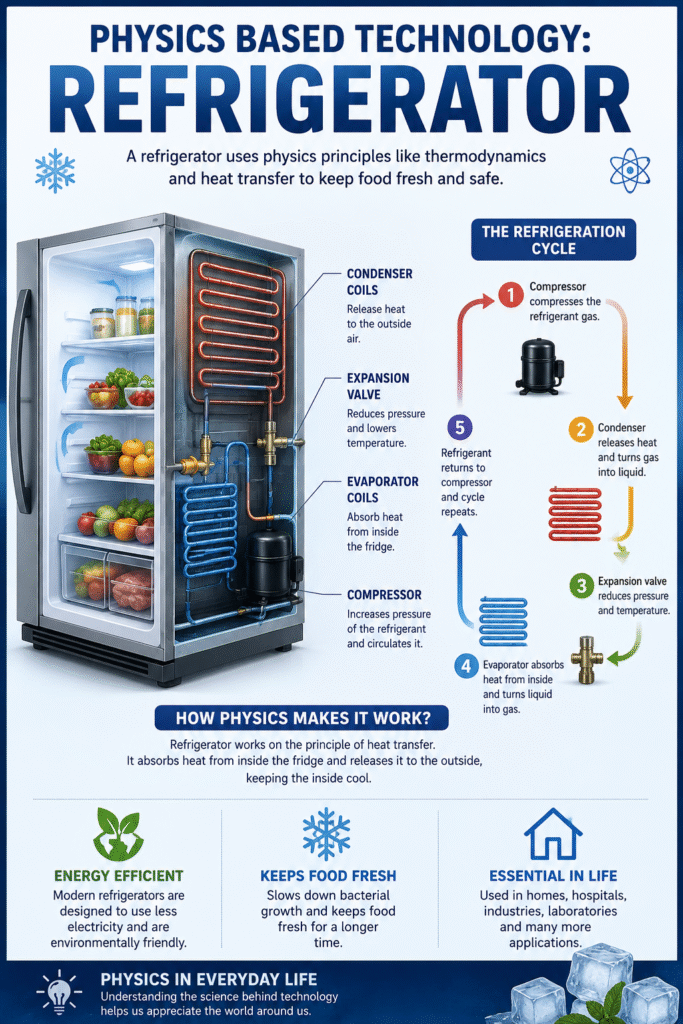
Compressor
The compressor increases the pressure of the refrigerant gas and pushes it through the system.
Condenser Coils
The condenser releases heat into the surrounding air and converts the refrigerant gas into a liquid.
Expansion Valve
The expansion valve reduces the pressure of the refrigerant, causing its temperature to drop significantly.
Evaporator Coils
The evaporator absorbs heat from inside the refrigerator, creating the cooling effect.
Refrigerant
The refrigerant is a special fluid that continuously circulates through the cooling cycle.
How a Refrigerator Works
The refrigeration cycle follows several steps:
- The compressor compresses the refrigerant gas.
- The hot gas moves through the condenser coils.
- Heat is released into the surrounding air.
- The refrigerant becomes a liquid.
- The liquid passes through the expansion valve.
- Pressure drops rapidly, causing cooling.
- The cold refrigerant enters the evaporator coils.
- Heat from inside the refrigerator is absorbed.
- The refrigerant returns to the compressor, and the cycle repeats.
This continuous cycle keeps food and beverages cold.
Advantages of Refrigerator Technology
Refrigerators offer many benefits:
Food Preservation
They slow bacterial growth and keep food fresh longer.
Medical Storage
Many medicines and vaccines require refrigeration.
Convenience
People can store food for days or weeks without spoilage.
Energy Efficiency
Modern refrigerators use advanced technology to reduce electricity consumption.
Applications of Refrigeration Technology
Refrigeration technology is used in many industries:
- Household refrigerators
- Supermarkets
- Hospitals
- Pharmaceutical storage
- Food processing industries
- Cold storage warehouses
- Transportation of perishable goods
These applications make refrigeration an essential technology worldwide.
Future of Refrigerator Technology
Scientists are developing smarter and more energy-efficient refrigerators. Future models may use environmentally friendly refrigerants, artificial intelligence, and advanced cooling systems to improve performance while reducing environmental impact.
As technology advances, refrigerators will become even more efficient, sustainable, and user-friendly.
Why Refrigerators Are Important in Daily Life
Refrigerators have become an essential part of modern living. Without refrigeration, food would spoil quickly, leading to waste and health risks. Fruits, vegetables, dairy products, meat, and beverages can be stored safely for extended periods because of refrigeration technology.
In addition, refrigerators help households save money by reducing food waste. Instead of purchasing fresh food every day, people can store groceries for longer periods. This convenience has made refrigerators one of the most valuable inventions of the modern age.
Thermodynamics and Refrigeration
Thermodynamics is the branch of physics that studies heat and energy transfer. Refrigerators operate according to thermodynamic principles by transferring heat from a colder region to a warmer region using external energy.
The refrigeration cycle demonstrates how energy can be used to control temperature. This practical application of thermodynamics is one of the best examples of physics being used in everyday life.
Environmental Impact of Refrigerators
Modern refrigerators are designed to be more environmentally friendly than older models. Early refrigeration systems used chemicals that could damage the ozone layer and contribute to global warming.
Today, manufacturers use safer refrigerants and energy-efficient technologies to reduce environmental impact. As a result, modern refrigerators consume less electricity while providing better cooling performance.
Smart Refrigerators and Future Innovations
Technology is rapidly transforming refrigeration systems. Smart refrigerators can now connect to the internet, monitor food freshness, and even notify users when items are running low.
Future refrigerators may use artificial intelligence to optimize cooling efficiency and reduce energy consumption. Scientists are also researching advanced cooling technologies that could replace traditional refrigerants and further improve environmental sustainability.
These innovations will make refrigeration technology smarter, greener, and more efficient in the coming years.
Interesting Facts About Refrigerators
- The first practical refrigerator was developed in the 19th century.
- Refrigerators work by removing heat rather than creating cold air.
- The back of a refrigerator feels warm because it releases heat absorbed from inside.
- Modern refrigerators can maintain temperatures close to 0°C without freezing food.
- Refrigeration technology plays a vital role in preserving vaccines and medicines worldwide.
These facts highlight the importance of refrigeration technology in both homes and industries.
Final Thoughts
The physics based technology refrigerator is a remarkable invention that combines thermodynamics, heat transfer, and engineering principles. From preserving food to supporting healthcare and industry, refrigerators have become an indispensable part of modern society.
As technology continues to advance, future refrigerators will become more energy-efficient, environmentally friendly, and intelligent. This demonstrates how physics-based technologies continue to improve our quality of life and shape a more sustainable future.
A physics based technology refrigerator is an excellent example of how scientific principles improve everyday life. By applying thermodynamics, heat transfer, and pressure changes, refrigerators remove heat and keep food fresh. Understanding this technology shows how physics continues to shape modern society and create practical solutions for daily needs.