Introduction
Physics Based Technology: Generator – How It Works
Physics Based Technology: Generator is one of the most important inventions in modern science and engineering. It converts mechanical energy into electrical energy using the principle of electromagnetic induction. Generators are widely used in power plants, industries, hospitals, and homes to produce electricity. Understanding how a generator works helps us see the practical application of physics in everyday life.
Electricity has become one of the most important parts of modern life. From charging smartphones to powering industries, electricity is everywhere. But have you ever wondered how electricity is generated? The answer lies in a remarkable invention called a generator. Understanding how a generator works helps us appreciate the role of physics in everyday technology.
In this article, we will explore the working principle of a generator, the physics behind electricity generation, its components, applications, advantages, and limitations.
What is a Generator?
A generator is a machine that converts mechanical energy into electrical energy. It does not create electricity from nothing; instead, it transforms one form of energy into another.
Generators are commonly used in power plants, industries, hospitals, and homes as backup power sources. They play a crucial role in supplying electricity when the main power supply is unavailable.
The Physics Behind a Generator
The concept of Physics Based Technology: Generator is based on Faraday’s law of electromagnetic induction.
The operation of a generator is based on the principle of electromagnetic induction, discovered by physicist Michael Faraday.
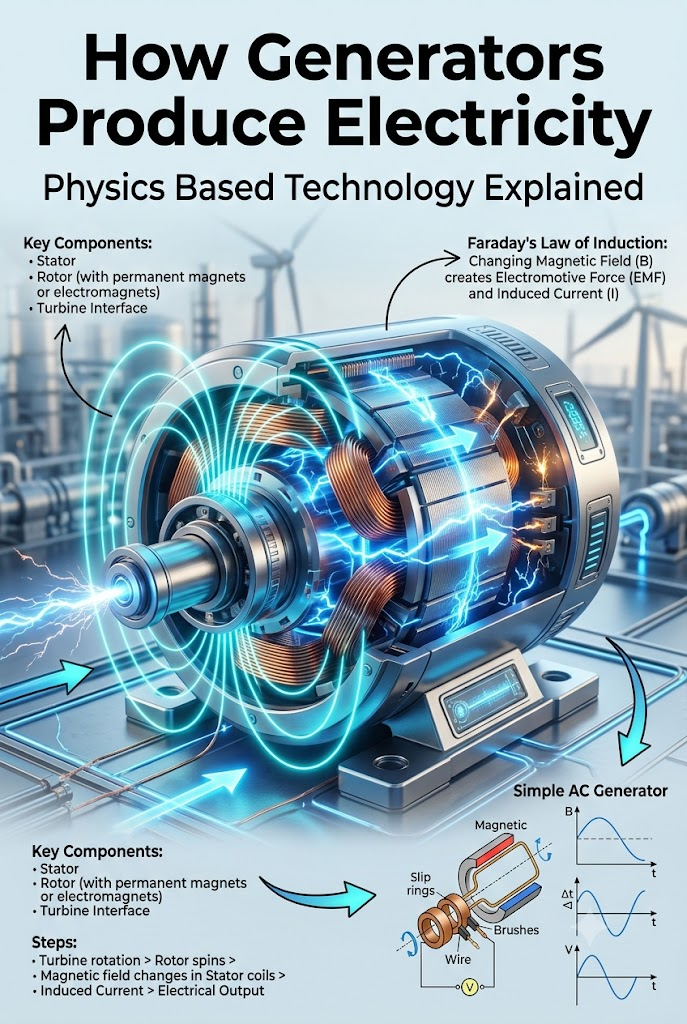
According to Faraday’s Law, when a conductor moves through a magnetic field, an electric current is induced in the conductor. This phenomenon forms the foundation of all modern generators.
In simple words, moving a wire inside a magnetic field causes electrons to flow, producing electricity.
Main Components of a Generator
A generator consists of several important components that work together to produce electrical energy.
Rotor
The rotor is the rotating part of the generator. It creates motion that interacts with the magnetic field.
Stator
The stator is the stationary part containing coils of wire where electricity is generated.
Magnetic Field
Permanent magnets or electromagnets provide the magnetic field necessary for electromagnetic induction.
Shaft
The shaft transfers mechanical energy from turbines, engines, or other sources to the rotor.
Slip Rings and Brushes
These components help transfer electrical current from the rotating part to the external circuit.
How Does a Generator Work?
The working process of a generator can be explained in a few simple steps.
Step 1: Mechanical Energy Input
Mechanical energy is supplied from a source such as a steam turbine, water turbine, wind turbine, or diesel engine.
Step 2: Rotation of the Rotor
The mechanical energy causes the rotor to spin inside a magnetic field.
Step 3: Electromagnetic Induction
As the rotor rotates, the magnetic field around the wire coils changes continuously. This changing magnetic field induces an electric current in the stator coils.
Step 4: Electricity Production
The induced current is collected and supplied to homes, industries, and electrical devices.
Types of Generators
Generators are available in different types depending on their design and application.
AC Generator
An AC generator produces alternating current (AC). Most power stations use AC generators because AC electricity can be transmitted efficiently over long distances.
DC Generator
A DC generator produces direct current (DC). These generators are commonly used in battery charging systems and specialized industrial applications.
Applications of Generators
Generators are widely used in various sectors of modern society. Today, Physics-Based Technology: Generator is used in power plants, industries, hospitals, and renewable energy systems.
Power Plants
Hydroelectric, thermal, nuclear, and wind power plants use generators to produce electricity on a large scale.
Emergency Backup Systems
Hospitals, offices, and data centers rely on generators during power outages.
Renewable Energy Systems
Wind turbines and some renewable energy technologies use generators to convert mechanical motion into electricity.
Industrial Operations
Factories and manufacturing facilities use generators for continuous power supply.
Advantages of Generators
Generators provide several benefits. One major advantage of Physics-Based Technology: Generator is its ability to convert mechanical energy into useful electrical energy efficiently
- Convert mechanical energy into useful electrical energy.
- Essential for large-scale electricity production.
- Reliable backup power source.
- Can operate using various energy sources.
- Support renewable energy generation.
Limitations of Generators
Despite their advantages, generators also have some limitations.
- Initial installation costs can be high.
- Fuel-powered generators may cause environmental pollution.
- Regular maintenance is required.
- Noise can be produced during operation.
Future of Generator Technology
Modern generator technology is becoming more efficient and environmentally friendly. Scientists and engineers are developing advanced generators for renewable energy systems, smart grids, and sustainable power production.
Future innovations may improve energy efficiency while reducing environmental impact, making generators even more important in the world’s energy infrastructure. The future of Physics-Based Technology: Generator includes smart grids, renewable energy integration, and high-efficiency power generation systems.
Final Thoughts
A generator is one of the most significant inventions in modern technology. Based on the principle of electromagnetic induction, it converts mechanical energy into electrical energy and powers countless devices around us. From power plants to backup systems, generators are essential for modern civilization. Understanding the physics behind generators not only helps us appreciate this technology but also highlights the importance of physics in everyday life. In conclusion, Physics-Based Technology: Generator demonstrates how physics principles can be applied to produce electricity for modern society.