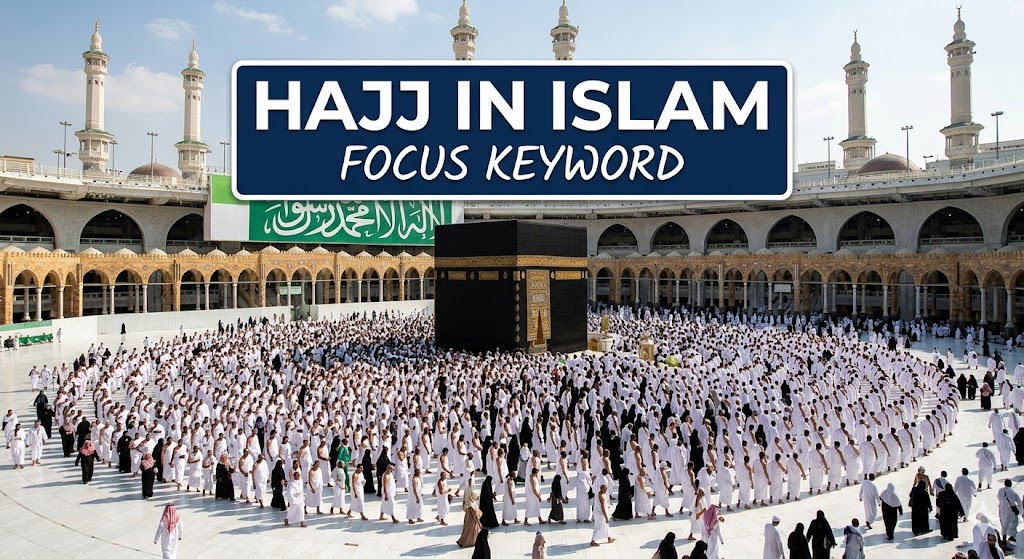
Introduction to Hajj in Islam
Hajj is one of the most important acts of worship in Islam and is the fifth pillar of Islam. Every Muslim who is physically and financially able is required to perform Hajj at least once in their lifetime. It is performed in the holy city of Makkah in Saudi Arabia and brings millions of Muslims from around the world together in unity, equality, and devotion to Allah.
Hajj is not just a physical journey; it is a spiritual transformation. It teaches patience, sacrifice, humility, and complete submission to Allah.
Historical Background of Hajj
The history of Hajj goes back to the time of the Prophet Ibrahim (Abraham) and his son Prophet Ismail (Ishmael).
Prophet Ibrahim was commanded by Allah to leave his wife Hajar and infant son Ismail in the barren valley of Makkah. In this difficult moment, Allah blessed them with the miraculous Zamzam water.
Later, Allah commanded Ibrahim (AS) to rebuild the Kaaba along with his son Ismail (AS) in Makkah. The Kaaba became the first house of worship dedicated to Allah on earth.
Over time, Hajj rituals were established based on the actions and sacrifices of Prophet Ibrahim (AS), Hajar (AS), and Prophet Ismail (AS). The Prophet Muhammad ﷺ later re-established the pure form of Hajj by removing all forms of idol worship and restoring it as a monotheistic act of worship.
Importance of Hajj in Islam
Hajj holds a very high status in Islam because:
- It is the fifth pillar of Islam.
- It is a direct command from Allah.
- It symbolizes unity among Muslims worldwide.
- It cleanses sins and gives a fresh spiritual start.
- It teaches patience, sacrifice, and discipline.
The Prophet Muhammad ﷺ said that a person who performs Hajj properly and avoids sins returns as pure as a newborn baby.
Who Is Required to Perform Hajj? (Conditions of Hajj)
Hajj becomes obligatory for a Muslim if the following conditions are met:
- The person is Muslim
- The person is an adult (has reached puberty)
- The person is mentally sound
- The person has financial ability (can afford travel and expenses)
- The person is physically capable of performing Hajj
- The route is safe for travel
If any of these conditions are not met, Hajj is not compulsory.
Types of Hajj
There are three main types of Hajj:
1. Hajj Tamattu
This is when a person performs Umrah first, comes out of Ihram, and then performs Hajj with a new Ihram.
2. Hajj Qiran
This is when a person performs both Umrah and Hajj in one Ihram without breaking it.
3. Hajj Ifrad
This is when a person performs only Hajj without Umrah.
Step-by-Step Guide to Hajj
Hajj is performed over several days in the Islamic month of Dhul-Hijjah.
1. Entering Ihram
Pilgrims enter the state of Ihram, wearing simple white clothes (for men) and making the intention for Hajj.
2. Tawaf of Kaaba
Pilgrims circle the Kaaba seven times in a counter-clockwise direction.
3. Sa’i between Safa and Marwah
Pilgrims walk seven times between the hills of Safa and Marwah, remembering the struggle of Hajar (AS).
4. Day of Tarwiyah (8th Dhul-Hijjah)
Pilgrims travel to Mina and stay there in worship and prayer.
5. Day of Arafah (9th Dhul-Hijjah)
This is the most important day of Hajj. Pilgrims stand in the plain of Arafah, making dua and seeking forgiveness from Allah.
6. Muzdalifah Night
After sunset, pilgrims move to Muzdalifah, collect pebbles, and spend the night under the open sky.
7. Rami (Stoning the Jamarat)
Pilgrims throw stones at the symbolic pillars representing Shaytan in Mina.
8. Animal Sacrifice (Qurbani)
An animal is sacrificed as an act of obedience to Allah.
9. Shaving or Cutting Hair
Men shave their heads or cut hair; women trim a small portion.
10. Final Tawaf (Tawaf al-Ifadah)
Pilgrims return to Makkah to perform the final Tawaf around the Kaaba.
Common Mistakes During Hajj
- Not learning the rituals properly
- Arguing or fighting during Hajj
- Ignoring rules of Ihram
- Lack of patience in crowds
- Not focusing on spiritual purpose
Spiritual Benefits of Hajj
Hajj purifies the soul and brings a person closer to Allah. It teaches:
- Patience in hardship
- Equality among all Muslims
- Humility and simplicity
- Gratitude towards Allah
Final Thoughts
Hajj is a life-changing journey that every Muslim dreams of completing. It is not only a physical act of worship but also a deep spiritual experience that cleanses sins and renews faith. The story of Prophet Ibrahim (AS), Prophet Ismail (AS), and the teachings of Islam make Hajj a powerful reminder of submission to Allah.
If performed with sincerity, Hajj becomes one of the most rewarding experiences in a believer’s life.