Intruduction
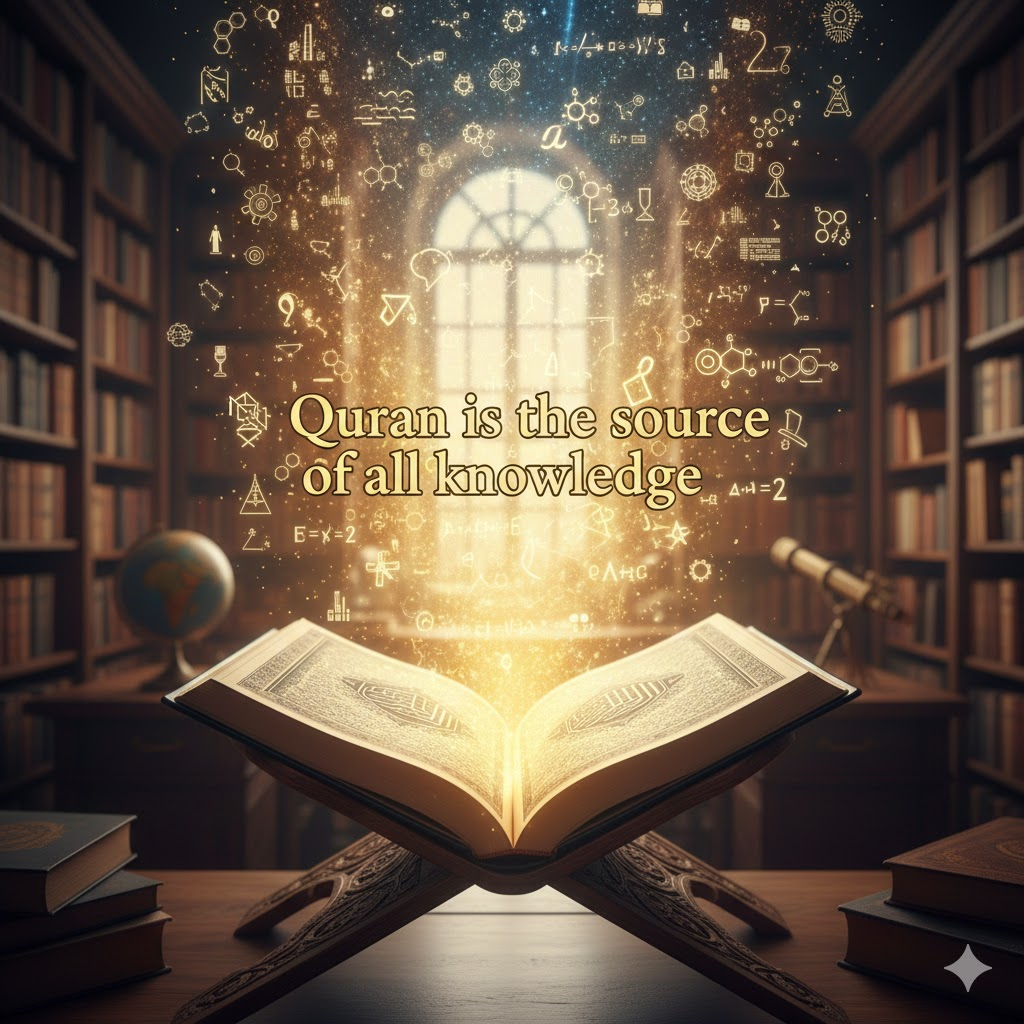
The Quran holds a unique and unmatched position in Islam. Muslims believe that the Quran is not merely a religious book but the complete source of all true knowledge. Revealed by Allah to Prophet Muhammad ﷺ, the Quran provides guidance for every aspect of human life—spiritual, moral, intellectual, and social.
From understanding the purpose of life to learning how to live ethically, the Quran serves as the ultimate reference point. This belief that the Quran is the source of all knowledge has shaped Islamic civilization for centuries and continues to guide millions of believers today.
📖 What Does “Source of All Knowledge” Mean in Islam?
In Islam, knowledge is not limited to science or academics. It includes:
- Knowledge of Allah
- Knowledge of right and wrong
- Knowledge of the unseen (Akhirah, angels, destiny)
- Knowledge of human behavior and morality
- Knowledge that leads to wisdom and humility
The Quran addresses all these dimensions. While it is not a textbook of modern science, it lays down foundational truths upon which all beneficial knowledge is built.
Islam teaches that any knowledge that benefits humanity and leads people closer to truth ultimately comes from Allah—and the Quran is His final, preserved revelation.
🌍 The Quran as Divine Guidance for Humanity
Allah describes the Quran as a guide for all people, not just Muslims. It provides clarity in confusion and light in darkness. The Quran explains:
- Why humans were created
- What their responsibilities are
- How to live a balanced and meaningful life
This guidance is timeless. Whether someone lived 1,400 years ago or lives in the modern digital age, the Quran’s principles remain relevant and applicable.
🧠 The Quran and the Importance of Knowledge
One of the strongest proofs that the Quran is the source of all knowledge is how much it emphasizes learning and thinking.
The very first revelation began with the command:
“Read!”
The Quran repeatedly encourages humans to:
- Reflect
- Observe nature
- Use reason
- Seek understanding
Islam does not support blind belief. Instead, it invites people to think deeply, question sincerely, and seek truth through both revelation and reflection.
🔬 Scientific Knowledge and the Quran
The Quran is not a science book, but it contains verses that encourage scientific thinking. It points humans toward the study of:
- The universe
- The sky and stars
- Human creation
- Nature and life cycles
Many Muslim scholars explain that the Quran provides the framework of knowledge, while human beings discover details over time. Science changes, but the Quran’s guidance remains constant.
This balance shows that all beneficial knowledge—whether religious or worldly—must align with truth, ethics, and purpose.
🧭 Moral and Ethical Knowledge from the Quran
One of the most important areas where the Quran acts as the source of knowledge is morality.
The Quran teaches:
- Honesty and justice
- Mercy and forgiveness
- Patience and humility
- Respect for parents
- Rights of neighbors and society
Without moral guidance, knowledge can become dangerous. Islam teaches that true knowledge must lead to good character. The Quran connects knowledge with responsibility, reminding humans that they will be accountable for how they use what they know.
📜 Knowledge of the Unseen (Ilm-ul-Ghayb)
Human knowledge is limited. There are many realities that humans cannot access through experiments or observation. The Quran provides knowledge of the unseen, including:
- The existence of angels
- Life after death
- Paradise and Hell
- Divine justice
- Destiny (Qadr)
This type of knowledge cannot be achieved through science or human intellect alone. It comes only through revelation, proving again why the Quran is considered the ultimate source of true knowledge.
🏛️ The Quran and Islamic Civilization
Throughout history, the Quran inspired Muslims to seek knowledge in all fields. Under its guidance, Muslims contributed to:
- Mathematics
- Medicine
- Astronomy
- Philosophy
- Literature
These scholars did not separate religion from knowledge. They believed that learning was an act of worship when done with the right intention. The Quran motivated them to explore the world while remaining conscious of Allah.
🧑🏫 The Quran as a Teacher for Daily Life
The Quran does not only teach grand ideas; it also provides practical knowledge for everyday life, such as:
- How to deal with hardship
- How to manage wealth
- How to maintain family relationships
- How to treat others with fairness
This makes the Quran a complete manual for life. Its teachings address both the heart and the mind, ensuring balance between knowledge and action.
⚖️ Difference Between Human Knowledge and Quranic Knowledge
Human knowledge:
- Is limited
- Can change
- May contain errors
Quranic knowledge:
- Comes from Allah
- Is perfect and complete
- Remains unchanged
Islam teaches that human discoveries should be guided by Quranic principles. When knowledge is separated from divine guidance, it can lead to harm. When guided by the Quran, knowledge becomes a means of benefit for all humanity.
🕌 Why Muslims Believe the Quran Is the Ultimate Source of Knowledge
Muslims believe the Quran is the source of all knowledge because:
- It comes directly from the Creator of knowledge
- It explains the purpose of life
- It guides both belief and behavior
- It balances reason with revelation
The Quran does not reject human learning; instead, it gives it direction, meaning, and limits.
✨ Final Thoughts
The Quran is far more than a religious scripture. In Islam, it is the foundation of all true knowledge, guiding humanity toward wisdom, morality, and purpose. While humans may continue to discover new information, the Quran remains the ultimate reference point that ensures knowledge is used for good.
Understanding the Quran as the source of all knowledge helps Muslims approach learning with humility, responsibility, and faith—recognizing that all beneficial knowledge ultimately comes from Allah.