Introduction
What Is Dark Matter? When we look up at the night sky, we see stars, planets, and glowing galaxies. But everything we can observe makes up only a tiny part of the universe.
Scientists believe that around 85% of the matter in the universe is something we cannot see, touch, or directly detect. This mysterious substance is called dark matter.
Even though dark matter is invisible, it plays a major role in shaping galaxies, holding the universe together, and controlling cosmic structures. In fact, without dark matter, the universe as we know it might not exist.
In this article, we will explore what dark matter is, how scientists discovered it, and why it remains one of the biggest mysteries in modern science.
What Exactly Is Dark Matter?
Dark matter is a type of matter that does not emit, absorb, or reflect light. This means we cannot see it using telescopes or any type of electromagnetic observation.
Unlike normal matter, which is made of atoms (like stars, planets, and humans), dark matter does not interact with light. This is why it is called “dark.”
However, even though we cannot see it, scientists are confident that it exists because of its gravitational effects on visible objects in space.
How Do Scientists Know Dark Matter Exists?
The existence of dark matter was not discovered directly. Instead, scientists observed its effects.
One of the first clues came from studying how galaxies rotate. According to physics, stars at the outer edges of a galaxy should move slower than stars near the center. But in reality, they move almost at the same speed.
This strange observation suggests that there must be extra unseen mass providing additional gravity to hold galaxies together.
That unseen mass is what we now call dark matter.
Dark Matter and Galaxy Rotation
To understand this better, imagine a spinning carousel. If you place weights on the edges, it will spin differently compared to a carousel with no extra weight.
Similarly, galaxies rotate in a way that cannot be explained by visible matter alone.
Scientists found that galaxies would fly apart if only normal matter existed. Something invisible must be providing extra gravitational pull.
This is one of the strongest pieces of evidence supporting dark matter.
What Is Dark Matter Made Of?
This is one of the biggest unanswered questions in physics.
So far, scientists do not know exactly what dark matter is made of. It does not match any known particle in the Standard Model of physics.
However, there are several leading theories:
WIMPs (Weakly Interacting Massive Particles)
These are hypothetical particles that rarely interact with normal matter but have mass and gravity.
Axions
Extremely light particles that might make up dark matter and explain certain cosmic observations.
Sterile Neutrinos
A theoretical type of neutrino that interacts even less than normal neutrinos.
Despite many experiments, none of these particles have been confirmed yet.
Why Is Dark Matter Important?
Dark matter is extremely important for understanding the structure of the universe.
Without dark matter:
- Galaxies might not form properly
- Stars could drift apart
- The universe would look completely different
- Cosmic structure would be unstable
In simple terms, dark matter acts like an invisible “glue” that holds galaxies together.
Dark Matter vs Dark Energy
Many people confuse dark matter with dark energy, but they are completely different.
- Dark matter helps pull things together using gravity
- Dark energy pushes the universe apart and causes expansion
Together, they make up most of the universe, while normal matter is only a small fraction.
How Do Scientists Search for Dark Matter?
Scientists are trying many methods to detect dark matter:
Underground Detectors
Deep underground laboratories try to catch rare interactions between dark matter particles and normal matter.
Particle Colliders
Facilities like the Large Hadron Collider attempt to create dark matter particles in high-energy collisions.
Space Observations
Telescopes study galaxy movements and gravitational effects to map dark matter distribution.
So far, dark matter has not been directly detected, but indirect evidence is very strong.
Could Dark Matter Be Everywhere?
Yes. In fact, scientists believe dark matter surrounds us right now.
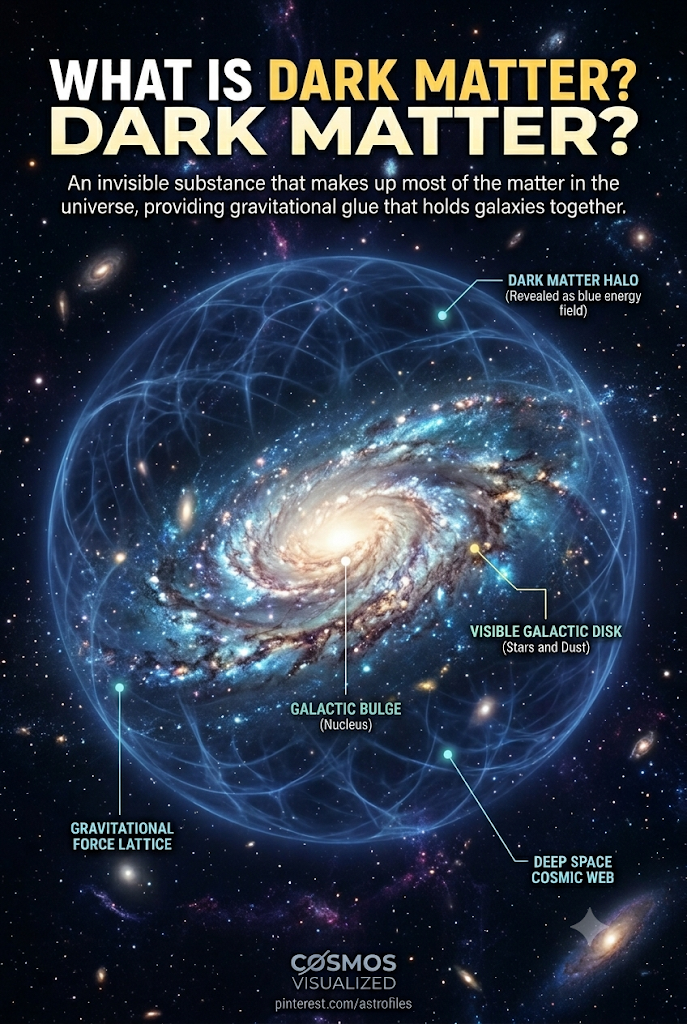
It forms massive invisible halos around galaxies, including our Milky Way.
Even though it passes through us without interaction, its gravity influences the motion of stars, planets, and entire galaxies.
You could say we are living inside a giant invisible structure shaped by dark matter.
The Mystery Still Continues
Despite decades of research, dark matter remains one of the greatest mysteries in science.
It does not fit into our current understanding of physics, and we still do not know its exact nature.
But this mystery is also exciting because it means there is still so much left to discover about the universe.
Future discoveries in physics, astronomy, and technology may one day reveal the true identity of dark matter.
Final Thoughts
Dark matter is an invisible but powerful component of the universe. Although we cannot see it directly, its gravitational effects clearly show that it exists.
It helps form galaxies, holds cosmic structures together, and shapes the universe at the largest scales.
The search for dark matter continues, and when scientists finally uncover its true nature, it could completely change our understanding of the universe.
Until then, dark matter remains one of the most fascinating puzzles in modern science.