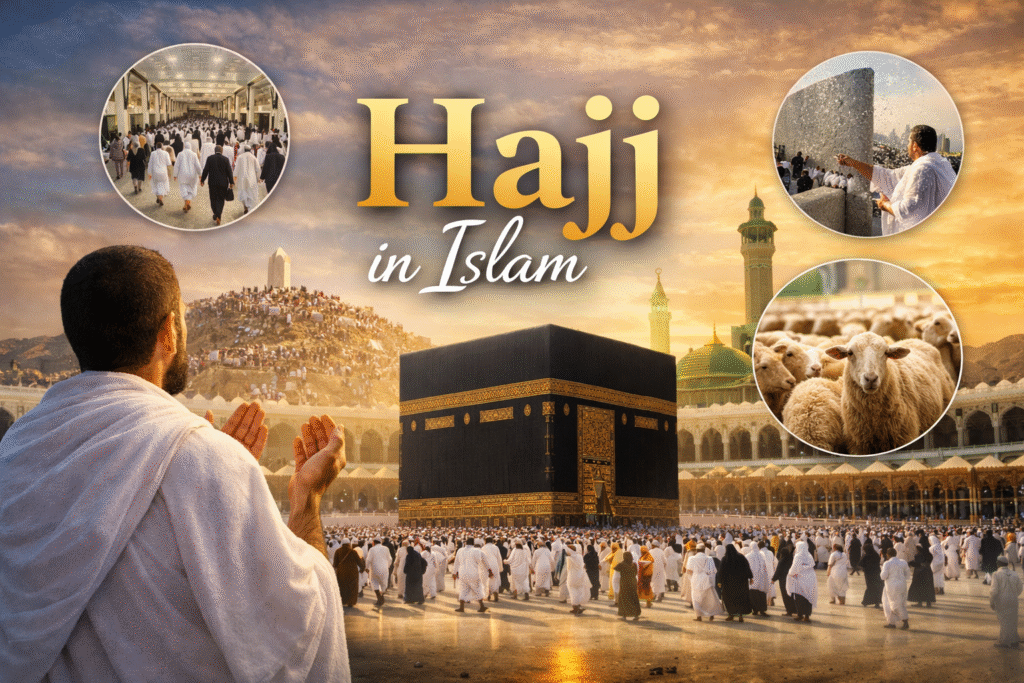
Introduction to Hajj in Islam
Hajj in Islam is one of the most sacred and significant acts of worship performed by Muslims around the world. It is the fifth pillar of Islam and is obligatory for every financially and physically capable Muslim at least once in their lifetime. Every year, millions of Muslims gather in Makkah, Saudi Arabia, to perform this spiritual journey.
Hajj is not just a physical journey; it is a deep spiritual experience that strengthens faith, promotes unity, and reminds Muslims of equality before Allah. Regardless of race, nationality, or status, all pilgrims wear simple clothing and perform the same rituals.
Definition of Hajj
Hajj in Islam refers to the pilgrimage to the holy city of Makkah during the Islamic month of Dhul-Hijjah. It involves a series of rituals performed over specific days, following the traditions of Prophet Ibrahim (AS), his wife Hajar (AS), and Prophet Muhammad (SAW).
The word “Hajj” literally means “to intend” or “to set out for a journey.” In Islamic terms, it means intending to visit the Kaaba and perform the prescribed acts of worship.
Importance of Hajj in Islam
Hajj holds immense importance in Islam because it is directly commanded by Allah in the Quran. It is a demonstration of submission, devotion, and obedience to Allah.
One of the greatest benefits of Hajj is the forgiveness of sins. It is believed that a person who performs Hajj sincerely returns as pure as a newborn baby, free from past sins.
Hajj also promotes unity among Muslims. People from all over the world come together, wearing the same simple attire, showing that all humans are equal in the eyes of Allah.
Who is Required to Perform Hajj?
Not every Muslim is required to perform Hajj. It becomes obligatory only when certain conditions are met.
A Muslim must be physically fit and mentally sound to perform Hajj. They must also have sufficient financial resources to cover the journey without affecting their family’s basic needs.
Additionally, the journey must be safe, and for women, there are specific guidelines regarding travel, often requiring a Mahram depending on interpretation.
Types of Hajj
There are three main types of Hajj that pilgrims can perform.
The first is Hajj Ifrad, where the pilgrim performs only Hajj without Umrah. The second is Hajj Qiran, where both Umrah and Hajj are performed together without leaving Ihram. The third is Hajj Tamattu, which involves performing Umrah first, exiting Ihram, and then entering Ihram again for Hajj.
Among these, Hajj Tamattu is the most commonly performed type.
Step-by-Step Process of Hajj
Understanding the step-by-step process of Hajj in Islam is essential for every pilgrim.
Entering Ihram
The journey begins with entering a sacred state called Ihram. Pilgrims wear simple white garments and make the intention for Hajj. They also recite the Talbiyah, declaring their presence before Allah.
Tawaf
Pilgrims perform Tawaf by circling the Kaaba seven times in a counterclockwise direction. This symbolizes unity and devotion to Allah.
Sa’i
After Tawaf, pilgrims walk between the hills of Safa and Marwah seven times. This act commemorates the struggle of Hajar (AS) in search of water for her son Ismail (AS).
Day of Arafah
The 9th day of Dhul-Hijjah is the most important day of Hajj. Pilgrims gather at the plain of Arafah and spend the day in prayer, seeking forgiveness and mercy from Allah.
Muzdalifah
After sunset, pilgrims travel to Muzdalifah, where they collect pebbles and spend the night under the open sky.
Rami (Stoning the Devil)
Pilgrims throw pebbles at three pillars representing Satan. This symbolizes rejecting evil and temptation.
Qurbani (Sacrifice)
Animals are sacrificed in remembrance of Prophet Ibrahim’s willingness to sacrifice his son for Allah.
Tawaf al-Ifadah
Pilgrims return to Makkah to perform another Tawaf, which is an essential part of Hajj.
Farewell Tawaf
Before leaving Makkah, pilgrims perform a final Tawaf to bid farewell to the Kaaba.
Rules and Prohibitions During Hajj
While in the state of Ihram, certain actions are strictly prohibited.
Pilgrims must avoid cutting hair or nails, using perfume, engaging in marital relations, and arguing or fighting. Hunting animals is also forbidden during this sacred state.
Maintaining patience, humility, and good behavior is essential throughout the journey.
Spiritual Benefits of Hajj
Hajj is not only about rituals; it is about spiritual transformation.
It teaches patience, sacrifice, and discipline. It reminds Muslims of the Day of Judgment when all people will stand equally before Allah.
Hajj also strengthens faith and encourages believers to become better individuals after returning home.
Lessons from Hajj
Hajj provides many life lessons that Muslims can apply daily.
It teaches equality, as everyone wears the same clothes regardless of social status. It also teaches unity, as millions perform the same rituals together.
Another important lesson is submission to Allah’s will, just like Prophet Ibrahim (AS) demonstrated.
Common Mistakes to Avoid During Hajj
Many pilgrims make mistakes due to lack of knowledge.
Some rush through rituals without understanding their meaning. Others may neglect proper intention or fail to follow the correct sequence.
It is important to learn and prepare properly before performing Hajj to ensure it is accepted.
Final Thoughts
Hajj in Islam is a powerful and life-changing journey that every capable Muslim should strive to perform. It is not just a physical act but a spiritual transformation that brings a person closer to Allah.
From the definition to the rituals and rules, every aspect of Hajj carries deep meaning and significance. By performing Hajj with sincerity and proper knowledge, Muslims can gain immense rewards and forgiveness.
If you are planning to perform Hajj, start preparing both spiritually and practically. May Allah grant every مسلمان the opportunity to perform Hajj and accept their عبادات. Ameen.