Introduction
Islam is the second-largest religion in the world, with more than two billion followers. Muslims share the same core beliefs: faith in one God (Allah), belief in Prophet Muhammad (peace be upon him), the Quran as the final revelation, and the practice of the five pillars of Islam.
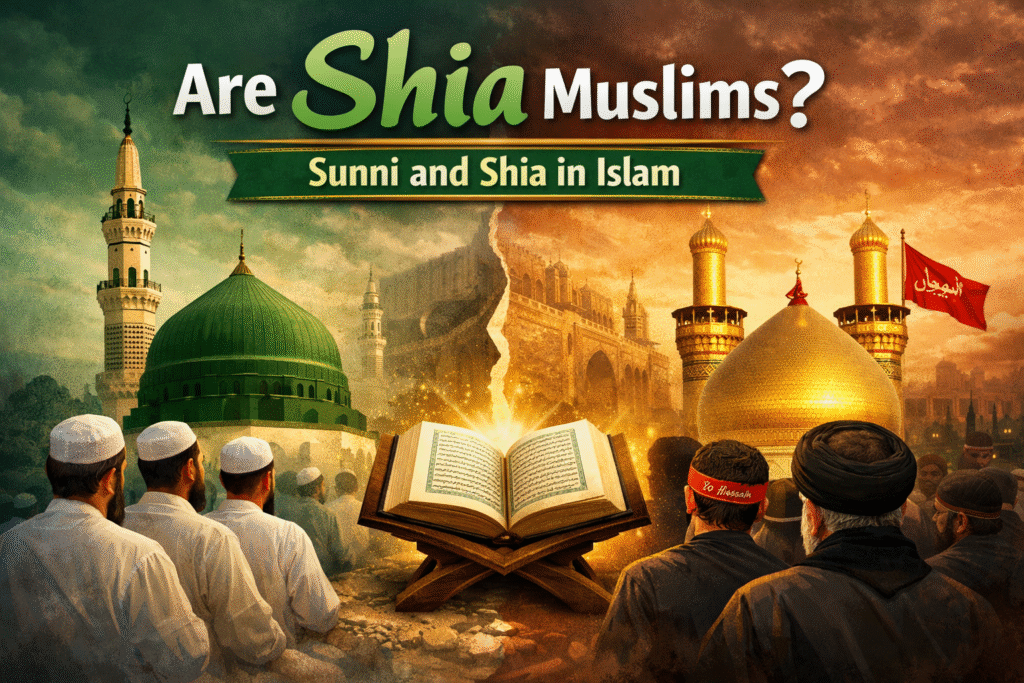
However, within the Muslim community, there are different groups and schools of thought. The two largest groups are Sunni and Shia Muslims. Many people often ask an important question: Are Shia Muslims considered Muslims in Islam?
Understanding this topic requires knowledge of Islamic history, theology, and scholarly opinions.
The Origin of the Sunni and Shia Division
The division between Sunni and Shia Muslims began shortly after the death of Prophet Muhammad (peace be upon him) in 632 CE.
The issue was mainly about who should lead the Muslim community after the Prophet.
Some Muslims believed the leader should be chosen through consultation among the companions. These Muslims supported Abu Bakr and later became known as Sunni Muslims.
Another group believed leadership should remain within the Prophet’s family and supported Ali ibn Abi Talib, the cousin and son-in-law of the Prophet. These followers later became known as Shia Muslims, which comes from the phrase Shiat Ali meaning “the party of Ali.”
Over time, political disagreements gradually developed into theological differences.
Core Beliefs Shared by Sunni and Shia Muslims
Despite their differences, Sunni and Shia Muslims share many fundamental Islamic beliefs.
Both groups believe in:
- One God (Allah)
- Prophet Muhammad as the final messenger
- The Quran as the holy book
- Angels and the Day of Judgment
- The five pillars of Islam (Shahada, Salah, Zakat, Sawm, Hajj)
Because of these shared beliefs, many scholars emphasize that both groups belong to the wider Muslim community.
Major Differences Between Sunni and Shia Beliefs
Although Sunni and Shia Muslims share core beliefs, there are some important theological and practical differences.
Leadership and Imamate
One of the biggest differences is the concept of leadership.
Sunni Muslims believe the leader of the Muslim community (Caliph) should be chosen by the community through consultation.
Shia Muslims believe leadership belongs to the Prophet’s family and that Ali and his descendants are divinely appointed leaders called Imams.
Religious Authority
In Sunni Islam, scholars interpret Islamic law based on the Quran and Hadith.
In Shia Islam, religious authority is often centered around the lineage of the Imams, whom they believe possess special spiritual authority.
Hadith Collections
Sunni and Shia Muslims use different collections of Hadith (sayings and actions of the Prophet).
Sunni Islam recognizes major collections such as Sahih Bukhari and Sahih Muslim, while Shia Islam relies on collections transmitted through the family of the Prophet.
Religious Practices
Some practices differ slightly, such as:
- Combining certain prayers
- Different prayer positions
- Commemorating the event of Ashura in different ways
However, both groups still perform the essential acts of Islamic worship.
Scholarly Opinions on Whether Shia Are Muslims
The question of whether Shia are Muslims has been debated among scholars for centuries.
Many classical and contemporary scholars state that Shia Muslims are part of the Muslim Ummah, even though they disagree with some Shia beliefs.
For example, many scholars consider the majority of Shia Muslims as Muslims because they affirm the Shahada: “There is no god but Allah, and Muhammad is the Messenger of Allah.”
However, some scholars criticize certain theological beliefs within Shia sects and consider those beliefs to be deviations from mainstream Islamic teachings.
Therefore, scholarly opinions vary depending on the specific beliefs being discussed.
Diversity Within Shia Islam
It is important to understand that Shia Islam itself is not a single unified group.
There are several branches within Shia Islam, including:
- Twelver Shia (the largest group)
- Ismaili Shia
- Zaydi Shia
Each group has slightly different theological interpretations and historical perspectives.
Because of this diversity, scholars often evaluate beliefs individually rather than making broad generalizations.
Unity in the Muslim Ummah
Despite historical disagreements, many modern Islamic scholars encourage unity among Muslims.
They emphasize that the Muslim Ummah should focus on shared beliefs such as:
- Worship of one God
- Following the Quran
- Following the Prophet Muhammad
In many Muslim countries, Sunni and Shia Muslims live together peacefully and pray in the same mosques.
Promoting unity and mutual respect is considered essential for strengthening the Muslim community.
Why This Question Is Often Controversial
The issue of Sunni and Shia differences has sometimes been influenced by political conflicts and historical tensions.
In some cases, political disputes between governments or groups have deepened divisions between Muslims.
However, many Islamic scholars stress that religious disagreements should be discussed through knowledge, dialogue, and respect rather than conflict.
Islam encourages Muslims to avoid division and maintain brotherhood whenever possible.
Final Thoughts
The question “Are Shia Muslims?” is a complex topic rooted in Islamic history and theology.
Sunni and Shia Muslims share the core foundations of Islam, including belief in Allah, the Quran, and Prophet Muhammad. The main differences relate to leadership, religious authority, and certain interpretations of Islamic teachings.
Many Islamic scholars consider Shia Muslims part of the broader Muslim community, while still acknowledging theological disagreements between different schools of thought.
Understanding these differences with knowledge and respect helps promote unity and awareness within the global Muslim Ummah.You can also know what islam says about Rape.