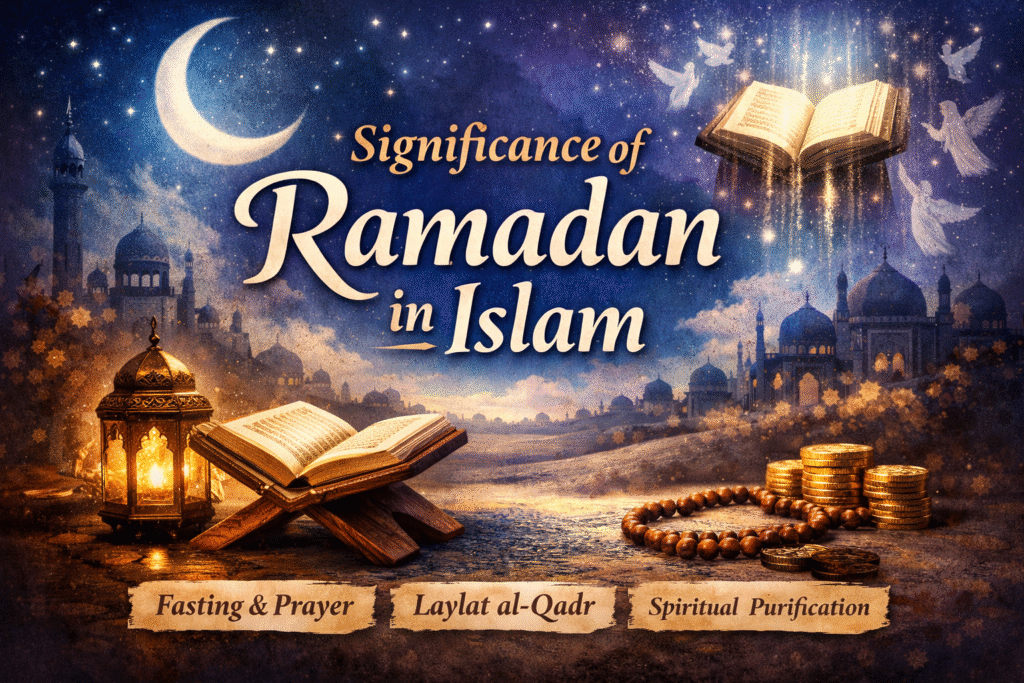
Significance of Ramadan in Islam
The significance of Ramadan in Islam goes beyond fasting from food and drink. Ramadan is the ninth month of the Islamic lunar calendar and holds immense spiritual, moral, and social importance for Muslims worldwide. It is a sacred month of worship, self-discipline, forgiveness, and closeness to Allah.
Ramadan is mentioned directly in the Holy Quran, making its importance undeniable. Every adult Muslim is obligated to fast unless exempted for valid reasons.
Quranic Verses About Ramadan
Ramadan Mentioned in the Quran
The most direct reference to Ramadan is found in Qur’an, Surah Al-Baqarah:
Surah Al-Baqarah (2:185)
“The month of Ramadan in which was revealed the Qur’an, a guidance for mankind and clear proofs for the guidance and the criterion…”
This verse establishes the significance of Ramadan in Islam as the month in which the Quran was revealed.
Obligation of Fasting
Surah Al-Baqarah (2:183)
“O you who have believed, decreed upon you is fasting as it was decreed upon those before you that you may become righteous.”
This verse shows that fasting is not new but a divine command given to previous nations as well.
Surah Al-Baqarah (2:184)
“…And to fast is better for you, if you only knew.”
Surah Al-Baqarah (2:187)
“It has been made permissible for you the night preceding fasting to go to your wives… Eat and drink until the white thread of dawn becomes distinct from the black thread…”
This verse clarifies the rules of fasting.
Laylat al-Qadr – The Night of Power
One of the greatest aspects of the significance of Ramadan in Islam is Laylat al-Qadr.
Surah Al-Qadr (97:1–5)
: Complete Verses
“Indeed, We sent it [the Qur’an] down during the Night of Decree.
And what can make you know what is the Night of Decree?
The Night of Decree is better than a thousand months.
The angels and the Spirit descend therein by permission of their Lord for every matter.
Peace it is until the emergence of dawn.”
Laylat al-Qadr is better than 83 years of worship, which shows the unmatched significance of Ramadan in Islam.
Spiritual Significance of Ramadan in Islam
Attaining Taqwa (God-Consciousness)
Fasting teaches patience, humility, and self-control. The core purpose is to achieve Taqwa — consciousness of Allah.
Ramadan purifies the soul, reduces sinful habits, and strengthens faith.
Forgiveness and Mercy
Ramadan is known as the month of mercy. According to authentic hadith, the gates of Paradise are opened, and the gates of Hell are closed.
Muslims seek forgiveness through prayer, charity, and repentance.
Social and Moral Impact of Ramadan
Charity and Zakat
Ramadan encourages increased charity. Muslims give Zakat and Sadaqah to support the poor. This strengthens unity and social harmony.
Unity of the Ummah
From Saudi Arabia to Bangladesh, Muslims fast together. Ramadan builds global unity among the Ummah.
Health and Scientific Benefits
Physical Detoxification
Modern research shows fasting improves metabolism, promotes detoxification, and enhances mental clarity.
Mental Discipline
Ramadan trains the mind to resist temptation, building strong character and emotional stability.
Final Thoughtshttps://mindhivenest.com/islamic-ethics-in-the-age-of-social-media/: Why the Significance of Ramadan in Islam Matters
The significance of Ramadan in Islam lies in its divine origin, spiritual purification, Quranic revelation, and transformative power. It is not just abstaining from food; it is a complete spiritual training program designed by Allah.
Through fasting, prayer, charity, and reflection, Muslims renew their faith and strengthen their relationship with Allah.
Ramadan is a gift — a sacred opportunity for forgiveness, growth, and eternal reward.